
Keep Your Family Warm and Safe—No Matter What
With winter lows averaging 48°F, wood heat is optional in Ormond Beach—but a real fire still has a place, whether for ambiance or backup warmth when storms knock out power.
Every Project Starts From One of These Five Situations
Ambiance, not necessity.
Ormond Beach sits at 2 feet of elevation on Florida's Atlantic coast, in climate zone 2A, where the region logs a winter heating load of roughly 708 a year. Compare that to a place like Duluth, Minnesota, which racks up close to 10,000—and it's clear why wood stoves never became a fixture of daily life here. Most winters, the coldest nights barely dip into the 40s, and central air conditioning does far more work in an Ormond Beach home than any heating appliance ever will.
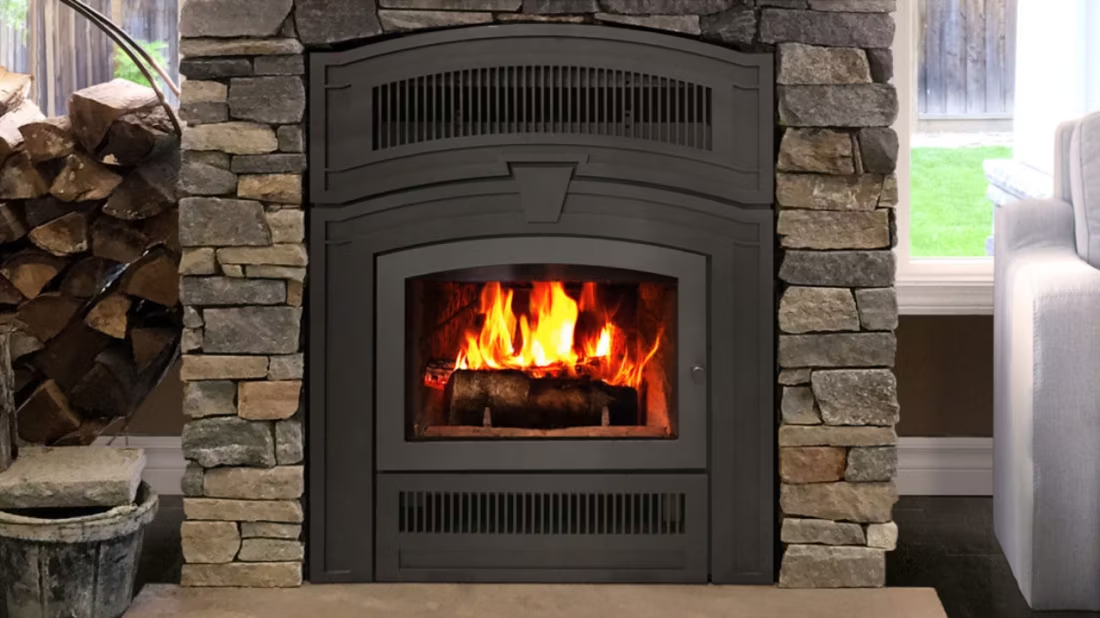
That said, wood fireplaces aren't absent from Ormond Beach—they're just installed for different reasons than they would be in a cold-climate town. Some homeowners want a real masonry fireplace for the look and feel of it, especially in older coastal homes near the Halifax River or the Trestle historic district. Others treat a wood stove as genuine backup: Volusia County sees its share of hurricane seasons, and a wood-burning unit doesn't care if Florida Power & Light or Duke Energy Florida is down for a week. With no local air quality non-attainment issues or winter inversion concerns, there's nothing stopping an occasional-use installation—it's simply a smaller, more specialized market than in colder parts of the country, which means fewer dealers stock full wood systems off the shelf.
Three steps. No salesperson until you're ready.
Tell us about your project
Your zip code, your situation, and the fuel you're leaning toward—or let the answers point you to one.
See what's actually available
The brands dealers within 100 miles genuinely carry—real options, never a catalog mirage.
Get your dealer & Project Guide
A trusted local dealer, plus the free Project Guide & Parts List that names every component of the job.
Frequently Asked Questions
How much does a wood fireplace or stove installation cost in Ormond Beach?
Because wood-burning installs are uncommon locally, most Ormond Beach projects are special-order rather than off-the-shelf, which affects both price and lead time. A decorative masonry fireplace retrofit or a small freestanding wood stove with Class A chimney venting typically lands somewhere in the $3,500 to $8,000 range, depending on whether you're building a new hearth pad and chimney chase from scratch or working with an existing fireplace opening. Homes without any existing masonry or chimney structure sit at the higher end once framing and roof penetration are factored in. A local hearth dealer can give you a firm number after seeing the space.
Do people actually install wood stoves in a climate like Ormond Beach's?
Not many, and that's honest—with winter lows averaging 48°F and only a winter heating load of around 708 a year, wood heat isn't something most Ormond Beach households need for warmth. When homeowners here do install a wood stove or fireplace, it's usually for one of three reasons: the ambiance of a real fire on the rare cold snap, resale appeal in an older coastal home, or as genuine backup heat and cooking capability during extended power outages after a hurricane. If your goal is everyday supplemental heat, an electric fireplace through FPL or Duke Energy Florida service is almost always the more practical and less expensive route.
What permits do I need to install a wood-burning fireplace in Ormond Beach?
New wood-burning installations require a building permit through either the City of Ormond Beach Building Division (for addresses within city limits) or the Volusia County Building Division (for unincorporated areas). The permit covers the hearth, chimney or venting system, and clearance-to-combustibles inspection. Because these installs are infrequent locally, it's worth confirming with your installer that they've pulled a wood-stove permit here before—most hearth contractors in the area do far more gas and electric work, so experience with solid-fuel code details varies.
Where does firewood come from if there's no cutting permit program here?
Unlike forested western states, Volusia County doesn't have a public-land cutting permit system, since there's no national forest tract locally set up for firewood harvest. Nearly all firewood used in Ormond Beach is purchased from local suppliers or seasonal roadside vendors, typically sold by the bundle or the rick rather than the full cord, since demand for large quantities is lower than in colder climates. Oak and pine are the most commonly available species locally; mahogany shows up more often in decorative applications than as burnable firewood.
Are there any burn restrictions or air quality rules in Ormond Beach?
No—Volusia County isn't a non-attainment area and doesn't have the winter inversion issues that trigger burn curtailment programs in places like the Pacific Northwest or interior mountain West. There's no seasonal restriction on when you can use a wood-burning fireplace here. The practical consideration is more about neighbors than regulation: with homes often close together in Ormond Beach's coastal neighborhoods, smoke drift is worth thinking through with your installer, particularly for a stove that will see regular use.
What kind of wood stove makes sense for occasional use in a climate like this?
Skip the long-burn catalytic stoves built for sub-zero nights in places like International Falls, Minnesota—that engineering is wasted in a climate where you might light a fire a dozen times a year. A smaller, non-catalytic stove with a large glass door for visibility, or a traditional zero-clearance wood-burning fireplace, suits Ormond Beach's occasional-use pattern better and typically costs less installed. If backup heat during power outages is part of the motivation, ask your dealer about models that don't require any electricity to operate—a genuine advantage when the grid is the thing that failed.
Should I get a wood fireplace or an electric one instead?
For most Ormond Beach homes, electric is the more practical everyday choice—Florida Power & Light and Duke Energy Florida both serve the area at residential rates around 13.7 to 16.6 cents per kWh, and electric fireplace inserts install in a fraction of the time and cost of a wood system, typically well under $1,500. Wood only pulls ahead if you specifically want the experience of a real fire, or you want a heat source that keeps working when the power doesn't—which, given Volusia County's hurricane exposure, is a reasonable thing to plan for. Many homeowners here end up choosing electric for daily use and treating wood as a separate, occasional-use decision.
Will a wood-burning fireplace affect my homeowners insurance?
It can, and it's worth a call to your insurer before you install one. Florida homeowners policies—already shaped heavily by hurricane and wind risk in coastal Volusia County—sometimes carry specific riders or inspection requirements for solid-fuel appliances, and some carriers ask for proof of a code-compliant installation and permit sign-off. This is less about wood being unusual here and more standard insurance practice for any open-flame heating appliance. Ask your local dealer for the permit and inspection paperwork so you have it on hand when you talk to your agent.
Does a wood stove actually help during hurricane season power outages?
Yes, and it's one of the more practical reasons Ormond Beach homeowners consider one despite the mild climate. A wood stove or fireplace doesn't need electricity to produce heat, and many models can also serve as a basic cooking surface—genuinely useful if a storm knocks out power to FPL or Duke Energy Florida customers for days, which has happened locally during past hurricane seasons. It won't replace a generator for running your refrigerator or AC, but for warmth, hot food, and morale during an extended outage, it's a real backup option that pellet and electric units can't match.
Why is my open fireplace making my house colder?
Open fireplaces suck—literally. As the fire burns, it consumes air your furnace already paid to heat and pulls it out through the chimney, so the house is actually colder after the fire goes out than before you lit it. An insert fixes this: it seals the chimney, puts fixed glass across the front, and turns that hole in your house into a real heat source.
What's the difference between an insert and a zero-clearance fireplace?
An insert is a fireplace that slides into a pre-existing wood-burning fireplace—if you don't have one, there's nothing to insert it into. A zero-clearance fireplace is built into a framed wall, which makes it the answer for remodels and new construction. Simple test: existing masonry fireplace means insert; blank or framed wall means zero-clearance.
Can a fireplace actually lower my heating bill?
Yes—by creating a comfort zone. A furnace heats every square foot of the house just to warm the one room you're in; a gas fireplace on low burns roughly a sixth of the gas a typical furnace does. Set the furnace around 55–60 degrees as a baseline, then heat the rooms your family actually uses. Families who heat this way commonly save $20–$60 a month.
How much should I budget for a fireplace?
For an average home—covering the fireplace, the vent pipe, and basic installation—a budget between $3,900 and $5,500 gives you a lot of options across wood, gas, and pellet. By the time you add finish work, gas line, and electrical, the average complete installation lands between $5,000 and $12,000 all-in. In a remodel or new build, a good rule is to put about 2.5% of the total project cost toward the fireplace.
Nearby Dealers
Hearth shops serving Ormond Beach and the surrounding area. Every listing shows whether it is a WhyFire partner, a dealer we have verified as authorized for the brands we recommend, or a local business carrying hearth products. No manufacturer pays for placement. How we verify dealers →
Daytona Gas & Grill
John's Appliance City
Terrence Miner Remodeling & Construction
Get matched with a wood fireplace dealer in Ormond Beach.
Tell us about your home and how you'd use a wood-burning fireplace—ambiance, resale, or hurricane-season backup—and we'll match you with a trusted local dealer and send over your free Project Guide & Parts List, including the exact venting components for your install.
Find Your Fireplace →