
A small flame for Lauderhill's rare cool nights.
Gas fireplaces aren't a heating necessity in Broward County, but a growing number of Lauderhill homeowners install one for ambiance, resale appeal, or the odd January cold snap. Find the right unit and a local dealer who installs it correctly.
Every Project Starts From One of These Five Situations
A heating season that barely exists doesn't leave much room for a heat source.
Lauderhill sits at 7 feet of elevation in climate zone 1A, with an average winter low around 59°F and one of the shortest, mildest heating seasons you'll find anywhere. Compare that to a place like Duluth, Minnesota, which endures a long, demanding heating season lasting most of the year, and it's clear why gas fireplaces here fall into the 'rare' category rather than the standard one—most homes across the 33311, 33313, 33319, and 33351 zip codes simply never need supplemental heat.
That said, gas fireplaces still show up in Lauderhill—usually as a decorative feature in a family room or lanai, a selling point in the area's many condos and townhomes, or genuine (if occasional) comfort during the rare nights when a cold front pushes lows into the 40s. There's no piped natural gas utility serving most of the city, so propane is the practical fuel source for any gas appliance. For year-round ambiance without a fuel tank to manage, electric fireplaces through Florida Power & Light are the more common local alternative, and worth comparing before you commit to gas.
Three steps. No salesperson until you're ready.
Tell us about your project
Your zip code, your situation, and the fuel you're leaning toward—or let the answers point you to one.
See what's actually available
The brands dealers within 100 miles genuinely carry—real options, never a catalog mirage.
Get your dealer & Project Guide
A trusted local dealer, plus the free Project Guide & Parts List that names every component of the job.
Frequently Asked Questions
How much does a gas fireplace installation cost in Lauderhill?
Because gas fireplaces are uncommon in South Florida, most installations here are smaller-scale than what you'd see in a colder climate—think a vent-free or direct-vent log set in an existing masonry opening, or a compact linear unit built into a family room wall. Costs typically land in the $2,000 to $6,000 range depending on the unit and whether a new propane line or tank setup is needed, since there's no piped natural gas utility covering most of Lauderhill. A local dealer will give you a firm number after seeing your space and confirming propane tank placement.
Does a gas fireplace even make sense in Lauderhill's climate?
For heating, not really—with an average winter low of 59°F and hardly any real heating season to speak of, Broward County homes don't need supplemental heat the way a house in Bismarck or Burlington would. Most Lauderhill homeowners who install gas fireplaces do it for the visual warmth and resale value, or for the handful of nights each winter when a cold front rolls through. If you want real emergency heat for storm season, an electric fireplace or space heater is usually the more practical call; if you want the look and occasional glow of a real flame, gas still works fine here.
Is natural gas or propane the right choice in Lauderhill?
There's no natural gas utility serving most of Lauderhill, so propane is the standard fuel for any gas fireplace installed in the city. That means a propane tank—usually a smaller above-ground tank tucked near the unit or along the side of the house—rather than a connection to a gas main. Your local dealer can size the tank and set up delivery or exchange service; it's a manageable add for a decorative or occasional-use fireplace, less so if you're picturing daily use in a large space.
Do I need a permit to install a gas fireplace in Lauderhill?
Yes—the City of Lauderhill Building Department requires a permit for gas fireplace installations, and any propane line work needs to be done by a licensed gas contractor per Florida Building Code. Because Broward County construction is built around hurricane resistance rather than cold-weather insulation, the permit review focuses more on venting clearances and propane tank placement relative to structures and property lines than on anything related to freeze protection. Most hearth dealers who install gas units in this area handle the permit paperwork as part of the job.
Will a gas fireplace work if the power goes out during a hurricane?
This is actually one of the more practical reasons South Florida homeowners consider gas at all. Units with a standing pilot or intermittent pilot ignition (IPI) with battery backup will light and run without grid power, which matters during the multi-day outages that can follow a Broward County hurricane. Valor's gas fireplaces go a step further—they generate their own electricity from the pilot's thermocouple, so there's no battery to remember. It won't heat the whole house, but a working fireplace can mean actual light and warmth in the living room during a post-storm outage.
Vented or vent-free—which is allowed in Lauderhill?
Both are legal in Florida. Vent-free (ventless) propane log sets and fireplaces are popular for smaller installations here because they skip the need for chimney or venting work—a real advantage in a slab-on-grade home without an existing masonry chimney. They do require attention to room size and ventilation per Florida's vent-free rules. Direct-vent units, which draw combustion air from outside and vent sealed combustion gases back out, are the safer choice for a larger or more frequently used fireplace, and don't affect indoor air quality the way vent-free units can.
Gas or electric fireplace—which fits a Lauderhill home better?
Given that heat output isn't really the point in Broward County, electric fireplaces have a real edge here. They run on standard household circuits through Florida Power & Light at about 13.7 cents per kWh, need no propane tank or gas line, and many condo and HOA communities in Lauderhill restrict open-flame propane installations anyway. Gas still wins on flame realism and that live-fire feel, and it's the better pick for anyone who specifically wants backup heat and light during storm-season outages. A lot of homeowners here end up choosing electric for the convenience and reserving gas for a primary living space where the ambiance matters most.
How often does a gas fireplace need to be serviced in Lauderhill?
An annual inspection is still recommended even for a unit that only runs occasionally, since Florida's humidity can affect pilot assemblies, seals, and propane connections over time. A technician will check the burner, gas connections, and ignition system, and clean the glass and interior—usually a $150 to $250 visit. Because gas fireplace use is light here compared to colder climates, service intervals are more about corrosion and humidity than soot buildup, but skipping it entirely isn't worth the risk with an open propane connection.
What kind of gas fireplace works best for a Lauderhill home?
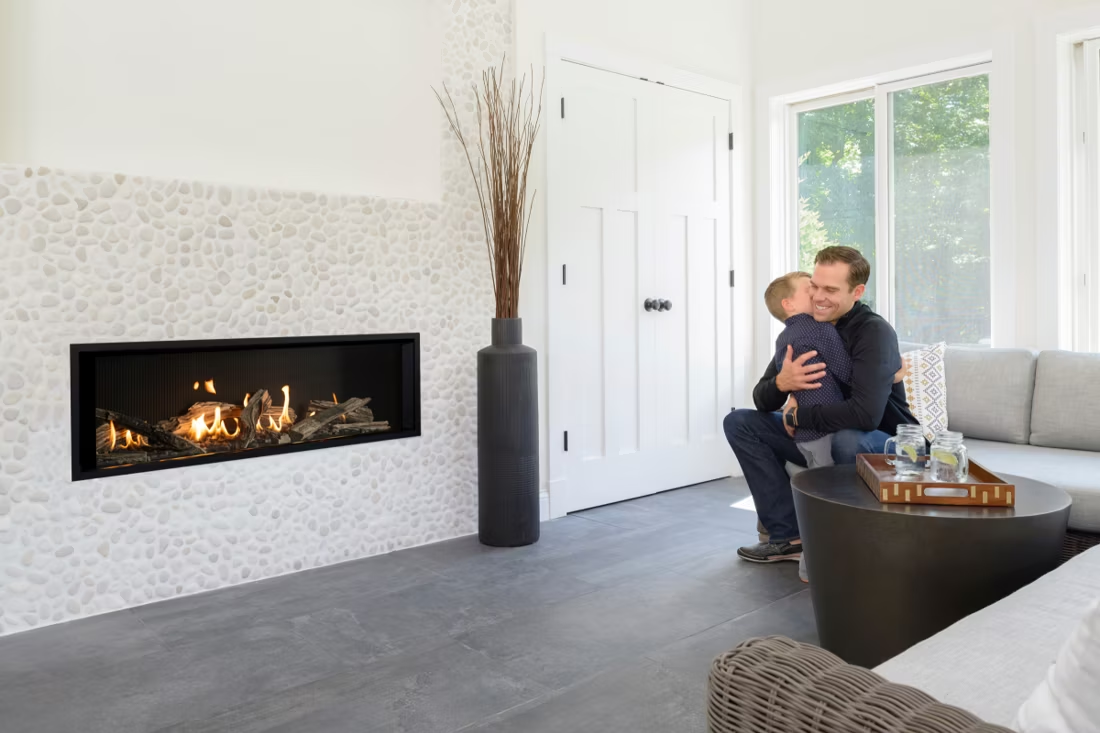
For most Lauderhill houses and townhomes, a vent-free propane log set in an existing fireplace opening or a compact direct-vent linear unit built into a family room wall covers the ambiance most homeowners are after without a major renovation. Condo owners should check HOA rules first, since many Broward County associations restrict open-flame propane appliances on balconies or in shared structures. If you're building new or renovating, a direct-vent fireplace gives you the most design flexibility and the safest long-term setup. A local dealer can walk you through what's realistic for your specific building type.
Why is my open fireplace making my house colder?
Open fireplaces suck—literally. As the fire burns, it consumes air your furnace already paid to heat and pulls it out through the chimney, so the house is actually colder after the fire goes out than before you lit it. An insert fixes this: it seals the chimney, puts fixed glass across the front, and turns that hole in your house into a real heat source.
What's the difference between an insert and a zero-clearance fireplace?
An insert is a fireplace that slides into a pre-existing wood-burning fireplace—if you don't have one, there's nothing to insert it into. A zero-clearance fireplace is built into a framed wall, which makes it the answer for remodels and new construction. Simple test: existing masonry fireplace means insert; blank or framed wall means zero-clearance.
Can a fireplace actually lower my heating bill?
Yes—by creating a comfort zone. A furnace heats every square foot of the house just to warm the one room you're in; a gas fireplace on low burns roughly a sixth of the gas a typical furnace does. Set the furnace around 55–60 degrees as a baseline, then heat the rooms your family actually uses. Families who heat this way commonly save $20–$60 a month.
How much should I budget for a fireplace?
For an average home—covering the fireplace, the vent pipe, and basic installation—a budget between $3,900 and $5,500 gives you a lot of options across wood, gas, and pellet. By the time you add finish work, gas line, and electrical, the average complete installation lands between $5,000 and $12,000 all-in. In a remodel or new build, a good rule is to put about 2.5% of the total project cost toward the fireplace.
Nearby Dealers
Hearth shops serving Lauderhill and the surrounding area. Every listing shows whether it is a WhyFire partner, a dealer we have verified as authorized for the brands we recommend, or a local business carrying hearth products. No manufacturer pays for placement. How we verify dealers →
The Kitchenworks
Brandel Masonry
A&S Reclaimed Wood
Lifestyle Barn LLC
Atlantic Purchasing
Outdoor Kitchen & Grill
Find your gas fireplace in Lauderhill.
Tell us a bit about your home and we'll match you with the right gas fireplace or log set for Lauderhill's climate, plus a free Project Guide & Parts List and a trusted local dealer to install it.
Find Your Fireplace →