
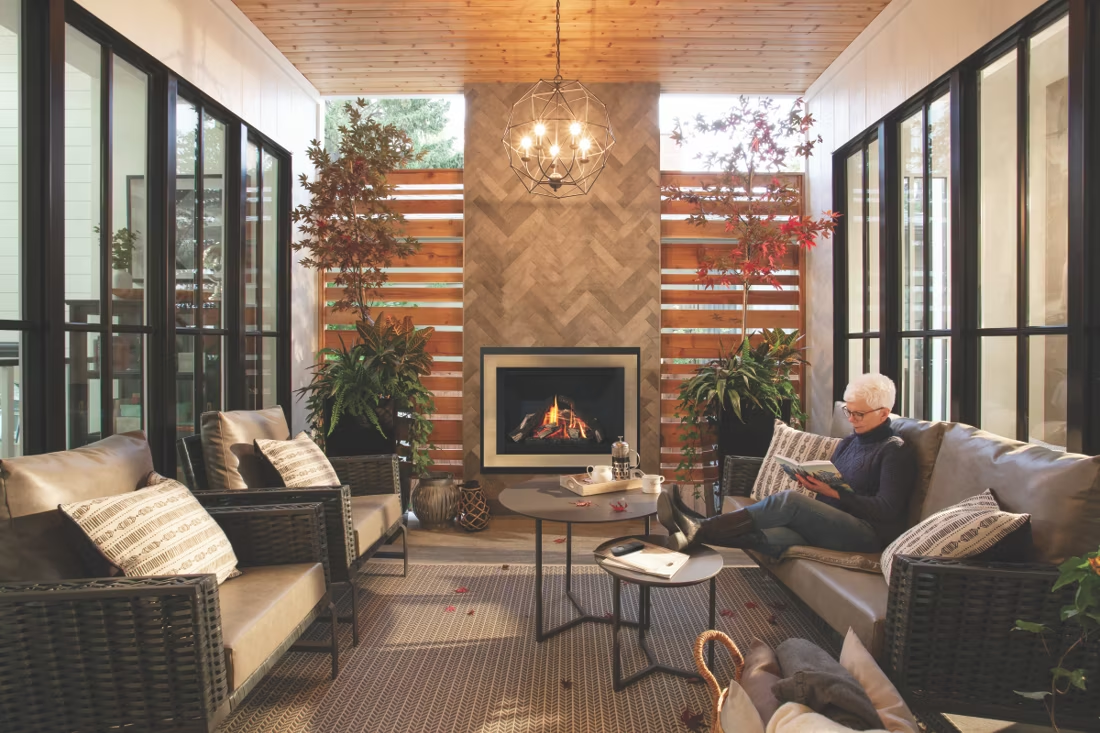
Bring gas fireplace ambiance to your DeSoto County home.
Winters here are short and mild, but a gas fireplace still earns its place in a DeSoto County living room—for the cold fronts that roll through, and for the look of a real fire without hauling wood. Find the right unit and connect with a trusted local dealer.
Every Project Starts From One of These Five Situations
Built for the occasional cold night, not the deep freeze.
DeSoto County sits in south-central Florida along the Peace River, with Arcadia as the county seat and cattle ranches covering much of the surrounding land. At roughly 581 heating degree days and a winter low average of 47°F, this is climate zone 2A—hot-humid Florida, not a place where heat load drives home design. Compare that to a place like Duluth, MN, which racks up over 9,000 HDD, and it's clear DeSoto County homeowners aren't buying a fireplace to survive the season. They're buying one for the handful of nights each winter when a cold front pushes temperatures into the 30s and 40s, and for the ambiance a real flame adds to a living room the rest of the year.
Most of rural DeSoto County sits outside any natural gas distribution network, so propane is the standard fuel for gas fireplaces here—supplied by regional propane companies serving Arcadia and the outlying ranch communities. Wood stoves and pellet stoves are rare in this part of Florida given how little heat the climate actually demands, so a direct-vent propane fireplace or insert tends to be the practical, low-maintenance choice for homeowners who want real heat on demand without a chimney, ash, or a wood supply to manage. Local oak and pine are common in the area's cabinetry and mantels, but they show up as design material here far more often than as fuel.
Three steps. No salesperson until you're ready.
Tell us about your project
Your zip code, your situation, and the fuel you're leaning toward—or let the answers point you to one.
See what's actually available
The brands dealers within 100 miles genuinely carry—real options, never a catalog mirage.
Get your dealer & Project Guide
A trusted local dealer, plus the free Project Guide & Parts List that names every component of the job.
Frequently Asked Questions
How much does a gas fireplace installation cost in DeSoto County?
A typical gas fireplace or insert installation in DeSoto County runs roughly $3,500 to $9,000, depending on the unit, whether it's propane or you're one of the few homes with natural gas access near Arcadia, and how much venting or framing work is involved. A direct-vent propane insert going into an existing masonry fireplace, with a tank already on the property, sits toward the lower end. A new built-in gas fireplace in a remodel—with fresh venting and a first-time propane tank setup—runs higher. Local dealers will size the job and give a firm number after seeing your home.
Do I need natural gas, or does propane work for a DeSoto County home?
Propane is the standard fuel choice for gas fireplaces throughout most of DeSoto County. Natural gas lines don't extend into the majority of the county's rural and ranch-land areas, so homeowners either use an existing propane tank (often already in place for a water heater or range) or have a supplier set up a new tank as part of the fireplace install. Nearly every gas fireplace model on the market can be configured for propane, so fuel availability isn't a reason to rule out a particular unit—your local dealer sets the correct orifice and regulator for whichever fuel you have.
Will a gas fireplace actually get used for heat in a climate this mild?
With only about 581 heating degree days a year and a winter low averaging 47°F, DeSoto County doesn't have the kind of sustained cold that makes a fireplace a primary heat source. But cold fronts do come through most winters, dropping overnight temperatures into the 30s, and a gas fireplace handles those nights easily while central HVAC stays off. Most homeowners here choose gas for a mix of reasons—supplemental warmth on the coldest nights, the visual of a real flame, and the fact that a properly equipped unit can still run during a power outage after a storm.
Will my gas fireplace work during a power outage?
Yes, if it's set up with the right ignition system. Units with IPI (intermittent pilot ignition) include a battery backup that keeps the fireplace operating when the power drops—which matters in DeSoto County given how often storms and hurricane-season outages knock out electricity. Valor fireplaces take a different approach: their pilot generates its own electricity through the thermocouple, so there's no battery to remember at all. Ask your local dealer about the ignition system on any model you're considering if outage backup matters to you.
What's the difference between a gas fireplace, gas insert, and gas stove?
A gas fireplace is a built-in unit framed into a wall, typically chosen for new construction or a full remodel. A gas insert drops into an existing masonry fireplace and uses the chimney (fitted with a liner) as the vent path—a common upgrade for older DeSoto County homes with an unused wood-burning fireplace. A gas stove is a freestanding, floor-standing unit that mimics a wood stove's look but runs on propane. For most homeowners here with an existing fireplace opening, an insert is the simplest path since it reuses what's already there.
Do I need a permit to install a gas fireplace in DeSoto County?
Yes—a building permit is required for new gas fireplace installations through the DeSoto County building department, and any gas line or propane connection work needs to be done by a licensed gas-fitter. Most established local dealers handle the permitting and inspection scheduling as part of the installation, so you're not left coordinating separate trades yourself.
Vented vs. vent-free gas fireplaces—which should I choose?
Vented (direct-vent) gas fireplaces pull combustion air from outside and exhaust it back outside through sealed venting—they're the safer, code-compliant standard almost everywhere, including Florida. Vent-free units burn fuel directly into the room without external venting; they're legal in Florida but come with strict room-size and ventilation requirements, and they release some combustion byproducts indoors. Given DeSoto County's humid climate, most local dealers steer homeowners toward direct-vent units, which don't add moisture or combustion gases to an already humid house.
How often should my gas fireplace be serviced?
An annual inspection is recommended for any gas fireplace or insert. A technician checks the burner, pilot assembly, venting, and gas connections, and cleans the glass and interior—a quick visit compared to wood-stove chimney sweeping, but important given how little most units get exercised in a mild climate where they may only run a handful of nights a year. Infrequent use can actually let dust and debris build up in the burner, so skipping service doesn't save you much.
Gas vs. electric fireplace—which is right for my DeSoto County home?
Electric fireplaces need no venting, no gas line, and no propane tank—you plug them in, and most produce a realistic flame effect with adjustable heat output, which is plenty for the occasional cool evening DeSoto County sees. Gas fireplaces produce real heat and a real flame, and with the right ignition system can run during a power outage, which matters here given hurricane-season risk. For a rental, a room addition, or a homeowner who just wants ambiance, electric is often the simpler and cheaper choice. For a primary living space where real warmth and outage backup matter, gas is usually worth the extra installation involved.
Does a gas fireplace work when the power is out?
Yes—modern gas fireplaces have a battery backup for the ignition system that lasts for weeks, so no power equals no problem. Your furnace can't say that: no electricity, no blower, no heat. It's one of the most common reasons families add a fireplace, and worth confirming on any model you're considering.
Why is my open fireplace making my house colder?
Open fireplaces suck—literally. As the fire burns, it consumes air your furnace already paid to heat and pulls it out through the chimney, so the house is actually colder after the fire goes out than before you lit it. An insert fixes this: it seals the chimney, puts fixed glass across the front, and turns that hole in your house into a real heat source.
Can a fireplace actually lower my heating bill?
Yes—by creating a comfort zone. A furnace heats every square foot of the house just to warm the one room you're in; a gas fireplace on low burns roughly a sixth of the gas a typical furnace does. Set the furnace around 55–60 degrees as a baseline, then heat the rooms your family actually uses. Families who heat this way commonly save $20–$60 a month.
What is an in-home preview and do I need one?
It's a visit where a hearth professional measures your space, confirms the model you picked actually works in your home, and walks the specs—framing, gas line, venting, finish work—before anything is ordered. Some details you just can't know until you see the house. Never make a down payment without one; it's the single most-skipped step that burns buyers.
Find your gas fireplace in DeSoto County.
Tell us a bit about your home and we'll match you with the right gas fireplace, insert, or stove—and hand you a free Project Guide & Parts List with your recommended local dealer.
Find Your Fireplace →