
Add Fireplace Warmth to Any Room in Shelton—No Venting Required.
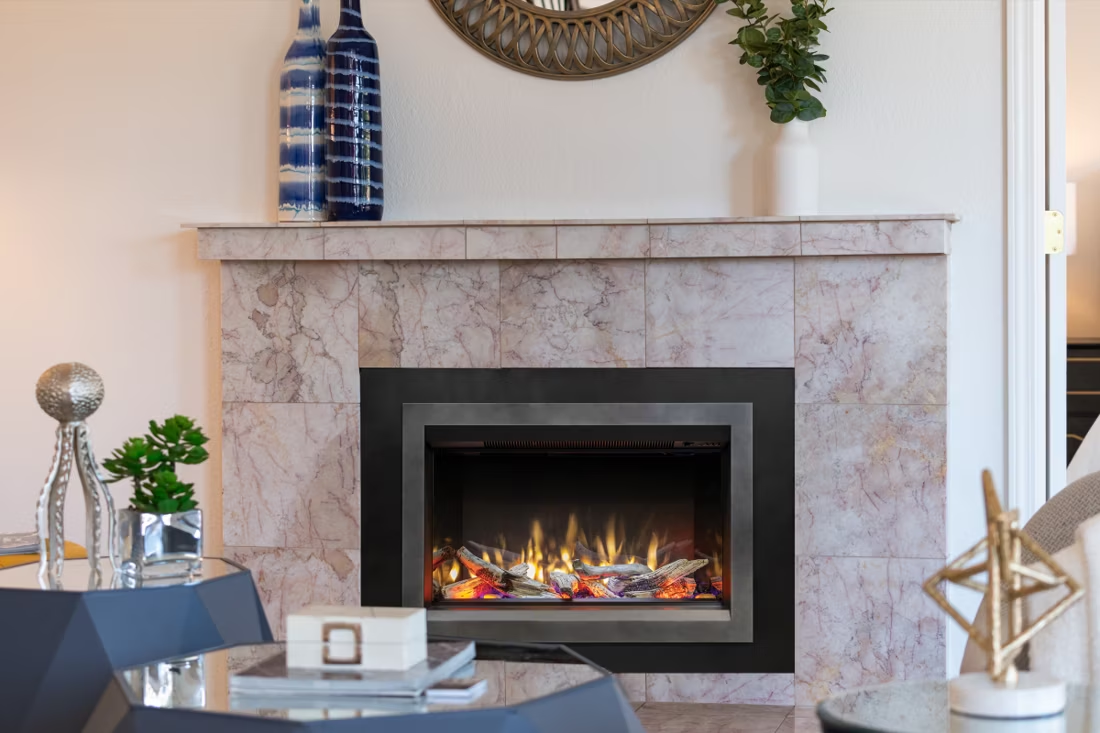
Plug-in ambiance or a hardwired wall unit—electric fireplaces work in Shelton's mill-loft condos, finished basements, and rentals where a chimney was never an option. Find the right unit and connect with a trusted local dealer.
Every Project Starts From One of These Five Situations
The easiest fireplace upgrade in the Naugatuck Valley.
Shelton sits along the Housatonic River in the Naugatuck Valley, where winter lows average 18°F and the region endures a long, cold heating season—a cold-climate profile closer to Burlington, VT than to coastal Connecticut. Much of the city's newer housing stock, though, is in converted mill buildings and downtown loft developments near the Birmingham green, where chimneys and gas lines were never part of the original construction. That's exactly where electric fireplaces earn their keep.
Electric service in Shelton splits between United Illuminating and Connecticut Light & Power (Eversource), and both carry residential rates—31.06 cents and 25.31 cents per kWh—among the highest in the country. That makes an electric fireplace a poor choice as a whole-home heat source, but a smart one as zone heat for a single room: a 1,500-watt unit running a few hours a night costs well under a dollar, and there's no wood to split, no gas line to run, and no masonry chimney to maintain. For condo associations, rental units, and finished basements in Shelton where venting isn't an option, electric is often the only fireplace that's actually allowed.
Three steps. No salesperson until you're ready.
Tell us about your project
Your zip code, your situation, and the fuel you're leaning toward—or let the answers point you to one.
See what's actually available
The brands dealers within 100 miles genuinely carry—real options, never a catalog mirage.
Get your dealer & Project Guide
A trusted local dealer, plus the free Project Guide & Parts List that names every component of the job.
Frequently Asked Questions
How much does an electric fireplace installation cost in Shelton?
Costs vary by type. A freestanding electric stove or a plug-in insert that drops into an existing mantel opening runs $300 to $1,200 and needs no installation beyond plugging into a standard outlet. A built-in wall unit or a linear electric fireplace set into new framing typically runs $1,200 to $3,500 once you factor in the unit, a dedicated 20-amp circuit, and finish carpentry. Units drawing more than 1,500 watts on a shared circuit are the most common reason installs run over budget—an electrician can confirm your panel has room before you buy.
Do I need a permit to install an electric fireplace in Shelton?
A plug-in unit that uses an existing outlet needs no permit at all. If you're having an electrician run a new dedicated circuit or hardwiring a built-in unit into a wall, that work requires an electrical permit through the City of Shelton Building Department, and the electrician typically pulls it as part of the job. There's no combustion, no venting, and no chimney inspection involved—which is a big part of why electric installs move faster than wood or gas projects in Shelton's older mill conversions.
What does it actually cost to run an electric fireplace in Shelton?
At United Illuminating's residential rate of about 31 cents per kWh, a typical 1,500-watt unit running on high costs roughly 46 cents an hour; at Connecticut Light & Power's rate of about 25 cents per kWh, it's closer to 38 cents an hour. Most owners run the heater setting only occasionally and leave the flame effect on LED-only mode the rest of the time, which draws under 100 watts and costs a few cents an hour. Given how high both utilities' rates run compared to the national average, most Shelton homeowners use electric fireplaces for supplemental warmth in one room rather than as a substitute for their furnace.
Will an electric fireplace actually heat my room, or is it just for looks?
Most electric fireplaces top out around 5,000 BTU (roughly 1,500 watts), which is enough to comfortably heat a single room of 300 to 400 square feet—a den, a bedroom, or a mill-loft living area—but it won't carry a whole floor on a cold Naugatuck Valley night. Think of it as zone heat: run the furnace or heat pump to hold the rest of the house at a baseline, then use the fireplace to boost comfort in the room you're actually sitting in. The flame effect works independently of the heater, so you can run the look without the wattage whenever you just want ambiance.
Are electric fireplaces a good fit for condos and apartments in Shelton?
Yes—this is one of the most common reasons Shelton homeowners choose electric. Many of the city's newer residential units are converted mill buildings and loft developments near downtown, where condo association rules or the building's original construction rule out a masonry chimney or gas line. Electric units need no venting and no exterior wall penetration, so they're typically the only fireplace type an HOA or landlord will approve. Wall-mounted linear units are especially popular in these buildings because they read as a built-in feature rather than an add-on appliance.
Which electric utility serves my part of Shelton?
It depends on where in the city you're located—United Illuminating serves part of Shelton while Connecticut Light & Power (Eversource) serves the rest, and the residential rates differ enough (31.06 cents versus 25.31 cents per kWh) that it's worth checking your own bill before comparing running costs with a neighbor. A local electrician or hearth dealer can confirm which utility serves your address and size the circuit accordingly.
What's the difference between an electric insert, a wall-mounted unit, and a mantel package?
An electric insert is designed to drop into an existing fireplace opening—a straightforward upgrade for a Shelton home with an old, unused masonry fireplace that's been sitting cold. A wall-mounted or linear unit is built into new framing, usually low-profile and wide, and reads as a modern architectural feature—common in the city's newer condo and loft developments. A mantel package pairs a freestanding or built-in electric unit with a surrounding mantel and hearth, giving you a traditional look without any chimney behind it. All three heat similarly; the difference is mostly aesthetic and how much construction is involved.
Electric vs. wood—which is right for my Shelton home?
Wood offers real heat output, works without electricity during outages, and burns oak, maple, birch, and ash that are all common firewood species cut throughout the Naugatuck Valley. But it requires a chimney, annual sweeping, and hauling and stacking cordwood. Electric requires none of that—no chimney, no permit beyond electrical work, no ash—but it depends on the grid and, at Shelton's electric rates, isn't cheap to run as a primary heat source. Most homeowners choosing between the two are really choosing between a supplemental heat source with real BTUs and low running cost per hour (wood) versus a low-maintenance ambiance feature with instant on-off convenience (electric).
Do electric fireplaces need any maintenance?
Very little. There's no chimney to sweep and no gas line to service. Most upkeep is dusting the unit, occasionally vacuuming the vent grille to keep airflow clear, and replacing LED flame bulbs every several years on older models (most current units use long-life LEDs that outlast the fireplace). If the heater fan gets noisy or stops kicking on, that's usually a sign the blower needs cleaning or the unit's thermal fuse has tripped—a local dealer or electrician can diagnose it quickly.
Can I put a TV above my fireplace?
Yes—with an asterisk. Fireplaces are hot and TVs don't like heat. Either put a mantel between them to deflect rising warmth, or choose a fireplace with heat-management technology that creates a cool zone on the wall above—the wall stays around 125 degrees, barely warm, while the room still gets full heat. If you like clean lines and don't want a mantel, heat management is the answer.
Do electric fireplaces actually produce heat?
Yes—most put out around 4,800–5,000 BTUs from a standard outlet, which comfortably warms a bedroom, office, or den as a comfort-zone heater. What they won't do is carry a whole house the way wood, gas, or pellet can. Think of electric as ambiance-first with honest supplemental heat: flames on with no heat in July, flames plus warmth in January.
Does a fireplace add value to my home?
On average, a fireplace adds back to the home about the same amount you spent installing it. Add the monthly savings from heating the rooms you actually use instead of the whole house—often hundreds of dollars a year—and the value case is strong before you even count what a fire does for how your family uses the room.
What is an in-home preview and do I need one?
It's a visit where a hearth professional measures your space, confirms the model you picked actually works in your home, and walks the specs—framing, gas line, venting, finish work—before anything is ordered. Some details you just can't know until you see the house. Never make a down payment without one; it's the single most-skipped step that burns buyers.
Nearby Dealers
Hearth shops serving Shelton and the surrounding area. Every listing shows whether it is a WhyFire partner, a dealer we have verified as authorized for the brands we recommend, or a local business carrying hearth products. No manufacturer pays for placement. How we verify dealers →
Neighborhood Chimney Service
Best In Backyards
New Haven Masonry
Hearth Products, LLC
Fireplace Surplus
Black Swan Fireside Hearth & Home
Leahy’s Metered Gas Service
Tani’s Masonry Supply, LLC
House Of Warmth Stove & Fireplace Shop
Hocon Gas Of Norwalk
Jj Sullivan Inc.
Four Seasons Fire & Hearth
Electric Service in Shelton
An electric fireplace's heater draws about 1,500 watts—pennies per hour at local rates.
United Illuminating Co
Connecticut Light & Power Co
Find your electric fireplace in Shelton.
Tell us a bit about your room and how you plan to use it, and we'll match you with a trusted local dealer and send over your free Project Guide & Parts List—sized to your space, your circuit, and your budget.
Find Your Fireplace →