
Zone heat for hill-town homes that don't need another chimney.
Northwest Hills runs on wood and oil through a 6,840-degree-day winter, but the room over the garage or the finished basement rarely gets warm from a single woodstove. An electric fireplace adds instant, no-flue heat to that space on a standard outlet or a dedicated Eversource circuit. I'll match you with a trusted local dealer who can size it right and tell you straight whether a plug-in unit or a wired built-in makes sense for your house.
Every Project Starts From One of These Five Situations
A supplement to wood heat, not a replacement for it.
The Northwest Hills region covers roughly twenty rural Litchfield County towns—Torrington, Litchfield, Winsted, Canaan, Norfolk, Salisbury, Kent, Cornwall, Sharon, Washington, and New Hartford among them—spread across hilly, heavily forested terrain that climbs toward 2,000 feet near Bear Mountain. With winters comparable to Burlington, VT and winter lows averaging 15°F, the climate here is on par with Burlington, VT, and the region has a long-standing wood-heat culture built on the abundant oak, maple, birch, and ash growing on its own hillsides. Most homes lean on a woodstove, oil furnace, or propane system for primary heat, which leaves electric fireplaces in a specific, well-defined role: warming a single room—a converted attic bedroom, a home office, a finished basement—without running new venting or opening up a wall for a second chimney.
That narrower role is actually electric's advantage in a county like this. There's no air-quality non-attainment designation here to navigate, so the appeal isn't emissions compliance—it's convenience and zone control. A freestanding or insert unit plugs into a standard 120V outlet with no permit at all; a built-in wall unit or a mantel package pulling more wattage typically needs a dedicated 240V circuit, which means an electrician and a quick permit through your town's building office, since each Northwest Hills town—Litchfield, Torrington, Winsted, and the rest—handles that locally rather than through a single county office. Either way, there's no cutting permit, no chimney sweep, and no cord of oak to stack for the season.
Three steps. No salesperson until you're ready.
Tell us about your project
Your zip code, your situation, and the fuel you're leaning toward—or let the answers point you to one.
See what's actually available
The brands dealers within 100 miles genuinely carry—real options, never a catalog mirage.
Get your dealer & Project Guide
A trusted local dealer, plus the free Project Guide & Parts List that names every component of the job.
Frequently Asked Questions
How much does it cost to install an electric fireplace in Northwest Hills?
A freestanding or insert-style electric fireplace that runs on a standard outlet typically lands between $300 and $900 installed, since there's no venting or gas line to run—most of that cost is the unit itself plus a straightforward mount or slide-in. A built-in wall unit or a linear model wired to its own 240V circuit runs higher, often $1,500 to $3,000, once an electrician adds the circuit and a carpenter frames the surround. Homes in outlying parts of the county—up toward Norfolk, Colebrook, or Salisbury—may see a modest travel charge from installers based closer to Torrington or Winsted.
Do I need a permit for an electric fireplace in Northwest Hills?
A plug-in freestanding or insert unit generally doesn't require a permit since it's just an appliance on an existing circuit. A built-in unit that needs a new dedicated line does require an electrical permit, pulled through your town's building department—Litchfield, Torrington, Winsted, Canaan, and the other Northwest Hills towns each issue these locally rather than through a shared county office, so check with your specific town hall before work starts. A licensed electrician handling the circuit will typically manage that paperwork as part of the job.
Can an electric fireplace actually heat a room in a Northwest Hills winter?
For the room it's in, yes—most units put out around 5,000 BTU (roughly 1,500 watts), enough to comfortably warm a bedroom, office, or den on its own even when outdoor temperatures sit in the teens. What it won't do is replace whole-home heat during a winter as long and cold as Burlington, VT sees; nobody in Barkhamsted or Cornwall is heating a farmhouse on electric resistance heat alone through a winter that demanding. Think of it as a supplement: heat the room you're actually using, and let the woodstove or furnace carry the rest of the house.
What does it cost to run an electric fireplace here versus burning wood?
A typical 1,500-watt electric fireplace run at Eversource's residential rates costs somewhere in the range of 20 to 40 cents an hour to operate, which adds up if you're running it as primary heat for a whole evening. Compare that to a load of oak or maple cut from your own woodlot or bought locally, and wood remains the cheaper BTU source for most Northwest Hills households—which is exactly why electric here tends to stay in the supplemental role rather than replacing the woodstove.
Will an electric fireplace still work if the power goes out?
No—unlike a wood or pellet stove, an electric fireplace has no function without grid power, so it's not a backup heat source during the ice storms and downed-line outages that hit hill towns like Norfolk, Colebrook, and Hartland most winters. Most Northwest Hills homes that install electric fireplaces already have a woodstove or oil furnace as their real cold-weather and outage backup; the electric unit is there for everyday convenience, not for the night the power's out at 10 below.
What type of electric fireplace fits a Northwest Hills home best?
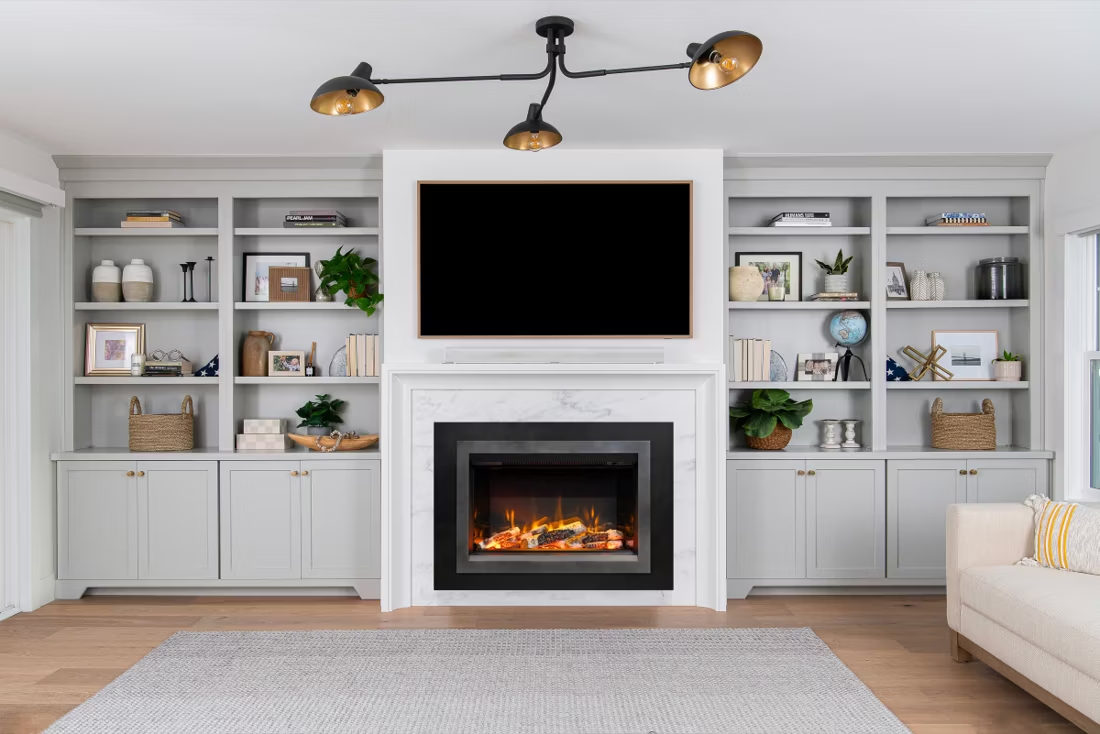
In older farmhouses and colonials common around Litchfield, Kent, and Washington, a freestanding electric stove or a mantel package tends to fit the existing room layout without any construction. In newer or renovated spaces—a finished basement in Torrington or an addition in New Hartford—a linear wall-mount or a built-in insert framed into a stud wall gives a more modern look and can double as the visual focal point of the room. A local dealer can walk the space and tell you which format actually works with your wall depth and outlet locations.
How do I size an electric fireplace for my room?
Electric units are rated in BTU rather than by a whole-home heat load calculation, so sizing is more about the room than the house. A standard 4,600-5,200 BTU unit comfortably supplements a bedroom or home office up to roughly 400 square feet; open-concept basements or larger dens may call for a higher-wattage model or two smaller units. Given how many Northwest Hills homes use these for converted attic rooms and basement additions with irregular layouts, it's worth having a local dealer look at the actual space rather than sizing off a general chart.
Are electric fireplaces available through local Northwest Hills dealers, or do I need to order online?
Trusted hearth and appliance dealers serving the Torrington-Litchfield-Winsted area carry electric units from mainstream manufacturers and can install built-in models with the correct electrical work—that's different from an online big-box order, where you're on your own for the circuit, the mounting, and any troubleshooting. Going through a local dealer also means someone who already knows which older Northwest Hills homes have panel capacity issues or knob-and-tube wiring that needs to be addressed before adding a dedicated circuit.
Electric vs. wood or pellet—which makes sense for my Northwest Hills home?
If you're heating a whole house through a winter as long and cold as Burlington, VT sees, wood cut from the oak, maple, birch, and ash common on Litchfield County woodlots—or pellets from regional suppliers like Lignetics, New England Wood Pellet, or Maine Woods Pellet Co—will carry the load far more cost-effectively than electric resistance heat, and both keep working in a power outage if you've got a non-electric wood stove. Electric wins on convenience for a single room: no venting, no fuel storage, no permit for a plug-in unit, and a flip-of-a-switch flame in a space where running a chimney isn't practical. Most Northwest Hills homeowners who add electric are supplementing an existing wood or oil system, not replacing it.
Can I put a TV above my fireplace?
Yes—with an asterisk. Fireplaces are hot and TVs don't like heat. Either put a mantel between them to deflect rising warmth, or choose a fireplace with heat-management technology that creates a cool zone on the wall above—the wall stays around 125 degrees, barely warm, while the room still gets full heat. If you like clean lines and don't want a mantel, heat management is the answer.
Do electric fireplaces actually produce heat?
Yes—most put out around 4,800–5,000 BTUs from a standard outlet, which comfortably warms a bedroom, office, or den as a comfort-zone heater. What they won't do is carry a whole house the way wood, gas, or pellet can. Think of electric as ambiance-first with honest supplemental heat: flames on with no heat in July, flames plus warmth in January.
Does a fireplace add value to my home?
On average, a fireplace adds back to the home about the same amount you spent installing it. Add the monthly savings from heating the rooms you actually use instead of the whole house—often hundreds of dollars a year—and the value case is strong before you even count what a fire does for how your family uses the room.
Can I install a fireplace myself?
If you're putting a fire in your house on purpose, it's best to work with an expert. Unless you're genuinely experienced in framing, gas line, vent pipe, and the national code on clearances to combustibles, have a professional do it—and ideally the same company that sells you the fireplace, so warranty, service, and liability all live under one roof.
Stove and Fireplace Dealers in Northwest Hills County
Get your free Project Guide & Parts List for an electric fireplace in Northwest Hills.
Tell me a bit about the room, the wall, and your electrical panel, and I'll match you with a trusted local Northwest Hills dealer and send over a free Project Guide & Parts List—the right unit, the circuit requirements if you need one, and a recommended local installer, no big-box guesswork.
Find Your Fireplace →