
Keep Your Family Warm and Safe—No Matter What
Winters here run cold—6,546 heating degree days and average lows near 13°F—but Phillips County's flat, treeless high plains mean almost no one heats primarily with wood. Here's an honest look at where it still fits, and who can actually install one.
Every Project Starts From One of These Five Situations
Cold winters, but almost no local wood supply.
Phillips County sits on Colorado's northeastern high plains, around Holyoke, Haxtun, and Paoli, at roughly 3,600 feet with no national forest or public timberland anywhere in the county. The climate is genuinely severe—6,546 heating degree days puts winter here in the same range as Minneapolis, MN or Madison, WI—but severity alone doesn't create a wood-heat culture. That takes standing timber and cutting permits, and Phillips County has neither.
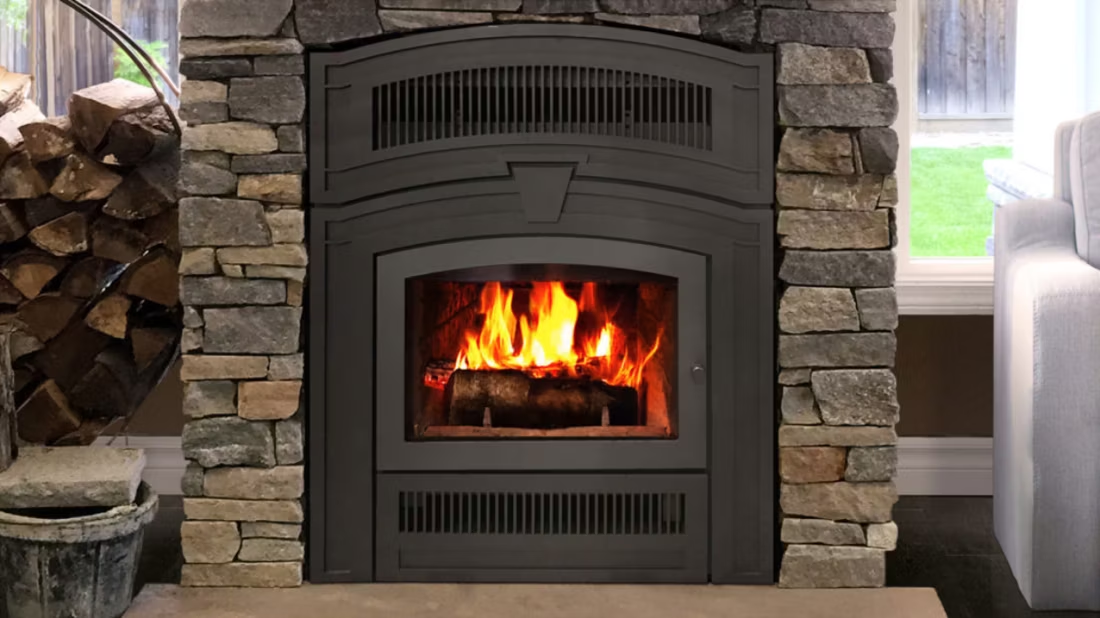
Whatever firewood does move through the county—ponderosa pine, aspen, pinyon, or juniper—is trucked in from Front Range forests or sourced through regional distributors, the same way pellet brands like Bear Mountain, Lignetics, and Forest Energy reach the area rather than being produced locally. That makes wood a specialty purchase rather than a default heating fuel. Most Phillips County homes rely on propane or electric heat instead, and that's the honest starting point for anyone weighing a wood stove here: it's a real option for a shop, a cabin, or backup heat during a plains blizzard—not the primary heat source it would be in a forested Colorado mountain county.
Three steps. No salesperson until you're ready.
Tell us about your project
Your zip code, your situation, and the fuel you're leaning toward—or let the answers point you to one.
See what's actually available
The brands dealers within 100 miles genuinely carry—real options, never a catalog mirage.
Get your dealer & Project Guide
A trusted local dealer, plus the free Project Guide & Parts List that names every component of the job.
Frequently Asked Questions
Is a wood stove a practical heating choice in Phillips County?
It can be, but it's a secondary or supplemental choice rather than a primary one. Most Phillips County homes use propane or electric heat as their main system, since natural gas mains don't reach most of the county's rural stretches and there's no local timber supply. A wood stove makes the most sense in a shop or outbuilding, a cabin, or as backup heat that keeps running when a winter storm knocks out power to the grid—which happens on the plains more often than people outside the region expect.
Why doesn't Phillips County have local firewood the way Colorado's mountain counties do?
Geography. The county is flat, dry high-plains farmland with no national forest, no BLM timber tracts, and no cutting permits to speak of—unlike counties along the Front Range or in the Colorado high country, where national forest land supplies most local firewood. Any ponderosa pine, aspen, pinyon, or juniper burned in Phillips County almost certainly arrived by truck from Front Range distributors or regional suppliers, not from a woodlot down the road.
What wood species are actually available if I want to burn wood here?
Ponderosa pine, aspen, pinyon, and juniper are the species most commonly sold through regional dealers that serve northeastern Colorado. Ponderosa and juniper burn hot and relatively fast, pinyon is prized for its aroma and pitch content, and aspen burns milder and cleaner—good as a starter or shoulder-season wood. None of it is local; expect delivered pricing that reflects a longer haul than you'd see in a forested county.
How much does a wood stove installation cost in Phillips County?
Because so few dealers install wood stoves in this part of the state, pricing here tends to track the broader regional range rather than a tight local number—typically $3,500 to $9,000 depending on the stove, chimney work, and hearth pad requirements. The nearest dealers with wood-burning expertise are usually based out of Sterling or similar northeastern Colorado hubs, sometimes crossing the border to serve nearby Nebraska towns as well. Getting a firm quote means finding one of those dealers willing to make the drive—which is exactly the kind of matching Find My Fireplace exists for.
Do I need a permit to install a wood stove in Phillips County?
Most likely yes—new wood-burning appliance installations typically require a building permit through your county building department, and the unit itself needs to meet current EPA emissions standards. Because wood stove installs are infrequent out here, it's worth confirming permit requirements directly with the county before work starts, rather than assuming a dealer from out of the area already knows the local process.
Is a wood stove worth having for power-outage backup on the plains?
For a lot of Phillips County homeowners, this is the strongest case for one. Winter storms on the high plains can bring high winds and ice that take down power lines, sometimes for a day or more in rural areas. A wood stove doesn't need electricity to produce heat, which makes it a legitimate backup system even in a county where it isn't anyone's primary heat source. If backup heat is the main goal, a simpler, smaller stove sized for one room is often the right call rather than a whole-home unit.
Wood vs. propane—which makes more sense for a Phillips County home?
Propane is the practical default here: it's widely available across the county, doesn't require a fuel supply chain trucked in from hours away, and heats a whole home evenly without daily tending. Wood requires buying and stacking delivered cordwood, cleaning ash, and sweeping a chimney annually—real commitments for a fuel that isn't locally sourced. Where wood earns its place is as a second system: a stove in a shop, cabin, or as blizzard backup, while propane or electric handles the day-to-day heating load.
Are there air quality concerns with burning wood in Phillips County?
The county's air quality concern isn't local wood smoke—it's regional wildfire smoke drifting in from fires burning elsewhere in the West during summer and fall. That's a different issue than winter burn restrictions common in forested, smoke-prone valleys. Still, if a smoke advisory is active, it's good practice to hold off on unnecessary burning until air quality clears, even though Phillips County doesn't see the kind of wintertime inversion problems that trigger mandatory curtailment periods in mountain valley communities.
Where can I actually find someone to install a wood stove near Holyoke or Haxtun?
Because Phillips County itself doesn't have a dedicated hearth retailer, most installs are handled by dealers based in nearby northeastern Colorado towns like Sterling, or occasionally by installers who also serve southwestern Nebraska communities across the state line. That's the gap Find My Fireplace is built to close—we're not a manufacturer or a store, we simply match you with a trusted dealer who genuinely covers Phillips County and can size, permit, and vent a stove correctly for your home or outbuilding.
Why is a fireplace insert so efficient?
An insert does two things: it seals the chimney completely, so you stop losing air you already paid to heat, and it radiates warmth into the room through the firebox and glass. Most add a heat-exchange fan that pulls cool room air underneath, wraps it around the hot firebox, and pushes it back out warm. Your home is more efficient before you've even lit the first fire.
Why is my open fireplace making my house colder?
Open fireplaces suck—literally. As the fire burns, it consumes air your furnace already paid to heat and pulls it out through the chimney, so the house is actually colder after the fire goes out than before you lit it. An insert fixes this: it seals the chimney, puts fixed glass across the front, and turns that hole in your house into a real heat source.
How much should I budget for a fireplace?
For an average home—covering the fireplace, the vent pipe, and basic installation—a budget between $3,900 and $5,500 gives you a lot of options across wood, gas, and pellet. By the time you add finish work, gas line, and electrical, the average complete installation lands between $5,000 and $12,000 all-in. In a remodel or new build, a good rule is to put about 2.5% of the total project cost toward the fireplace.
Can a fireplace actually lower my heating bill?
Yes—by creating a comfort zone. A furnace heats every square foot of the house just to warm the one room you're in; a gas fireplace on low burns roughly a sixth of the gas a typical furnace does. Set the furnace around 55–60 degrees as a baseline, then heat the rooms your family actually uses. Families who heat this way commonly save $20–$60 a month.
Find your wood stove option in Phillips County.
Tell us about your home, shop, or cabin and we'll match you with a trusted dealer who actually serves Phillips County, and send over a free Project Guide & Parts List—the exact parts, including the vent kit, for your specific project.
Find Your Fireplace →