
Warm up your Centennial home without a chimney.
No venting, no gas line, no wood permits—just plug-in or hardwired warmth that works in any Centennial townhome, condo, or single-family home. Find the right unit and connect with a trusted local dealer.
Every Project Starts From One of These Five Situations
Clean heat built for Front Range suburbs.
Centennial sits at 5,721 feet in Arapahoe County, part of the Denver metro's southern suburbs, with a climate zone of 5B and a winter heating load closer to Buffalo, NY than to the Rockies' high country, but still enough that winter lows averaging 19°F make supplemental heat worth planning for. Many of the newer subdivisions around zip codes 80016 and 80112 are built with central forced-air gas furnaces as primary heat, which leaves electric fireplaces as the natural choice for zone heat and ambiance in a family room, basement, or bedroom without touching the home's existing HVAC.
Wood-burning fireplaces are a poor fit for much of Centennial: the Denver metro area issues winter inversion air quality advisories that restrict new solid-fuel appliances, and a large share of Centennial's housing stock—especially in HOA-governed communities near 80016 and 80015—prohibits new chimneys or exterior venting changes. Electric fireplaces sidestep all of that. There's no flue, no wildfire-smoke concern, no cutting permit through the Arapaho-Roosevelt National Forests, and no Xcel Energy gas line to run. A licensed electrician handles any new circuit, and Public Service Company of Colorado's residential electric rate of about $0.1505 per kWh makes running one for ambiance or supplemental warmth an affordable add-on to an existing heating system.
Three steps. No salesperson until you're ready.
Tell us about your project
Your zip code, your situation, and the fuel you're leaning toward—or let the answers point you to one.
See what's actually available
The brands dealers within 100 miles genuinely carry—real options, never a catalog mirage.
Get your dealer & Project Guide
A trusted local dealer, plus the free Project Guide & Parts List that names every component of the job.
Frequently Asked Questions
How much does an electric fireplace installation cost in Centennial?
Plug-in electric inserts and freestanding units that use an existing outlet typically run $300 to $1,200 installed, since there's no venting or gas work involved. Built-in linear electric fireplaces—the kind increasingly popular in new-construction Centennial homes around 80016 and 80112—run higher, often $1,500 to $3,500, because they require a licensed electrician to run a dedicated 20-amp circuit and a carpenter to frame the surround. Local dealers will quote a firm number based on your wall type and whether new wiring is needed.
How much does it cost to run an electric fireplace in Centennial?
At Public Service Company of Colorado's residential rate of roughly $0.1505 per kWh, a typical 1,500-watt electric fireplace running on full heat costs about $0.23 per hour to operate. Most Centennial homeowners run these for a few hours a evening in a family room or bedroom as supplemental heat alongside a central gas furnace, so the added cost is modest—usually a few dollars a week even with regular winter use.
Do I need a permit to install an electric fireplace in Centennial?
Plug-in units that use an existing standard outlet generally don't require a permit. Built-in units that need a new dedicated circuit do require an electrical permit, pulled through the City of Centennial's Building Division if you're inside city limits, or Arapahoe County if you're in one of the unincorporated zip codes like 80016 or 80015. A licensed electrician handling the circuit work will typically pull this permit as part of the job.
Why are electric fireplaces so common in Centennial compared to wood-burning fireplaces?
Two local realities push homeowners toward electric. First, the Denver metro area issues winter inversion air quality advisories that discourage new wood-burning appliances, and Arapahoe County doesn't offer the kind of easy Forest Service wood-cutting access you'd find further into the mountains. Second, a large share of Centennial's housing—particularly newer subdivisions with HOA covenants—restricts exterior chimney modifications entirely. An electric unit needs no flue and no exterior penetration, so it works in a townhome, condo, or HOA-governed single-family home where a wood or masonry option simply isn't allowed.
Will my electric fireplace work during a power outage?
No. Unlike a gas fireplace with battery-backed ignition, an electric fireplace depends entirely on utility power from Public Service Company of Colorado. Outages are relatively infrequent in Centennial, but Front Range ice storms and high-wind events do knock out power for hours at a time in some winters. If backup heat during an outage matters to you, pair the electric unit with a vented gas fireplace elsewhere in the home rather than relying on electric as your only heat source.
Electric fireplace insert vs. built-in linear fireplace—what's the difference?
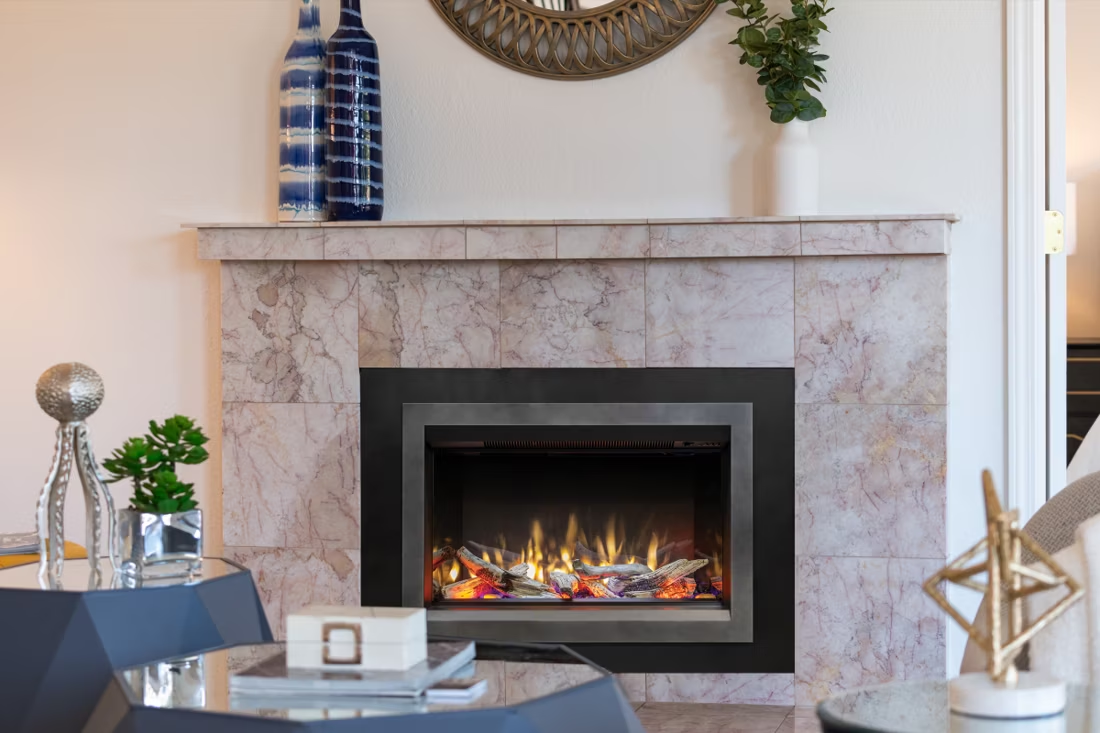
An electric insert is sized to drop into an existing masonry fireplace opening, which is common in Centennial's older ranch-style homes from the 1970s and 80s that already have a fireplace box but rarely burn wood in it. A built-in linear electric fireplace is framed into a wall from scratch—the look favored in newer construction around 80016 and 80112, often with a wide, low-profile glass viewing area and a stone or tile surround. Retrofits usually call for an insert; new construction or remodels usually call for a linear built-in.
Can I convert my existing wood-burning fireplace to electric in Centennial?
Yes, and it's a common project for older Centennial homes with a masonry fireplace that rarely gets used because of winter air quality advisories or simple inconvenience. An electric insert fits into the existing opening with no venting, no chimney sweep, and no Forest Service cutting permit required. It's usually the fastest and least invasive of the fuel-conversion options a local dealer can install.
Are there rebates available for electric heating in Centennial?
Public Service Company of Colorado (Xcel Energy) runs residential efficiency programs, but these are generally aimed at heat pumps and whole-home electrification rather than supplemental electric fireplaces, which draw relatively little power. It's worth checking Xcel's current program list before you buy, but most Centennial homeowners should plan on the fireplace itself being an out-of-pocket cost rather than a rebate-eligible upgrade.
Electric vs. gas fireplace—which is right for my Centennial home?
Gas fireplaces put out real heat, can run during a power outage with battery-backed ignition, and are a good primary or near-primary heat source for a main living area—natural gas service is standard throughout Centennial. Electric fireplaces trade heat output for flexibility: no venting, no gas line, and an install that works in any room, condo, or HOA-restricted property regardless of exterior modification rules. Many Centennial homeowners end up choosing gas for a main living space and electric for a bedroom, basement, or secondary room where running a gas line isn't practical.
Can I put a TV above my fireplace?
Yes—with an asterisk. Fireplaces are hot and TVs don't like heat. Either put a mantel between them to deflect rising warmth, or choose a fireplace with heat-management technology that creates a cool zone on the wall above—the wall stays around 125 degrees, barely warm, while the room still gets full heat. If you like clean lines and don't want a mantel, heat management is the answer.
Does an electric fireplace need a vent or chimney?
No—that's its superpower. An electric fireplace needs a wall and an outlet, period. No vent pipe, no gas line, no clearances to design around, which is why it works in bedrooms, offices, apartments, and walls where venting a gas or wood unit would be impractical or impossible. Installation is typically the simplest and least expensive of any fireplace type.
Can a fireplace actually lower my heating bill?
Yes—by creating a comfort zone. A furnace heats every square foot of the house just to warm the one room you're in; a gas fireplace on low burns roughly a sixth of the gas a typical furnace does. Set the furnace around 55–60 degrees as a baseline, then heat the rooms your family actually uses. Families who heat this way commonly save $20–$60 a month.
How much should I budget for a fireplace?
For an average home—covering the fireplace, the vent pipe, and basic installation—a budget between $3,900 and $5,500 gives you a lot of options across wood, gas, and pellet. By the time you add finish work, gas line, and electrical, the average complete installation lands between $5,000 and $12,000 all-in. In a remodel or new build, a good rule is to put about 2.5% of the total project cost toward the fireplace.
Nearby Dealers
Hearth shops serving Centennial and the surrounding area. Every listing shows whether it is a WhyFire partner, a dealer we have verified as authorized for the brands we recommend, or a local business carrying hearth products. No manufacturer pays for placement. How we verify dealers →
Midtown Chimney Fireplace Store
Spa Brokers Iii
Spa Brokers
Thoshini LLC
Spa Brokers V
Proud Souls Barbecue & Provisions
Outdoor Kitchen Dist. Inc
Spa Brokers
Fireplace And Grill Experts - Service Only
Aria Custom Design
Distinctive Mantel Designs
Spa Brokers (Corporate)
Rio Grande Co.
Spa Brokers
Western Fireplace Supply
Electric Service in Centennial
An electric fireplace's heater draws about 1,500 watts—pennies per hour at local rates.
Public Service Co Of Colorado
Find your electric fireplace in Centennial.
Tell us a bit about your home and we'll put together a free Project Guide & Parts List for your Centennial electric fireplace project—the right unit, the exact parts, and a trusted local dealer to install it.
Find Your Fireplace →