
Find your pellet stove in Siskiyou County.
Thermostatic, low-maintenance heat for a county where wildfire smoke season and long shoulder winters both matter—I'll match you with a trusted local dealer who can size and install it right.
Every Project Starts From One of These Five Situations
A clean-burning option for smoke-conscious winters.
Siskiyou County sits in a rugged stretch of far-northern California, ringed by the Klamath and Rogue River-Siskiyou National Forests, with Mount Shasta's volcanic bulk dominating the skyline. At roughly 4,951 heating degree days and average winter lows near 27°F, it's a genuinely cold county by California standards—more in line with a shoulder-season Midwest winter than coastal norms—but not extreme enough to demand the overnight-burn capacity of places like Duluth or Bozeman. That middle ground is exactly where pellet stoves do their best work.
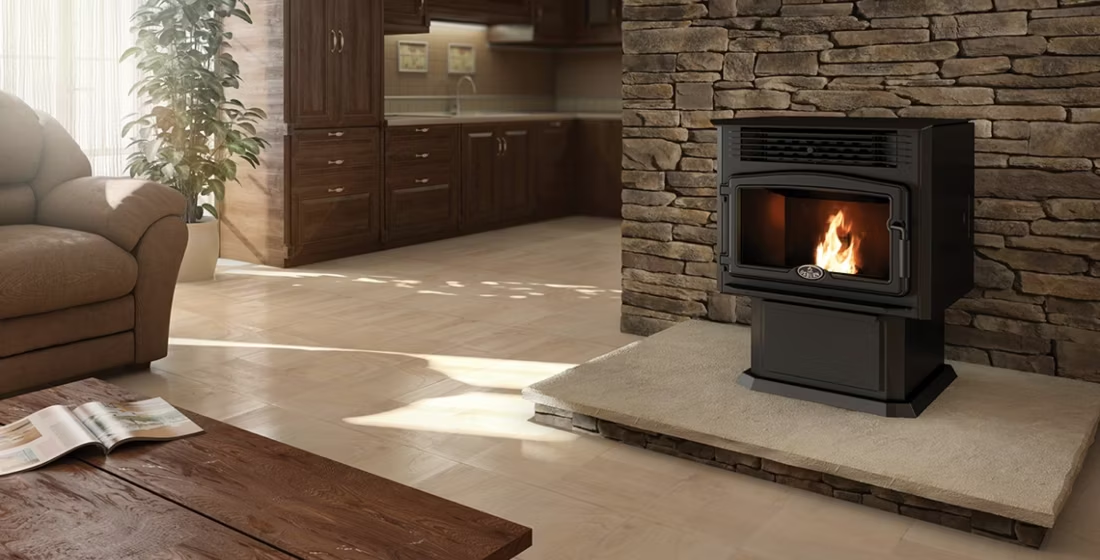
Siskiyou's summers bring real wildfire smoke risk, and open burning and cutting permits are seasonally restricted around Klamath National Forest, Rogue River-Siskiyou National Forest, and BLM Medford District lands. Pellet stoves sidestep a lot of that friction: they burn cleaner than cordwood, don't require a chainsaw trip into the forest during fire season, and stoves from regional suppliers like Bear Mountain, Lignetics, and Pacific Pellet are stocked at retailers across the county. Set the thermostat, load the hopper, and the stove holds a steady output through Yreka's cold valley nights or a Mount Shasta City evening without the ash volume or creosote maintenance of a wood-burning setup.
Three steps. No salesperson until you're ready.
Tell us about your project
Your zip code, your situation, and the fuel you're leaning toward—or let the answers point you to one.
See what's actually available
The brands dealers within 100 miles genuinely carry—real options, never a catalog mirage.
Get your dealer & Project Guide
A trusted local dealer, plus the free Project Guide & Parts List that names every component of the job.
Frequently Asked Questions
How much does a pellet stove installation cost in Siskiyou County?
Pellet stove and insert installations in Siskiyou County typically run in the $4,500 to $7,500 range, depending on whether the unit is a freestanding stove or an insert going into an existing masonry fireplace, and whether new electrical service is needed for the hopper motor and blower. Inserts into an existing chimney with a liner already in decent shape tend to land on the lower end. New venting through an exterior wall in a home without an existing fireplace pushes toward the higher end. Local dealers will confirm exact numbers after seeing your home.
Where can I buy pellets in Siskiyou County?
Regional brands like Bear Mountain, Lignetics, and Pacific Pellet are commonly stocked at hearth and farm supply retailers around Yreka, Mount Shasta, and Weed. Buying a season's supply (typically 2-4 tons for a primary-heat home) before the fall rush is the standard local strategy, since demand and pricing both tighten once cold weather sets in. Your local dealer can point you to the closest reliable supplier and tell you which pellet brands burn cleanest in the specific stove model you buy.
Will a pellet stove keep running during a power outage?
Not without backup power. Pellet stoves rely on an electric auger to feed fuel and a blower to distribute heat, so a standard outage stops the stove entirely—this matters in a county where winter storms and, occasionally, wildfire-related grid shutoffs can knock out power for extended stretches. A small battery backup or portable generator (even a modest 1000-1500 watt unit) is enough to keep most pellet stoves running through an outage. If backup power isn't part of your plan, ask your local dealer about wood stove alternatives for true off-grid resilience.
How do pellet stoves compare to wood stoves for Siskiyou County homes?
Wood stoves burn cordwood from local species like oak, madrone, and Douglas fir, work without electricity, and pair with low-cost Forest Service cutting permits (typically $5-$20 per cord through Klamath National Forest or Rogue River-Siskiyou National Forest during the May-October season). Pellet stoves need no cutting, splitting, or seasoning, produce far less ash, and burn cleaner overall—a real advantage during wildfire smoke season when air quality is already a concern. For county residents without the time, space, or interest in a woodpile, and in homes where reliable grid power isn't a worry, pellet is often the simpler choice. For remote properties where power outages are common, wood remains the more resilient backup.
Do I need a permit to install a pellet stove in Siskiyou County?
Yes—a building permit is generally required for a new pellet stove installation, covering the venting and any electrical work for the unit. Most local dealers handle the permitting process as part of the installation, so homeowners typically don't need to navigate it themselves. Unlike wood stoves, pellet appliances are generally exempt from wildfire-season air quality curtailment rules since they burn more completely and produce far less particulate matter.
What size pellet stove do I need for my home in Siskiyou County?
Sizing depends on square footage, insulation, and whether the stove is primary or supplemental heat. Given Siskiyou County's roughly 4,951 heating degree days, a mid-size unit (rated for 1,000-2,000 sq ft) is right for most main living areas in town, while smaller cabins and outbuildings around Mount Shasta or the Scott Valley can often get by with a compact unit rated under 1,000 sq ft. Homes at higher elevation or with older, drafty construction should size up. A local dealer will size the unit correctly during an in-home visit rather than relying on square footage alone.
How often does a pellet stove need to be cleaned and serviced?
Plan on cleaning the burn pot and glass every few days during regular use, a deeper ash removal from the ash pan weekly, and a full professional service annually—typically before the start of the fall burning season. The auger, blower, and venting should all get checked as part of that annual visit. Homes running the stove as primary heat through a full Siskiyou County winter will need more frequent burn pot attention than a home using it just for supplemental warmth.
What's the difference between a pellet stove and a pellet insert?
A pellet stove is a freestanding unit that sits on its own hearth pad and vents through a wall or existing chimney chase—it can go almost anywhere in a home with the right clearances. A pellet insert is built to slide into an existing masonry fireplace opening, converting an old wood-burning fireplace into an efficient, thermostatically controlled heat source while reusing the existing chimney for venting. For Siskiyou County homes with an existing fireplace they rarely use, an insert is usually the more cost-effective upgrade. Homes without an existing fireplace are better suited to a freestanding stove.
Is a pellet stove a good fit for a vacation cabin in Siskiyou County?
It can be, with one caveat: since pellet stoves need electricity to run the auger and blower, a cabin that sits unattended for stretches needs either reliable grid power or a backup power plan for cold snaps. For cabins around Mount Shasta, the Scott Valley, or the Klamath River corridor that are used intermittently through winter, a pellet stove offers easy startup (no seasoned wood needed on arrival) and steady, low-maintenance heat during a stay. Owners who want a stove that works even if the power is out, or who won't be around to restock a pellet hopper, often pair a pellet unit with a wood stove as backup.
What's the difference between an insert and a zero-clearance fireplace?
An insert is a fireplace that slides into a pre-existing wood-burning fireplace—if you don't have one, there's nothing to insert it into. A zero-clearance fireplace is built into a framed wall, which makes it the answer for remodels and new construction. Simple test: existing masonry fireplace means insert; blank or framed wall means zero-clearance.
Why is a fireplace insert so efficient?
An insert does two things: it seals the chimney completely, so you stop losing air you already paid to heat, and it radiates warmth into the room through the firebox and glass. Most add a heat-exchange fan that pulls cool room air underneath, wraps it around the hot firebox, and pushes it back out warm. Your home is more efficient before you've even lit the first fire.
Can a fireplace actually lower my heating bill?
Yes—by creating a comfort zone. A furnace heats every square foot of the house just to warm the one room you're in; a gas fireplace on low burns roughly a sixth of the gas a typical furnace does. Set the furnace around 55–60 degrees as a baseline, then heat the rooms your family actually uses. Families who heat this way commonly save $20–$60 a month.
Does a fireplace add value to my home?
On average, a fireplace adds back to the home about the same amount you spent installing it. Add the monthly savings from heating the rooms you actually use instead of the whole house—often hundreds of dollars a year—and the value case is strong before you even count what a fire does for how your family uses the room.
Stove and Fireplace Dealers in Siskiyou County
Pellet Brands Stocked Around Siskiyou County
Manufacturers will point you to the nearest stocking dealer.
Get matched with a local Siskiyou County pellet dealer.
Tell me about your home and I'll send you a free Project Guide & Parts List—the right pellet stove or insert, the exact venting parts, and a trusted local dealer to install it.
Find Your Fireplace →