
Keep Your Family Warm and Safe—No Matter What
Lake Elsinore doesn't need wood heat to survive January the way the Sierra or the Rockies do—but between mild-but-real cool nights, wildfire-season power shutoffs, and oak country right up the hill, plenty of local homeowners still want it done properly. We'll match you with a trusted local dealer who knows the rules.
Every Project Starts From One of These Five Situations
A supplemental fire, not a survival necessity—but still worth doing right.
At 1,279 feet in the Inland Empire, Lake Elsinore averages a winter low around 42°F and has a mild, short heating season—a fraction of what a place like Bozeman, Montana sees in a single cold snap. Nobody here is heating a house through a Montana winter. But that doesn't mean a wood stove is decorative. Southern California Edison's public safety power shutoffs (PSPS events) during Santa Ana wind season can leave homes without electricity for a day or more, and a wood stove is one of the few heat sources that keeps working when the grid doesn't. Plenty of Lake Elsinore homeowners also just want the ambiance of a real fire on the cooler evenings that roll in off the lake and the surrounding hills.
Lake Elsinore sits within the South Coast Air Basin, which the EPA classifies as a non-attainment area for particulate matter—meaning any wood-burning installation here has to meet South Coast Air Quality Management District (SCAQMD) Rule 445, which requires EPA-certified, low-emission devices and restricts wood burning on declared no-burn days under the Check Before You Burn program. Wildfire smoke is also a recurring concern in the foothills and canyons around town, which is part of why local installers steer most homeowners toward certified, efficient stoves rather than open masonry fireplaces. Oak, madrone, and Douglas fir are the common species available locally, much of it cut under permit from the nearby San Bernardino and Angeles National Forests.
Firewood Cutting Permits Near Lake Elsinore
Three steps. No salesperson until you're ready.
Tell us about your project
Your zip code, your situation, and the fuel you're leaning toward—or let the answers point you to one.
See what's actually available
The brands dealers within 100 miles genuinely carry—real options, never a catalog mirage.
Get your dealer & Project Guide
A trusted local dealer, plus the free Project Guide & Parts List that names every component of the job.
Frequently Asked Questions
How much does a wood stove installation cost in Lake Elsinore?
Most wood stove or insert installations in the area run roughly $4,000 to $9,500, depending on the stove, whether a new Class A chimney needs to be built through the roof, and any hearth pad work required for clearance-to-combustible rules. Homes with an existing masonry fireplace converting to an insert tend to land on the lower end since the chimney is already in place. New construction or additions without an existing flue push toward the higher end once full chimney chase framing and roof flashing are added in. A local installer will give you a firm number after seeing your home.
Do I actually need a big stove for a Lake Elsinore home?
Usually not. With an average winter low around 42°F and a mild, short heating season, most Lake Elsinore homes are looking for supplemental or ambiance heat rather than a whole-home primary heat source—the way you'd size a stove in a place with real hard winters. A small to medium freestanding stove or insert (sized for 800–1,500 square feet) covers a great room or open living area comfortably on the handful of genuinely cold nights, without the risk of overheating a mild-climate house on an average evening. A local retailer can walk your space and confirm sizing for free.
Where do I find a certified wood stove installer near Lake Elsinore?
Look for NFI (National Fireplace Institute) certified installers or CSIA-credentialed chimney professionals—both matter more than usual here because SCAQMD Rule 445 compliance and correct clearance-to-combustible spacing are inspected items, not suggestions. A qualified local installer will also know how to document the stove's EPA certification for your building permit file, which the county will want on record. Skipping a certified installer in favor of a handyman is the most common way homeowners end up with a failed inspection or an insurance issue down the road.
Wood stove or wood insert—which fits my Lake Elsinore home better?
If your home already has a masonry fireplace—common in the older neighborhoods around downtown Lake Elsinore and the lake-adjacent tracts—an insert is usually the better move. It slides into the existing firebox, uses a stainless liner through your current chimney, and turns an inefficient open hearth into a real heat source. Freestanding stoves make more sense for newer homes without an existing fireplace, garages converted to living space, or detached structures like a casita or shop where you're starting from scratch on venting.
What permits and air quality rules apply to wood stoves in Lake Elsinore?
You'll need a building permit through the City of Lake Elsinore Building Division (or Riverside County Building and Safety for unincorporated areas), and the stove itself must be an EPA-certified, low-emission unit to satisfy South Coast Air Quality Management District Rule 445. Once installed, burning is also subject to SCAQMD's Check Before You Burn program, which can declare no-burn days during winter inversions when particulate levels spike in the South Coast Air Basin—certified stoves and inserts are generally allowed more flexibility than older uncertified units, but it's worth checking the daily status during inversion-prone stretches.
What's the best wood stove for Lake Elsinore's climate?
Because you're not fighting single-digit overnight lows here, you don't need an oversized catalytic stove built for 20-hour burns in brutal cold. Mid-size non-catalytic models from brands like Pacific Energy, Lopi, or Regency are a good fit—efficient, EPA-certified, and sized right for supplemental heat rather than a whole-house furnace replacement. If backup heat during a PSPS power outage is a priority, ask your local dealer about models that need zero electricity to operate, since some blower-equipped stoves lose convection assist (though not heat output) without power.
How often should my chimney be inspected in Lake Elsinore?
An annual inspection before burning season is standard practice per CSIA guidelines, even for a stove that only sees occasional use here. Because Lake Elsinore sits in wildfire-prone foothill and canyon terrain, it's also worth having your sweep check the chimney cap and spark arrestor condition specifically—embers from nearby wildland fire activity are a real consideration for any home with an open flue in this part of Riverside County.
Where can I get firewood near Lake Elsinore?
Oak, madrone, and Douglas fir are the common local species, and a good amount of it is cut under Forest Service permit from the San Bernardino and Angeles National Forests, which run permits from May through October at roughly $5 to $20 per cord for self-cut wood. For delivered firewood, several Inland Empire suppliers serve the Lake Elsinore area, with seasoned oak typically running $300 to $400 per cord—pricier than pine-country regions since oak burns longer and is in steady demand across Southern California.
Wood stove or pellet stove—which makes more sense here?
Wood has one clear edge in Lake Elsinore: it keeps producing heat during a Southern California Edison PSPS power shutoff, since it needs no electricity to burn. Pellet stoves need power for the auger and blower, so they go cold in an outage unless you add a battery backup. On the flip side, EPA-certified pellet stoves are typically treated more favorably under SCAQMD's Check Before You Burn no-burn-day rules than open wood burning, and they're easier to load and run day to day. If wildfire-season outages are your bigger concern, wood wins. If daily convenience and air-quality-day flexibility matter more, pellet is worth a look—a local dealer can walk you through both.
Why is my open fireplace making my house colder?
Open fireplaces suck—literally. As the fire burns, it consumes air your furnace already paid to heat and pulls it out through the chimney, so the house is actually colder after the fire goes out than before you lit it. An insert fixes this: it seals the chimney, puts fixed glass across the front, and turns that hole in your house into a real heat source.
Why is a fireplace insert so efficient?
An insert does two things: it seals the chimney completely, so you stop losing air you already paid to heat, and it radiates warmth into the room through the firebox and glass. Most add a heat-exchange fan that pulls cool room air underneath, wraps it around the hot firebox, and pushes it back out warm. Your home is more efficient before you've even lit the first fire.
Can a fireplace actually lower my heating bill?
Yes—by creating a comfort zone. A furnace heats every square foot of the house just to warm the one room you're in; a gas fireplace on low burns roughly a sixth of the gas a typical furnace does. Set the furnace around 55–60 degrees as a baseline, then heat the rooms your family actually uses. Families who heat this way commonly save $20–$60 a month.
How much should I budget for a fireplace?
For an average home—covering the fireplace, the vent pipe, and basic installation—a budget between $3,900 and $5,500 gives you a lot of options across wood, gas, and pellet. By the time you add finish work, gas line, and electrical, the average complete installation lands between $5,000 and $12,000 all-in. In a remodel or new build, a good rule is to put about 2.5% of the total project cost toward the fireplace.
Nearby Dealers
Hearth shops serving Lake Elsinore and the surrounding area.
Palm Springs True Value Hardware & Patio
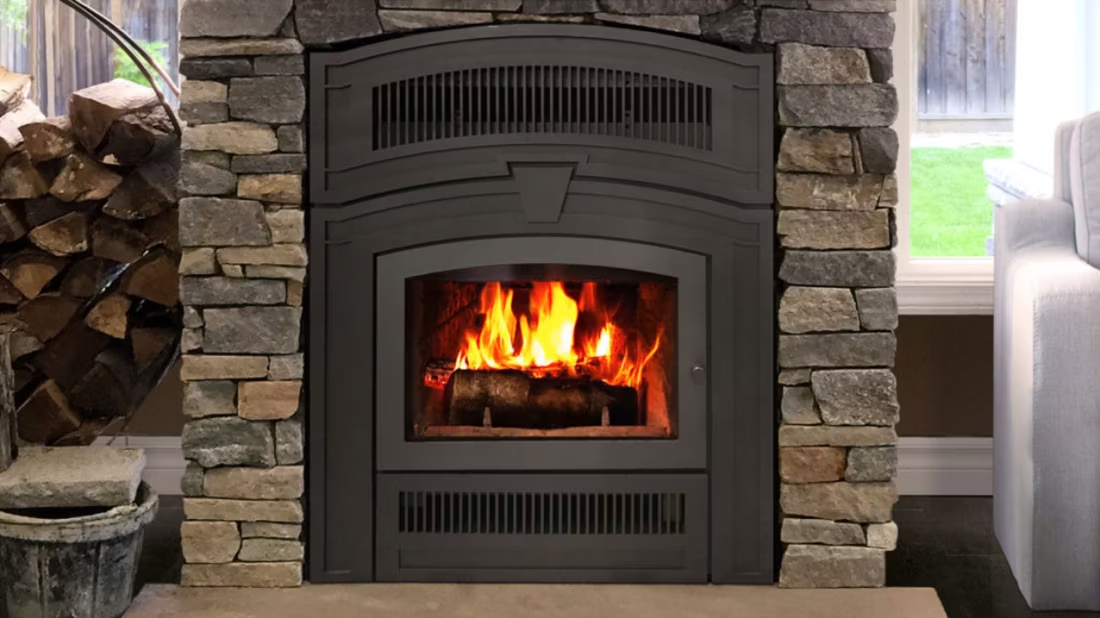
Find your wood fireplace in Lake Elsinore.
Tell us about your home and we'll put together a free Project Guide & Parts List—the exact stove or insert, vent kit, and hearth components for your Lake Elsinore project—and connect you with a trusted local dealer who can pull the permits and install it right.
Find Your Fireplace →