
Keep Your Family Warm and Safe—No Matter What
With winter lows averaging 32°F and a short, mild heating season, wood isn't the default heat source in Pulaski County—but for backup heat during ice storms or a stove that just feels right, we'll match you with a local dealer who installs it correctly.
Every Project Starts From One of These Five Situations
Central Arkansas rarely needs a wood stove to survive winter.
McAlmont sits in climate zone 3A at 274 feet elevation, just north of Little Rock, where winters are short and mild—the average winter low is 32°F, and the area has a notably short, light heating season. For comparison, a cold-climate city like Duluth, Minnesota has a heating season several times longer and far more demanding; McAlmont's heating season is a fraction of that. Central air and heat pumps handle the vast majority of winter heating here, and a wood stove is not something most homeowners consider essential.
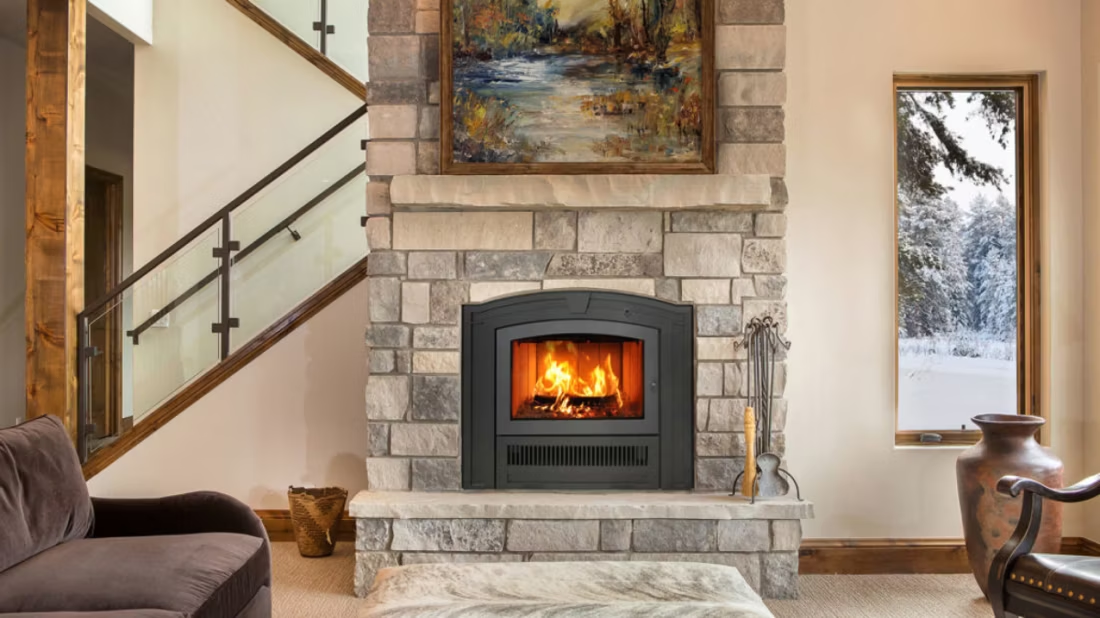
That said, wood heat hasn't disappeared from Pulaski County. Central Arkansas is prone to winter ice storms that knock out power for days at a time, and a wood stove or fireplace insert is one of the few heat sources that keeps working when the grid doesn't. Others want a stove purely for the look and feel of a real fire on the handful of genuinely cold nights each year, or to make use of the oak, hickory, and pine that grow throughout the region. If either of those describes you, the right unit still needs to be sized, vented, and installed by someone who won't oversell you on a stove built for a much colder place than McAlmont.
Firewood Cutting Permits Near McAlmont
Three steps. No salesperson until you're ready.
Tell us about your project
Your zip code, your situation, and the fuel you're leaning toward—or let the answers point you to one.
See what's actually available
The brands dealers within 100 miles genuinely carry—real options, never a catalog mirage.
Get your dealer & Project Guide
A trusted local dealer, plus the free Project Guide & Parts List that names every component of the job.
Frequently Asked Questions
How much does a wood stove installation cost in McAlmont?
Because most McAlmont installs are smaller freestanding stoves or inserts meant for backup and ambiance rather than whole-home heating, a typical project runs roughly $3,500 to $7,500—on the lower end of what you'd see in a colder climate where stoves need to carry the full heating load. The bigger cost swing is whether you already have a usable chimney. Installing an insert into an existing masonry fireplace is generally the cheaper path; a new freestanding stove that needs Class A chimney pipe run through a wall or roof from scratch pushes toward the higher end.
Does a wood stove actually make sense for McAlmont's climate?
For most homes, no—not as a primary heat source. With a short, mild heating season and winter lows that average 32°F, central heating alone gets most McAlmont households through the season comfortably. Where a wood stove earns its keep here is as backup heat during the ice storms that periodically knock out power across Pulaski County, or as a secondary heat source in a den, workshop, or older home with an existing fireplace. If you're picturing a stove that runs daily from November to March the way it might in Fargo or Bismarck, that's not the typical McAlmont use case.
Where can I get firewood near McAlmont?
Most McAlmont homeowners buy split, seasoned cordwood from local firewood dealers rather than cutting their own—the nearest self-cut options through Forest Service permits, the Ouachita National Forest and the Ozark-St. Francis National Forests, are both well outside Pulaski County, roughly a two-hour drive or more. Permits there run $10 to $20 per cord and are typically issued May through October. For most people wanting occasional fires rather than a wood-supply system, buying delivered cordwood locally is simpler than making that drive.
What kind of wood burns best in a McAlmont stove?
Oak and hickory are the two workhorses in central Arkansas—both are dense hardwoods that burn hot and long, which matters for an occasional-use stove where you want a solid fire without constant reloading. Pine is also common locally but burns faster and hotter with more resin, so it's better suited to kindling or quick evening fires than an all-night burn. If you're mainly using the stove for backup heat during an ice storm, a mixed load of oak or hickory with pine to get it started is the practical approach most local dealers will recommend.
Do I need a permit to install a wood stove in McAlmont?
McAlmont is unincorporated, so building permit requirements run through Pulaski County rather than a city building department. Requirements typically cover the stove's clearances, hearth pad, and chimney or venting work, and any EPA-certified stove will meet current emissions standards without issue. Because there's no local non-attainment or air quality restriction in this part of Arkansas—unlike some western states—burning itself isn't restricted by season or air quality advisory here. A local installer familiar with Pulaski County's process can confirm what paperwork, if any, applies to your specific project.
Will a wood stove keep my house warm if the power goes out?
Yes, and that's one of the strongest reasons to have one in this part of Arkansas. Ice storms are the most common cause of extended power outages for Entergy Arkansas and City of North Little Rock customers in Pulaski County, sometimes for several days at a stretch. A wood stove or fireplace insert doesn't need electricity to produce heat, unlike a gas furnace with an electric blower or an electric heater plugged into a dead outlet. A modestly sized stove in a central room can keep a home livable through a multi-day outage even if it isn't your everyday heat source.
Should I get a wood stove or a wood insert for my McAlmont home?
If your home already has a masonry fireplace—common in many of the older homes around North Little Rock and Pulaski County—an insert is usually the better fit. It slides into the existing opening, uses the chimney you already have, and turns a fireplace that loses more heat than it produces into something genuinely useful for backup heat. A freestanding stove makes more sense if you don't have an existing fireplace, want to heat a workshop or detached space, or want more flexibility in where the stove sits in the room.
What size wood stove do I actually need?
Given how mild McAlmont's winters run, most homeowners here are better served by a small to mid-size stove—rated for 800 to 1,500 square feet—used to heat one main living area rather than a whole house. Oversizing is a real risk in this climate: a stove sized for northern winters will run too hot for the room and force you to burn small, smoldering fires to keep it comfortable, which creates more creosote, not less. A local dealer can size the stove to the specific room you plan to heat rather than the whole house.
Wood stove vs. electric heater for backup heat—which makes more sense here?
Electric space heaters and electric fireplaces are simple, need no chimney or permit, and work fine day-to-day—Entergy Arkansas and City of North Little Rock both run residential rates around 12 to 13 cents per kWh, which is affordable for occasional use. The catch is that electric heat is useless in the exact scenario where McAlmont households most want backup heat: an ice storm that's taken down the power lines. A wood stove costs more upfront and needs a chimney, but it's the only one of the two that still works when the grid doesn't. Many homeowners here use electric for everyday convenience and keep a wood stove specifically for storm season.
Why won't my new wood stove get going like my old one?
New wood stoves are 70%+ efficient, so far less heat goes up the flue—which also means less draft to get a fire established. The rule: build a genuinely hot fire for about 45 minutes before you choke it down. Skip that and you get smoke in the room, creosote in the chimney, and a fire that never takes off. Most performance complaints trace straight back to this.
Do I have to leave the stove door cracked open to start a fire?
On many stoves, yes—a new fire needs extra air, and cracking the door a couple inches is how most stoves get it. But some modern stoves offer an automatic startup air system: engage it when you light, and timed air jets feed the fire for the first 20 minutes with the door fully shut, then close automatically. It's mechanical—like an egg timer, no electricity—and it means you can load it, light it, and walk away.
What is an in-home preview and do I need one?
It's a visit where a hearth professional measures your space, confirms the model you picked actually works in your home, and walks the specs—framing, gas line, venting, finish work—before anything is ordered. Some details you just can't know until you see the house. Never make a down payment without one; it's the single most-skipped step that burns buyers.
How much should I budget for a fireplace?
For an average home—covering the fireplace, the vent pipe, and basic installation—a budget between $3,900 and $5,500 gives you a lot of options across wood, gas, and pellet. By the time you add finish work, gas line, and electrical, the average complete installation lands between $5,000 and $12,000 all-in. In a remodel or new build, a good rule is to put about 2.5% of the total project cost toward the fireplace.
Nearby Dealers
Hearth shops serving McAlmont and the surrounding area. Every listing shows whether it is a WhyFire partner, a dealer we have verified as authorized for the brands we recommend, or a local business carrying hearth products. No manufacturer pays for placement. How we verify dealers →
Acme Brick Company
G&S Insulating And Fireplace
Abc Block And Brick
Royal Overhead Door Co Inc
See what's possible for wood heat in McAlmont.
Tell us about your home and how you'd use a wood stove—backup heat, ambiance, or both—and we'll send you a free Project Guide & Parts List with the right unit, venting, and a trusted local dealer to install it.
Find Your Fireplace →