
Add real fire ambiance to your Tucson Mountains home—without the smoke.
With winter lows that rarely drop below the high 30s, most Tucson Mountains homes need a flicker of flame more than a furnace. Find the right electric unit and connect with a trusted local dealer.
Every Project Starts From One of These Five Situations
Electric fireplaces fit the desert's mild winters perfectly.
Tucson Mountains sits in the Sonoran Desert foothills west of Saguaro National Park at about 2,450 feet, in a climate zone (2B) with a very short, mild heating season—a fraction of what a mountain town in Montana or the upper Midwest logs. The average winter low here is 39°F. That means most homeowners aren't chasing BTUs; they want the look and feel of a fire on the handful of genuinely cool desert evenings, without adding a heat source the house doesn't need for ten months of the year.
Pima County's non-attainment status, winter temperature inversions, and periodic wildfire smoke also make an emissions-free option appealing—an electric fireplace adds zero particulate to the airshed and isn't subject to any burn advisories. Most of the area is served by Tucson Electric Power, with Ajo Improvement Co. and the Tohono O'odham Utility Authority serving parts of the surrounding communities; residential rates run roughly 12.6¢ to 15.6¢ per kWh, which keeps the cost of running a fireplace mostly for ambiance genuinely low. No gas line, no chimney, no venting—just a wall outlet or a dedicated circuit and a local electrician.
Three steps. No salesperson until you're ready.
Tell us about your project
Your zip code, your situation, and the fuel you're leaning toward—or let the answers point you to one.
See what's actually available
The brands dealers within 100 miles genuinely carry—real options, never a catalog mirage.
Get your dealer & Project Guide
A trusted local dealer, plus the free Project Guide & Parts List that names every component of the job.
Frequently Asked Questions
How much does an electric fireplace installation cost in Tucson Mountains?
A plug-in electric fireplace or insert that runs on a standard 120V outlet can be installed for a few hundred dollars in most cases—often just the unit and a mounting bracket. Built-in models that require a dedicated 240V circuit run higher, typically $1,000 to $2,500 once you factor in an electrician to run new wiring behind a wall or into a mantel surround. Because Tucson Mountains homes don't need the unit to carry real heating load the way a home in Duluth MN would, many owners choose smaller, simpler units and skip the electrical upgrade entirely.
Do I even need heat output, or just the look of a fire?
For most homes in the Tucson Mountains area, the honest answer is: mostly the look. With a very short, mild heating season and winter lows averaging 39°F, an electric fireplace here is rarely asked to do serious heating work—it's ambiance in the living room on a December evening, not a backup furnace. That's actually an advantage: look for models with a flame-only mode that runs the visual effect with the heating element switched off, so you can enjoy the fire in October without running a space heater you don't need.
Do I need a permit to install an electric fireplace in Tucson Mountains?
A freestanding, plug-in electric fireplace generally doesn't require a permit—it's treated like any other appliance. A built-in unit that requires new electrical wiring or a dedicated circuit does typically need an electrical permit, handled through Pima County Development Services since Tucson Mountains is unincorporated county land. Most licensed electricians who do this work pull the permit as part of the job, so it's rarely something a homeowner has to manage directly.
What's the difference between an electric insert, a built-in, and a freestanding unit?
An electric insert is sized to slot into an existing masonry or wood-burning fireplace opening, instantly converting an old, unused hearth into a working fireplace with no venting changes. A built-in electric fireplace is designed to be framed into a new wall or cabinetry, similar to a linear gas fireplace, and usually needs that dedicated circuit. A freestanding or mantel-style unit just needs floor space and an outlet. For the many Tucson Mountains homes with existing but rarely-used masonry fireplaces, an insert is often the simplest upgrade.
Will my electric fireplace work if the power goes out?
No—electric fireplaces stop working the moment the power does, which is worth knowing given that summer monsoon storms can knock out TEP service in parts of the Tucson Mountains for a few hours at a time. That's not usually a dealbreaker here since winter heating isn't a survival issue at 39°F average lows, but if backup heat during an outage matters to you, a wood stove burning local mesquite or pinyon, or a gas unit with battery-backed ignition, is a better complement than relying on electric alone.
What's the best type of electric fireplace for this climate?
Look for a model with independent flame and heat controls, since most Tucson Mountains owners will run the flame effect far more often than the heater. Linear electric inserts and wall-mount units from brands like Dimplex and Napoleon are popular choices for this reason—the flame display looks convincing on its own, and the heating element can stay off from roughly April through October. If you do want supplemental heat for the cooler stretch from December through February, a unit with a built-in thermostat lets it cycle on only when the room actually drops below a set temperature.
How much does it cost to run an electric fireplace here?
Most electric fireplaces draw around 1,500 watts on the heat setting and a fraction of that on flame-only mode. At Tucson Electric Power's residential rate of roughly 15.6¢ per kWh (or about 12.6¢ under Ajo Improvement Co. or Tohono O'odham Utility Authority service), running the heater for a few hours on a cool evening costs well under a dollar, and flame-only ambiance mode is closer to a few cents. It's one of the cheapest ways to add fire to a room in this climate precisely because the unit isn't working hard.
Are electric fireplaces a good fit given local air quality concerns?
Yes—this is one of the clearer advantages of electric in this area. Pima County's non-attainment designation and winter inversion pattern mean wood smoke can linger in the basin on still nights, and wildfire smoke drifting in from regional fires adds to the concern in some seasons. An electric fireplace produces zero combustion byproducts, so it's never subject to burn advisories and doesn't add to the local airshed at all—a meaningful difference from a wood stove burning mesquite or juniper on an inversion night.
Electric vs. wood or gas—which makes more sense in Tucson Mountains?
Wood has real cultural roots here—mesquite, pinyon, and juniper are all cut locally under Coronado National Forest permits (roughly $5 to $20 per cord, May through October)—but it means smoke, ash, and occasional air quality advisories. Gas offers instant heat with no ash but requires a fuel line and venting work. Electric skips both: no venting, no combustion, low operating cost, and installation that's usually measured in hours rather than days. Given how little actual heating this climate demands, electric is often the simplest and least regrettable choice for homeowners who just want the look of fire without adding a system built for a colder place.
Does an electric fireplace need a vent or chimney?
No—that's its superpower. An electric fireplace needs a wall and an outlet, period. No vent pipe, no gas line, no clearances to design around, which is why it works in bedrooms, offices, apartments, and walls where venting a gas or wood unit would be impractical or impossible. Installation is typically the simplest and least expensive of any fireplace type.
Can I put a TV above my fireplace?
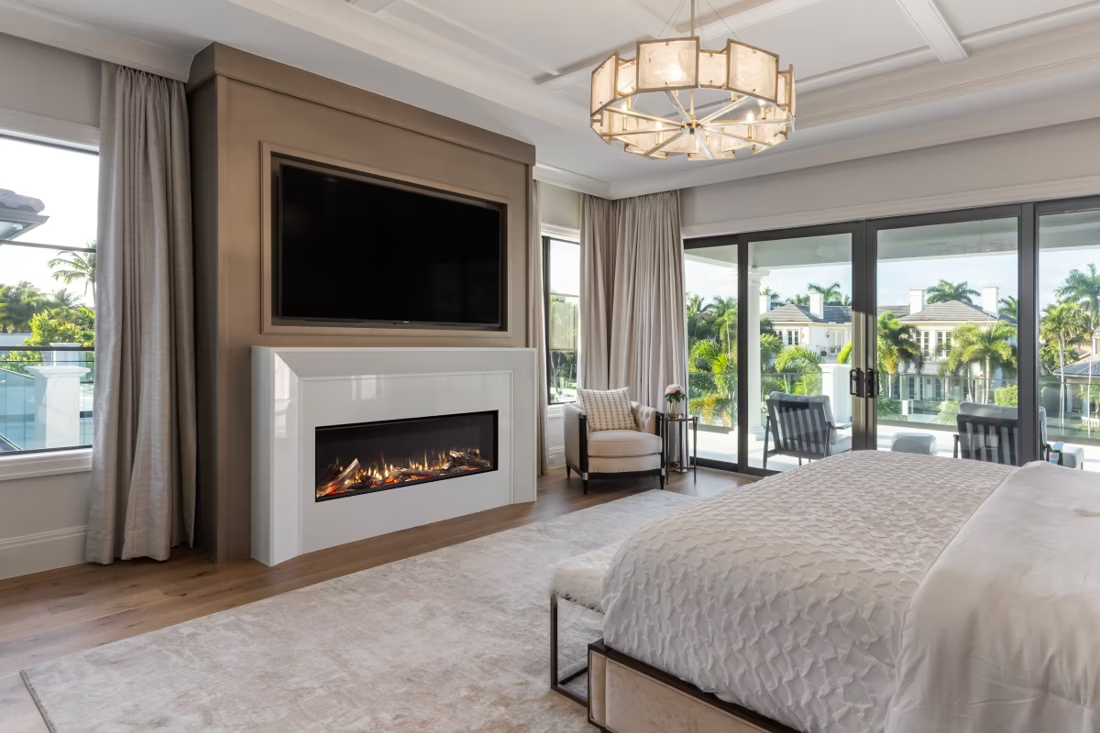
Yes—with an asterisk. Fireplaces are hot and TVs don't like heat. Either put a mantel between them to deflect rising warmth, or choose a fireplace with heat-management technology that creates a cool zone on the wall above—the wall stays around 125 degrees, barely warm, while the room still gets full heat. If you like clean lines and don't want a mantel, heat management is the answer.
How much should I budget for a fireplace?
For an average home—covering the fireplace, the vent pipe, and basic installation—a budget between $3,900 and $5,500 gives you a lot of options across wood, gas, and pellet. By the time you add finish work, gas line, and electrical, the average complete installation lands between $5,000 and $12,000 all-in. In a remodel or new build, a good rule is to put about 2.5% of the total project cost toward the fireplace.
Does a fireplace add value to my home?
On average, a fireplace adds back to the home about the same amount you spent installing it. Add the monthly savings from heating the rooms you actually use instead of the whole house—often hundreds of dollars a year—and the value case is strong before you even count what a fire does for how your family uses the room.
Nearby Dealers
Hearth shops serving Tucson Mountains and the surrounding area. Every listing shows whether it is a WhyFire partner, a dealer we have verified as authorized for the brands we recommend, or a local business carrying hearth products. No manufacturer pays for placement. How we verify dealers →
Earth Energy's Hearth & Patio
Electric Service in Tucson Mountains
An electric fireplace's heater draws about 1,500 watts—pennies per hour at local rates.
Tucson Electric Power Co
Ajo Improvement Co
Tohono O'Odham Utility Authority
Find your electric fireplace in Tucson Mountains.
Tell us about your home and we'll put together a free Project Guide & Parts List for your electric fireplace project—the right unit, the electrical requirements, and a trusted local dealer near Tucson Mountains to install it.
Find Your Fireplace →