
The Fireplace Option That Fits Family Housing.
No chimney, no gas line, no lease headaches—just plug-in or built-in warmth for Warren AFB housing and the surrounding Cheyenne area. We'll help you find a local dealer who knows what's actually installable here.
Every Project Starts From One of These Five Situations
Electric heat solves the base-housing puzzle.
F.E. Warren Air Force Base sits at 6,110 feet on the high plains just north of Cheyenne, in climate zone 6B with a long, cold winter—colder over a season than Fargo, ND—and average winter lows around 18°F. With a resident population near 2,800, most housing here is Air Force family housing, and most families are on assignment cycles measured in a few years, not decades. That changes what actually makes sense to install.
Base family housing generally prohibits solid-fuel appliances—wood stoves and pellet stoves—for fire-safety and lease-turnover reasons, even though the surrounding Medicine Bow-Routt and Arapaho-Roosevelt National Forests are full of lodgepole pine, aspen, and ponderosa pine, and cutting permits run a modest $5-$20 per cord. That leaves gas and electric as the fuels that actually get installed at Warren AFB. Electric in particular fits the PCS lifestyle: no venting, no chimney, no gas line, and in most cases no structural change to the housing unit—a real advantage when your next set of orders could come in 24 months. Cheyenne Light Fuel & Power and Black Hills Power both serve the area at roughly $0.14-$0.17 per kWh, reasonable rates for the kind of supplemental, zone-based heat an electric fireplace actually provides.
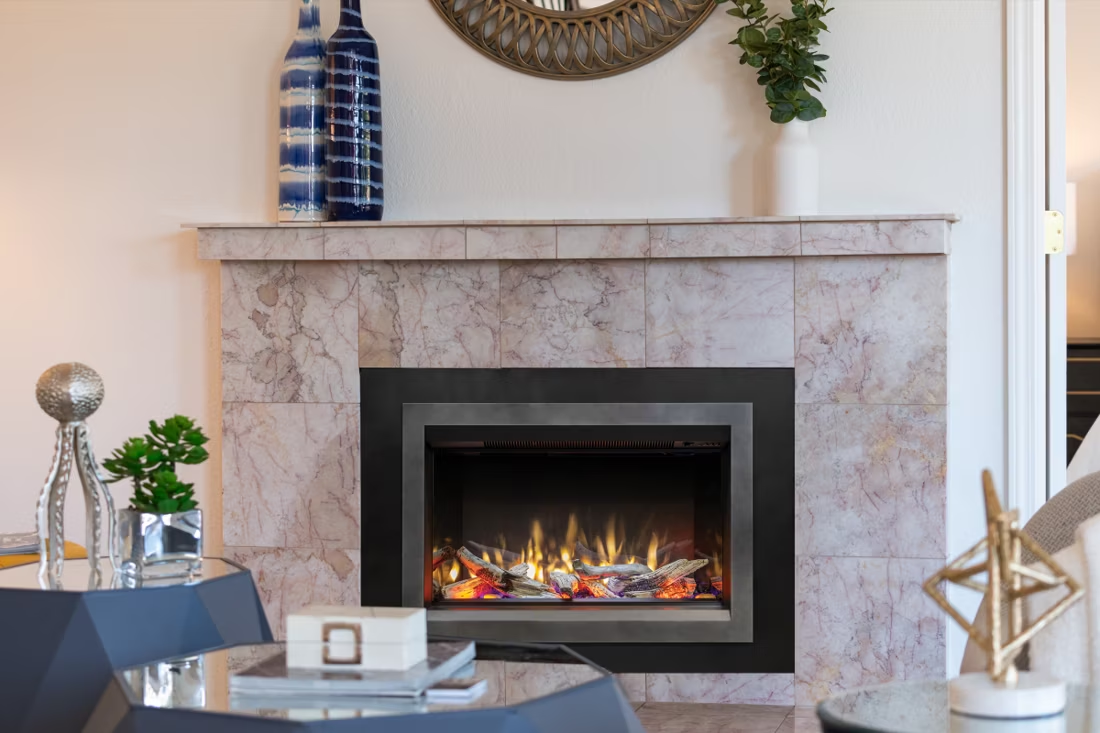
Three steps. No salesperson until you're ready.
Tell us about your project
Your zip code, your situation, and the fuel you're leaning toward—or let the answers point you to one.
See what's actually available
The brands dealers within 100 miles genuinely carry—real options, never a catalog mirage.
Get your dealer & Project Guide
A trusted local dealer, plus the free Project Guide & Parts List that names every component of the job.
Frequently Asked Questions
How much does an electric fireplace cost to install at Warren AFB?
A freestanding or insert-style plug-in unit typically runs $300-$1,500 installed, since there's no venting or gas line to run—often just placement and, if it's an insert, fitting it into an existing fireplace opening. A recessed or built-in wall unit that requires a dedicated 120V or 240V circuit and minor framing runs closer to $1,500-$4,000. If you're in on-base family housing, check with the 90th Civil Engineer Squadron Housing Office before any wall cutting or built-in work—plug-in freestanding units generally need no approval, but permanent modifications to a housing unit do.
Can an electric fireplace actually heat a home in Warren AFB's climate?
Not as a primary heat source, and it's worth being direct about that. Most electric fireplaces top out around 1,500 watts and 5,000-9,000 BTU—enough to noticeably warm a single room, but not enough to carry a whole house through a Wyoming high-plains winter with a long, cold heating season and lows in the high teens. Think of it as zone heat for a living room or bedroom, layered on top of your furnace or heat pump, not a replacement for it. That said, for base housing where wood and pellet stoves aren't an option, an electric unit is often the only supplemental heat source residents can actually install.
Do I need a permit to install an electric fireplace near Warren AFB?
In on-base family housing, plug-in freestanding units generally don't require anything beyond common sense, but any built-in or recessed unit involving new wiring or wall changes needs sign-off from the Housing Office before work starts. Off base—in Cheyenne proper (82001) or unincorporated Laramie County (82005)—a built-in unit tied into a new electrical circuit typically requires an electrical permit through the City of Cheyenne Building Permits Office or Laramie County Building Department, while a simple plug-in unit does not.
What's the difference between a plug-in electric fireplace and a built-in wall unit?
A plug-in unit is freestanding or drops into an existing fireplace opening as an insert, runs on a standard household outlet, and can move with you at the end of a PCS assignment—a meaningful advantage in a base community where turnover is constant. A built-in wall unit is recessed into the wall, often wired to a dedicated circuit, and becomes a fixed part of the home. For renters and base housing residents, plug-in units are by far the more common and more practical choice; built-ins make more sense for owner-occupied homes off base where you're settling in longer term.
Electric vs. gas—which fits my home near Warren AFB better?
Both are viable here, unlike wood or pellet, which base housing rules generally rule out. Gas delivers real heat output—enough to matter on an 18°F morning—and can run during a power outage with the right ignition system, which is worth considering given how exposed the high plains are to winter storms. Electric skips the gas line and venting entirely, installs faster, and works well for supplemental warmth in a room, but it produces less heat per dollar and does nothing for you if the power goes out. If you're in on-base housing without gas service to the unit, electric is often the practical default. If you have access to natural gas or propane, it's worth comparing both with a local dealer before deciding.
Why isn't a wood stove an option at Warren AFB?
It's not that wood doesn't work in this climate—lodgepole pine, aspen, and ponderosa pine are all abundant in the nearby Medicine Bow-Routt and Arapaho-Roosevelt National Forests, and cutting permits run just $5-$20 per cord from May through October. The issue is base family housing policy: solid-fuel stoves and inserts are generally prohibited in Air Force housing units due to fire-safety liability and the difficulty of maintaining chimneys across constant tenant turnover. Wildfire smoke is also a periodic air-quality concern in this part of Wyoming, which further discourages solid-fuel burning. Electric and gas are the fuels that are actually approved and installed here.
What will an electric fireplace cost to run each month?
Running a 1,500-watt unit for about four hours a night works out to roughly 6 kWh a day. At Cheyenne Light Fuel & Power's residential rate of about $0.17 per kWh, that's close to $1 a day, or $25-$30 a month for evening use in one room. Homes served by Black Hills Power, at roughly $0.144 per kWh, run slightly less. Either way, it's a modest addition to the utility bill compared to extending furnace runtime, which is part of why electric units work well as supplemental heat rather than a whole-home solution.
Will my electric fireplace work if the power goes out?
No—this is worth being upfront about. Electric fireplaces require household power to run their heater elements, LED flame effects, and fans, so they go dark along with everything else during an outage. That matters on the high plains around Warren AFB, where winter storms can knock out power for hours at a time. If backup heat during outages is a real concern, a gas fireplace with a battery-backed or self-powered ignition system is worth discussing with a local dealer alongside your electric fireplace plans.
What are the best electric fireplace brands for a Wyoming winter?
Look at brands built for real supplemental heat output rather than just visual effect—Dimplex and Napoleon both make 1,500-watt units with adjustable thermostats that hold their own in a cold room, and Touchstone's electric inserts are a common choice for retrofitting an existing fireplace opening in older Cheyenne-area homes. For base housing specifically, a compact freestanding or insert model that doesn't require wall modification is usually the easiest to get approved and the easiest to take with you at your next assignment. A local dealer can walk through wattage and room size to match a unit to your specific space.
Do electric fireplaces actually produce heat?
Yes—most put out around 4,800–5,000 BTUs from a standard outlet, which comfortably warms a bedroom, office, or den as a comfort-zone heater. What they won't do is carry a whole house the way wood, gas, or pellet can. Think of electric as ambiance-first with honest supplemental heat: flames on with no heat in July, flames plus warmth in January.
Can I put a TV above my fireplace?
Yes—with an asterisk. Fireplaces are hot and TVs don't like heat. Either put a mantel between them to deflect rising warmth, or choose a fireplace with heat-management technology that creates a cool zone on the wall above—the wall stays around 125 degrees, barely warm, while the room still gets full heat. If you like clean lines and don't want a mantel, heat management is the answer.
What is an in-home preview and do I need one?
It's a visit where a hearth professional measures your space, confirms the model you picked actually works in your home, and walks the specs—framing, gas line, venting, finish work—before anything is ordered. Some details you just can't know until you see the house. Never make a down payment without one; it's the single most-skipped step that burns buyers.
Can a fireplace actually lower my heating bill?
Yes—by creating a comfort zone. A furnace heats every square foot of the house just to warm the one room you're in; a gas fireplace on low burns roughly a sixth of the gas a typical furnace does. Set the furnace around 55–60 degrees as a baseline, then heat the rooms your family actually uses. Families who heat this way commonly save $20–$60 a month.
Nearby Dealers
Hearth shops serving Warren AFB and the surrounding area. Every listing shows whether it is a WhyFire partner, a dealer we have verified as authorized for the brands we recommend, or a local business carrying hearth products. No manufacturer pays for placement. How we verify dealers →
We’ve paused dealer listings for this connection today. Enter your zip or postal code above to find dealers near you, or come back tomorrow.
Popular Electric Brands
Where each brand came from, what's inside it today, and every current model. No brand pays to be here. Not every dealer carries every brand, so enter your zip code to see what's sold near Warren AFB.
Fireplace Xtrordinair
Fireplace Xtrordinair, now often called FireplaceX, is the fireplace brand of Travis Industries, Inc., of Mukilteo, Washington.
5 electric models →DaVinci
DaVinci Custom Fireplaces is a brand of Travis Industries, Inc., of Mukilteo, Washington, the company behind Lopi and Fireplace Xtrordinair.
5 electric models →Kozy Heat
Kozy Heat was founded in 1976 by Dudley Hussong in Lakefield, Minnesota, and incorporated as Hussong Manufacturing Co., Inc. in 1978.
3 electric models →Forge & Flame
Forge & Flame is the stove brand Hearth & Home Technologies introduced in August 2023 to bring Vermont Castings, Harman, and Quadra-Fire under one name.
1 electric model →Electric Service in Warren AFB
An electric fireplace's heater draws about 1,500 watts—pennies per hour at local rates.
Cheyenne Light Fuel & Power
Black Hills Power, Inc.
Find your electric fireplace near Warren AFB.
Tell us about your home or housing unit and we'll help you find a trusted local dealer and a free Project Guide & Parts List—the exact unit, mounting or venting needs, and parts list for your Warren AFB electric fireplace project.
Find Your Fireplace →