
Electric heat that keeps up with Lac du Flambeau winters.
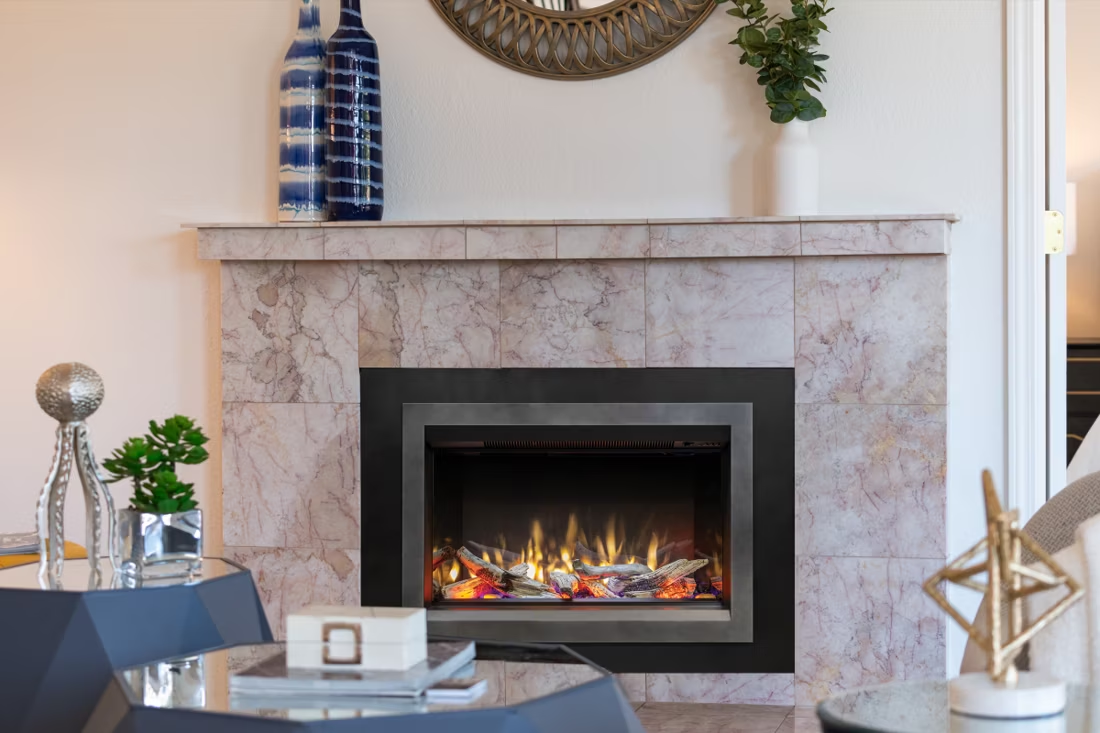
No chimney, no gas line, no fuel delivery down icy lake roads—just a unit that plugs in and warms the room. Find the right electric fireplace for your cabin or home and connect with a trusted local dealer.
Every Project Starts From One of These Five Situations
Reliable zone heat for single-digit nights.
Lac du Flambeau sits among the chain of lakes in Vilas County, in climate zone 7—the coldest classification found in the Lower 48—with one of the longest, most demanding heating seasons in the country and winter lows that average around 1°F, putting it in the same cold-weather league as International Falls, MN. Most of the roughly 1,755 year-round residents share the town with a much larger population of seasonal lake-cabin owners, and a lot of the local housing stock reflects that: cabins with no existing chimney, bunkhouses added on later, or rental units where the owner's insurance policy has opinions about open flame. Electric fireplaces fit that reality well because they install without venting, without a gas line, and without any structural changes to a building that was never designed to burn anything.
Depending on which side of town or which lake road your property sits on, your power comes from Northern States Power (Xcel Energy), Wisconsin Public Service Corporation, or Bayfield Electric Cooperative—residential rates run roughly $0.158 to $0.162 per kWh across the three. With winters this long and cold, running electric resistance heat as the sole whole-home heat source gets expensive fast, so most local installs use an electric fireplace or stove as zone heat: warming the main room, the bunkhouse, or the space a propane furnace can't quite reach, rather than replacing whole-home heat outright. For weekend cabins that just need the chill taken off before guests arrive, that's often all the heat they need.
Three steps. No salesperson until you're ready.
Tell us about your project
Your zip code, your situation, and the fuel you're leaning toward—or let the answers point you to one.
See what's actually available
The brands dealers within 100 miles genuinely carry—real options, never a catalog mirage.
Get your dealer & Project Guide
A trusted local dealer, plus the free Project Guide & Parts List that names every component of the job.
Frequently Asked Questions
How much does it cost to install an electric fireplace in Lac du Flambeau?
A plug-in electric fireplace or stack-style insert that runs off a standard 120v outlet typically costs $300 to $900 installed, with no electrician required beyond confirming the circuit can handle the load. A built-in wall unit or a larger insert that needs a dedicated 120v or 240v circuit run from the panel usually lands between $1,500 and $3,500 once you add a licensed electrician's time—more if the panel is older or the run is long, which is common in lake cabins that have been added onto over the decades. A local dealer can tell you which category your project falls into after seeing your panel and the room.
Will an electric fireplace heat my whole cabin through a Northwoods winter?
Probably not as your only heat source. With one of the longest, coldest heating seasons in the Lower 48 and average winter lows around 1°F, Lac du Flambeau sees the kind of sustained cold where electric resistance heat becomes expensive if it's carrying the whole load—similar to what homeowners deal with up around International Falls, MN. Most local installs use the electric fireplace as supplemental zone heat in the main living area or a bunkhouse, paired with a propane furnace or boiler doing the primary heating lift. Where an electric unit shines is exactly the situations a lot of lake properties have: a room that runs cold, a cabin used mainly on weekends, or a space you want warm in twenty minutes without firing up the whole system.
Which electric utility serves my home in Lac du Flambeau?
It depends on where your property sits. Northern States Power (Xcel Energy) and Wisconsin Public Service Corporation both serve portions of the area, while Bayfield Electric Cooperative covers some of the outlying lake properties. Rates across the three run about $0.1583 to $0.1623 per kWh residentially—close enough that it rarely changes the fireplace decision, but worth checking your bill if you're comparing running costs for a larger unit.
Do I need a permit to install an electric fireplace here?
A plug-in unit that uses an existing outlet doesn't require a permit. A built-in insert or wall unit that needs a new dedicated circuit does need an electrical permit, and jurisdiction here isn't always straightforward—properties within Vilas County typically go through the Vilas County Planning & Zoning Department, while homes on Lac du Flambeau Band trust land may fall under tribal building authority instead. A local licensed electrician who's worked in the area will already know which office your address falls under, which is one good reason to have the wiring done by someone familiar with the town rather than a general handyman.
What's the difference between a plug-in electric fireplace and a built-in insert?
A plug-in electric fireplace is a self-contained unit—freestanding, wall-mounted, or a stove-style cabinet—that runs off a standard outlet and can be moved if you sell the cabin or change rooms. A built-in insert is recessed into a wall or an existing masonry fireplace opening, wired to a dedicated circuit, and finished to look permanent. For rental cabins around the lakes, plug-in units are popular because they're simple to explain to renters and don't involve any wiring changes. For a primary residence or a cabin you're renovating anyway, a built-in insert gives a more finished look and usually more consistent heat output.
What's the best electric fireplace for a seasonal lake cabin?
Look for a unit with a built-in thermostat and a shut-off timer—useful for a cabin that sits empty for stretches between visits or rental turnovers. Wall-mounted and recessed insert styles are popular for cabins because they don't eat up floor space in a small bunkhouse or lake room, and most models separate the flame effect from the heater, so you can run the ambiance in summer without the heat. Because there's no open flame or venting involved, electric units also tend to satisfy the no-open-flame clauses that show up in a lot of vacation-rental insurance policies around the Flambeau chain. A local dealer can match a model to your room size and your panel capacity.
How much does it cost to run an electric fireplace day to day?
Most electric fireplaces draw around 1,500 watts on the heat setting. At the local residential rate of roughly $0.16 per kWh, that works out to about $0.24 an hour, or a little over $2 for a full evening of use—cheap compared to running a propane heater or waiting on a fuel delivery truck to make it up the lake roads in a snowstorm. Running the flame effect alone without heat draws only a fraction of that, which is why a lot of cabin owners leave it on for ambiance during warmer months.
Electric or propane—which fuel is right for my home?
There's no natural gas main serving Lac du Flambeau, so propane is the standard whole-home fuel in this area, typically delivered by truck and stored in a tank on the property. A propane furnace or boiler makes sense as primary heat given the region's cold—that long, severe heating season is a lot of ground to cover with electric resistance alone. Electric fireplaces work well alongside that setup: no delivery schedule to manage, no tank to maintain, and no risk of running out mid-winter if a delivery gets delayed by weather. Many local homes run propane for the furnace and electric for the fireplace or supplemental zone heat.
Electric or wood—which is right for a Lac du Flambeau property?
Oak, maple, birch, and aspen are all abundant locally, and cutting permits through the Chequamegon-Nicolet and Ottawa National Forests run $10 to $20 per cord during the May-through-October season, so firewood itself isn't the obstacle. What we see in the local installer data, though, is that new dedicated wood-stove installs are uncommon here compared to electric—likely a mix of rental-insurance policies that favor no open flame, and the added step of confirming whether a build falls under Vilas County or Lac du Flambeau Band building jurisdiction before cutting into a chimney or running new venting. Electric fireplaces sidestep both issues, which is part of why they've become the more common new install for cabins and vacation properties in town. If you already have a working wood setup or want one for a primary residence, a local dealer can still walk you through what's involved.
Can I put a TV above my fireplace?
Yes—with an asterisk. Fireplaces are hot and TVs don't like heat. Either put a mantel between them to deflect rising warmth, or choose a fireplace with heat-management technology that creates a cool zone on the wall above—the wall stays around 125 degrees, barely warm, while the room still gets full heat. If you like clean lines and don't want a mantel, heat management is the answer.
Do electric fireplaces actually produce heat?
Yes—most put out around 4,800–5,000 BTUs from a standard outlet, which comfortably warms a bedroom, office, or den as a comfort-zone heater. What they won't do is carry a whole house the way wood, gas, or pellet can. Think of electric as ambiance-first with honest supplemental heat: flames on with no heat in July, flames plus warmth in January.
How much should I budget for a fireplace?
For an average home—covering the fireplace, the vent pipe, and basic installation—a budget between $3,900 and $5,500 gives you a lot of options across wood, gas, and pellet. By the time you add finish work, gas line, and electrical, the average complete installation lands between $5,000 and $12,000 all-in. In a remodel or new build, a good rule is to put about 2.5% of the total project cost toward the fireplace.
What is an in-home preview and do I need one?
It's a visit where a hearth professional measures your space, confirms the model you picked actually works in your home, and walks the specs—framing, gas line, venting, finish work—before anything is ordered. Some details you just can't know until you see the house. Never make a down payment without one; it's the single most-skipped step that burns buyers.
Nearby Dealers
Hearth shops serving Lac du Flambeau and the surrounding area. Every listing shows whether it is a WhyFire partner, a dealer we have verified as authorized for the brands we recommend, or a local business carrying hearth products. No manufacturer pays for placement. How we verify dealers →
We’ve paused dealer listings for this connection today. Enter your zip or postal code above to find dealers near you, or come back tomorrow.
Popular Electric Brands
Where each brand came from, what's inside it today, and every current model. No brand pays to be here. Not every dealer carries every brand, so enter your zip code to see what's sold near Lac du Flambeau.
Fireplace Xtrordinair
Fireplace Xtrordinair, now often called FireplaceX, is the fireplace brand of Travis Industries, Inc., of Mukilteo, Washington.
5 electric models →DaVinci
DaVinci Custom Fireplaces is a brand of Travis Industries, Inc., of Mukilteo, Washington, the company behind Lopi and Fireplace Xtrordinair.
5 electric models →Kozy Heat
Kozy Heat was founded in 1976 by Dudley Hussong in Lakefield, Minnesota, and incorporated as Hussong Manufacturing Co., Inc. in 1978.
3 electric models →Forge & Flame
Forge & Flame is the stove brand Hearth & Home Technologies introduced in August 2023 to bring Vermont Castings, Harman, and Quadra-Fire under one name.
1 electric model →Electric Service in Lac du Flambeau
An electric fireplace's heater draws about 1,500 watts—pennies per hour at local rates.
Northern States Power Co
Wisconsin Public Service Corp
Bayfield Electric Coop, Inc
Find your electric fireplace in Lac du Flambeau.
Tell us about your cabin or home and we'll put together a free Project Guide & Parts List—the right unit, the electrical work it needs, and a trusted local dealer near Lac du Flambeau who can install it.
Find Your Fireplace →