
Add real heat to any room in Cross Plains—no flue required.
Zone heat for a Dane County winter, without a chimney, a gas line, or a permit headache. Find the right unit and connect with a trusted local dealer.
Every Project Starts From One of These Five Situations
Electric heat earns its keep alongside a furnace.
Cross Plains sits along Highway 14 at the base of the Blue Mounds hills, about 15 miles west of Madison. At 886 feet elevation and climate zone 6A, the village has winters in the same range as Minneapolis, with average winter lows around 10°F. Whole-home heat here comes from a gas or propane furnace, not a fireplace, so the appeal of electric units in Cross Plains is narrower and more specific: warming a finished basement rec room, a three-season porch that got closed in, a home office over the garage, or a bedroom addition without existing ductwork.
Because an electric fireplace plugs into a standard outlet or a dedicated 20-amp circuit rather than a flue or a gas line, it sidesteps the venting and combustion-air rules that come with wood or gas units. Depending on your street, your power comes from Madison Gas & Electric, Wisconsin Power & Light (Alliant Energy), or Rock Energy Cooperative—and the rate difference between them, from about $0.145 to $0.203 per kWh, actually matters when you're running a 1,500-watt heater for a few hours every winter evening. It's the kind of detail a local dealer will walk through with you before you buy, rather than after.
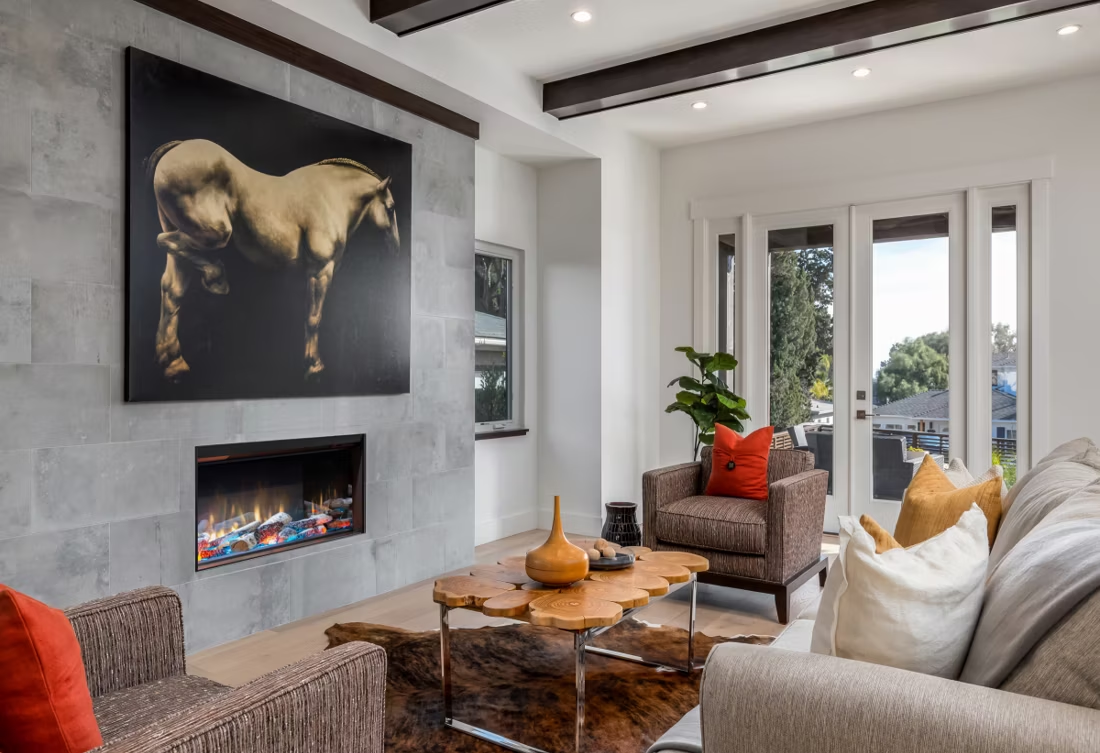
Three steps. No salesperson until you're ready.
Tell us about your project
Your zip code, your situation, and the fuel you're leaning toward—or let the answers point you to one.
See what's actually available
The brands dealers within 100 miles genuinely carry—real options, never a catalog mirage.
Get your dealer & Project Guide
A trusted local dealer, plus the free Project Guide & Parts List that names every component of the job.
Frequently Asked Questions
How much does it cost to install an electric fireplace in Cross Plains?
A plug-in mantel or wall-mount electric fireplace runs $300 to $1,500 installed, since most only need an existing outlet and a bracket. A built-in linear electric fireplace or a retrofit insert into an old masonry firebox typically lands between $1,500 and $4,000, mainly because it needs a dedicated 20-amp circuit run by a licensed electrician and, in some cases, minor framing or surround work. If the circuit work triggers a permit, it's handled through the Village of Cross Plains Building Inspection Department rather than Dane County, since the village is incorporated.
Do I need a permit for an electric fireplace in Cross Plains?
Not for a plug-in unit—there's no venting, no gas line, and no combustion appliance inspection involved. A permit only comes into play if your installer needs to add a new dedicated circuit or subpanel work to support a built-in unit, in which case a licensed electrician pulls an electrical permit through the Village of Cross Plains Building Inspection Department. This is a much lighter process than the building and mechanical permits required for a wood stove or gas insert.
What will an electric fireplace actually cost to run on my electric bill?
A typical 1,500-watt electric fireplace costs about $0.22 to $0.31 per hour to run, depending on which utility serves your address. On Rock Energy Cooperative's residential rate of roughly $0.145/kWh, that's about $0.22 an hour; on Wisconsin Power & Light's rate near $0.169/kWh it's about $0.25; on Madison Gas & Electric's higher rate of roughly $0.203/kWh it's closer to $0.31. Run six hours a night through a typical Cross Plains heating season and you're looking at somewhere between $195 and $275, depending on your provider—worth knowing before you decide whether an electric unit or a small ductless heat pump makes more sense for the space.
Which electric utility serves my home in Cross Plains?
Cross Plains is served by a mix of providers—Madison Gas & Electric in parts of the village, Wisconsin Power & Light (Alliant Energy) in others, and Rock Energy Cooperative reaching some rural Dane County addresses just outside the village limits. Check a recent bill to confirm which one serves your specific address, since the rate difference between them is real and worth factoring into which size or wattage unit you choose.
Electric vs. gas fireplace—which makes more sense for my Cross Plains home?
Gas is the better choice if you want a fireplace that can meaningfully offset furnace load in a main living area—natural gas service reaches much of the village, and a direct-vent gas insert puts out real heat, 20,000 to 30,000 BTU on many models, enough to take the edge off a Wisconsin cold snap. Electric makes more sense for rooms without a gas line or existing chimney: basements, additions, apartments above garages, or rental units where running new gas piping isn't practical. Plenty of Cross Plains homes end up with both—gas in the main room, electric in a secondary space.
Can an electric fireplace heat my whole house?
No, and it's worth being direct about that in a climate zone 6A location with winters in the same range as Minneapolis. A 1,500-watt electric fireplace produces around 5,100 BTU, enough to comfortably heat one room of 300 to 400 square feet, not a whole house. Think of it as zone heat that lets you turn the furnace down a couple degrees while you're using one room, not a furnace replacement. If you need more heating capacity than that, a ductless mini-split or a gas insert is a better fit.
Can I put an electric insert into my existing fireplace?
Yes—this is one of the more common projects local dealers see in older Cross Plains homes with an existing masonry firebox that's gone unused for years. An electric insert slides into the opening, uses the existing mantel and surround, and skips any chimney cleaning, creosote concerns, or flue repair that a wood-burning restart would require. It's a straightforward way to get a working, good-looking fireplace back without touching the chimney at all.
Will my electric fireplace work during a power outage?
No—unlike a wood stove, an electric fireplace has no output at all without power, since the heating element, blower, and flame effect all run on electricity. Given how exposed Cross Plains can be to winter storms and ice off the Blue Mounds ridge, it's worth having a backup heat plan for extended outages if the electric unit is your main source of supplemental warmth in a room. Most homeowners here treat it as convenient daily heat rather than emergency heat.
Why don't more homes in Cross Plains use wood or pellet stoves?
Wood and pellet appliances are genuinely uncommon within the village itself—lot sizes are tighter than the surrounding township, several newer developments carry deed restrictions on solid-fuel burning, and most homes are already piped for natural gas, which removes a lot of the practical reason to burn wood. Rural acreage owners just outside the village limits are more likely to run a wood stove, often using oak, maple, or birch cut locally. Inside Cross Plains proper, gas and electric are what local dealers install almost exclusively.
Can I put a TV above my fireplace?
Yes—with an asterisk. Fireplaces are hot and TVs don't like heat. Either put a mantel between them to deflect rising warmth, or choose a fireplace with heat-management technology that creates a cool zone on the wall above—the wall stays around 125 degrees, barely warm, while the room still gets full heat. If you like clean lines and don't want a mantel, heat management is the answer.
Do electric fireplaces actually produce heat?
Yes—most put out around 4,800–5,000 BTUs from a standard outlet, which comfortably warms a bedroom, office, or den as a comfort-zone heater. What they won't do is carry a whole house the way wood, gas, or pellet can. Think of electric as ambiance-first with honest supplemental heat: flames on with no heat in July, flames plus warmth in January.
Can a fireplace actually lower my heating bill?
Yes—by creating a comfort zone. A furnace heats every square foot of the house just to warm the one room you're in; a gas fireplace on low burns roughly a sixth of the gas a typical furnace does. Set the furnace around 55–60 degrees as a baseline, then heat the rooms your family actually uses. Families who heat this way commonly save $20–$60 a month.
Can I install a fireplace myself?
If you're putting a fire in your house on purpose, it's best to work with an expert. Unless you're genuinely experienced in framing, gas line, vent pipe, and the national code on clearances to combustibles, have a professional do it—and ideally the same company that sells you the fireplace, so warranty, service, and liability all live under one roof.
Nearby Dealers
Hearth shops serving Cross Plains and the surrounding area. Every listing shows whether it is a WhyFire partner, a dealer we have verified as authorized for the brands we recommend, or a local business carrying hearth products. No manufacturer pays for placement. How we verify dealers →
Fireside Hearth & Home - Madison
Dischler Heating – Cooling & Fireplaces, Inc.
Al Beyers Indoor Comfort System-Cambridge, Wi
Electric Service in Cross Plains
An electric fireplace's heater draws about 1,500 watts—pennies per hour at local rates.
Madison Gas & Electric Co
Wisconsin Power & Light Co
Rock Energy Cooperative
Find your electric fireplace in Cross Plains.
Tell us about the room, your utility, and your goals, and we'll put together a free Project Guide & Parts List—the right unit, the exact parts, and a recommended local dealer for your Cross Plains project.
Find Your Fireplace →