
Find a Gas Fireplace Built for Bristol's Cold.
With winter lows averaging 13°F and a heavy winter heating load, Bristol homes need reliable, instant heat. Find the right gas fireplace or insert and get matched with a trusted local dealer.
Every Project Starts From One of These Five Situations
Steady warmth without splitting a single log.
Bristol sits in southeastern Kenosha County just north of the Illinois state line, at roughly 760 feet elevation, where winters bring a heavy heating load—comparable to Madison, about 90 minutes north. Winter lows average 13°F, and cold snaps below zero aren't unusual between December and February. Most Bristol homes are newer construction on larger exurban lots along the I-94 corridor, and gas has become the default choice for supplemental and zone heat in living rooms and finished basements.
Wisconsin Electric Power Co (We Energies) serves natural gas to much of incorporated Kenosha County, and many newer Bristol subdivisions are on that gas main. Because the Town of Bristol remains largely unincorporated, though, plenty of rural parcels and farmsteads sit outside the gas main and run on propane instead—either way, a direct-vent gas fireplace or insert delivers heat at the flip of a switch, with none of the wood handling, ash cleanup, or chimney maintenance that's genuinely rare to see in this part of Kenosha County.
Three steps. No salesperson until you're ready.
Tell us about your project
Your zip code, your situation, and the fuel you're leaning toward—or let the answers point you to one.
See what's actually available
The brands dealers within 100 miles genuinely carry—real options, never a catalog mirage.
Get your dealer & Project Guide
A trusted local dealer, plus the free Project Guide & Parts List that names every component of the job.
Frequently Asked Questions
How much does a gas fireplace installation cost in Bristol?
Most gas fireplace and insert installations in the Bristol area run between roughly $3,800 and $9,500, depending on the unit, the venting run, and whether new gas line work is needed. A direct-vent gas fireplace going into a framed wall in a newer subdivision home, with a gas line already stubbed nearby, tends to land on the lower end. Projects that require a longer gas line run from the meter, a propane tank installation for homes off the We Energies gas main, or more complex venting through masonry or multiple floors push toward the higher end. A local dealer will give you a firm number after seeing the space.
Can I convert my existing wood fireplace to gas?
You can, though it's a less common project in Bristol than in older river towns nearby—most homes here were built after the era of open masonry wood fireplaces, so there are fewer existing chimneys to convert. For the farmhouses and older properties in the Town of Bristol that do have a masonry firebox, a gas insert with a stainless liner run up the existing flue is a straightforward upgrade, typically in the $4,500 to $9,000 range depending on chimney condition and whether the home is on natural gas or propane. For everyone else, a new direct-vent gas fireplace built into a framed wall is the more typical route.
Do I need natural gas, or should I plan on propane?
It depends on where in Bristol you're located. Homes in newer platted subdivisions closer to the I-94 corridor are often on the We Energies (Wisconsin Electric Power Co) natural gas main, which makes adding a fireplace simple if you already have gas appliances. Because much of the Town of Bristol is unincorporated rural land, a lot of farmsteads and larger-lot properties sit outside the gas main entirely and rely on a propane tank for heating appliances. Nearly every gas fireplace and insert on the market can be configured for either fuel—your installer sets the correct orifice and regulator—so the fireplace choice itself isn't limited by which fuel you're on.
Will my gas fireplace still work if the power goes out?
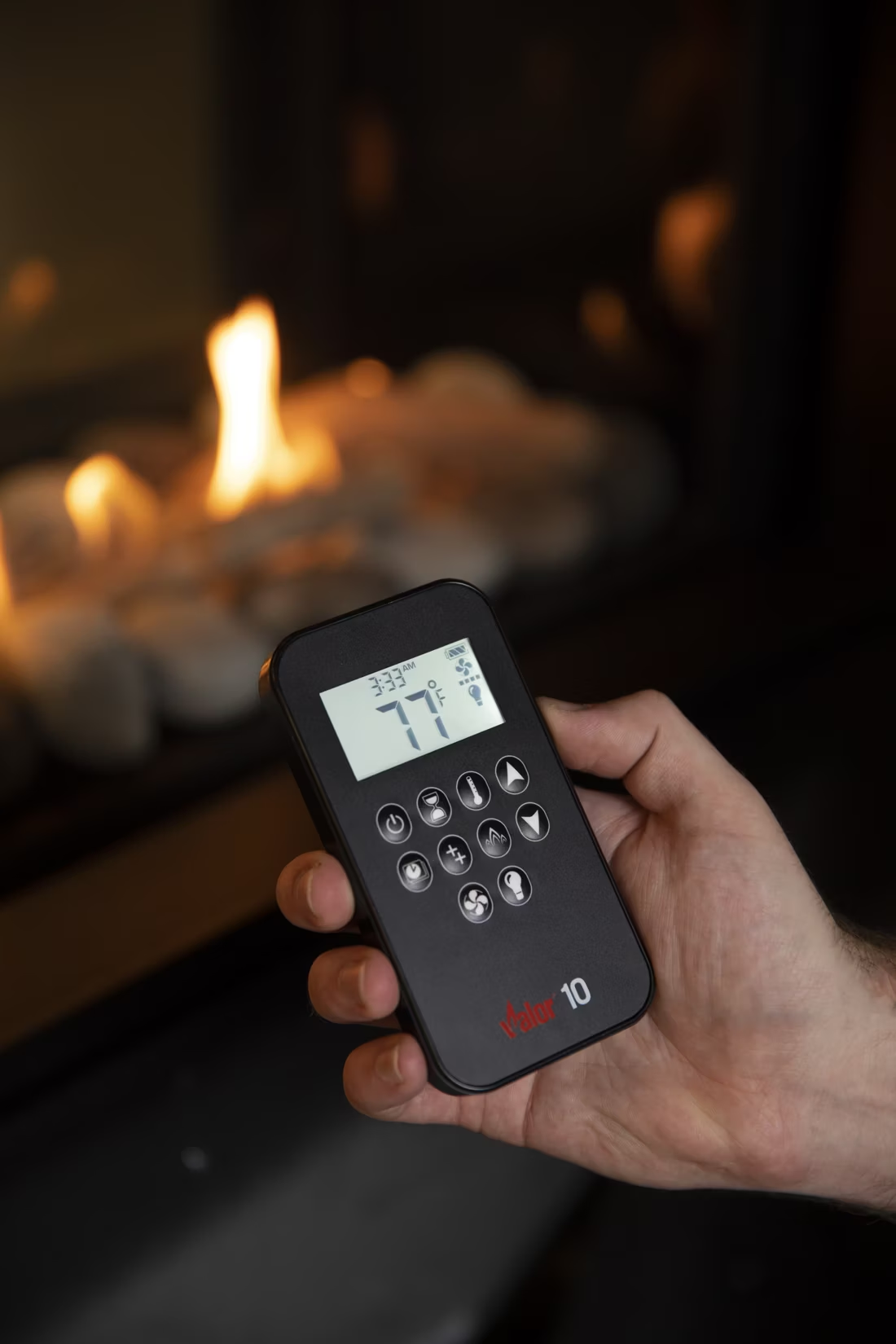
Most modern gas fireplaces will, which matters in Bristol—rural electric feeders here can take longer to restore after ice storms or high-wind events than in denser parts of Kenosha County. Units with IPI (intermittent pilot ignition) run on a battery backup, usually a few AA batteries inside the unit, that kicks in automatically and lets the fireplace light on demand even with no grid power. Valor's gas fireplaces go a step further: their on-demand pilot generates its own electricity through the thermocouple, so there are no batteries to remember at all. If backup heat during outages matters to you, ask your local dealer about the ignition system on any unit you're considering.
What's the difference between a gas fireplace, gas insert, and gas stove?
A gas fireplace is a fully built-in unit framed into a wall—the common choice for new construction and the newer subdivision homes that make up much of Bristol. A gas insert is sized to slide into an existing masonry firebox, which applies mainly to the town's older farmhouses. A gas stove is a freestanding cast-iron or steel unit that sits on the floor like a wood stove but burns gas, and it works well in a basement rec room or an addition without existing venting. Most Bristol projects are new-build direct-vent fireplaces, since relatively few homes here have an existing masonry chimney to work with.
Do I need a permit to install a gas fireplace in Bristol?
Yes. Because Bristol is an unincorporated town, permitting for gas fireplace installations runs through the Kenosha County Division of Planning and Development rather than a city building department, and both a building permit and a licensed gas-fitter's sign-off on the gas line are typically required. Most established hearth dealers handle the permit application and inspection scheduling as part of the installation, which is one reason to avoid a big-box or handyman install—coordinating the gas line, framing, and venting through one licensed contractor keeps the inspection process simple.
What's the difference between vented and vent-free gas fireplaces?
Vented (direct-vent) gas fireplaces pull combustion air from outside and exhaust the byproducts back outside through sealed pipe—they're the standard, code-friendly choice everywhere, including Bristol. Vent-free units burn gas directly into the room with no outside venting; they're legal under Wisconsin's Uniform Dwelling Code but come with strict room-size minimums, an oxygen depletion sensor, and ventilation requirements, and they're not permitted in bedrooms in many jurisdictions. Given how cold Bristol winters run and how much time families spend in closed-up living rooms during heating season, most local dealers steer homeowners toward direct-vent units for both comfort and indoor air quality.
How often should a gas fireplace be serviced?
Plan on an annual inspection, ideally in late summer or early fall before the first cold snap. A certified technician checks the burner, pilot assembly, venting, gas connections, and any battery backup or electronic ignition, and cleans the glass and interior. This runs far less involved than a wood chimney sweep, but skipping it is still the most common cause of ignition problems and inefficient burns going into a Wisconsin winter. Local gas appliance service providers in the Kenosha County area typically charge $150 to $250 for a standard annual visit.
Should I consider a wood-burning fireplace instead of gas?
For most Bristol homeowners, gas is the more practical answer. Wood-burning is genuinely uncommon here—the town's mostly newer housing stock means fewer existing chimneys, and the exurban subdivision layout doesn't lend itself to storing and splitting cordwood the way it might in a more rural, forested part of Kenosha County. There's no meaningful local firewood permit infrastructure or cutting season to speak of, even though oak, maple, birch, and aspen all grow regionally. A handful of larger rural properties in the Town of Bristol still run an outdoor wood boiler or an older farmhouse stove, but for the typical subdivision home, a direct-vent gas fireplace delivers comparable heat with none of the fuel handling.
Why is my open fireplace making my house colder?
Open fireplaces suck—literally. As the fire burns, it consumes air your furnace already paid to heat and pulls it out through the chimney, so the house is actually colder after the fire goes out than before you lit it. An insert fixes this: it seals the chimney, puts fixed glass across the front, and turns that hole in your house into a real heat source.
What's the difference between an insert and a zero-clearance fireplace?
An insert is a fireplace that slides into a pre-existing wood-burning fireplace—if you don't have one, there's nothing to insert it into. A zero-clearance fireplace is built into a framed wall, which makes it the answer for remodels and new construction. Simple test: existing masonry fireplace means insert; blank or framed wall means zero-clearance.
Can a fireplace actually lower my heating bill?
Yes—by creating a comfort zone. A furnace heats every square foot of the house just to warm the one room you're in; a gas fireplace on low burns roughly a sixth of the gas a typical furnace does. Set the furnace around 55–60 degrees as a baseline, then heat the rooms your family actually uses. Families who heat this way commonly save $20–$60 a month.
How much should I budget for a fireplace?
For an average home—covering the fireplace, the vent pipe, and basic installation—a budget between $3,900 and $5,500 gives you a lot of options across wood, gas, and pellet. By the time you add finish work, gas line, and electrical, the average complete installation lands between $5,000 and $12,000 all-in. In a remodel or new build, a good rule is to put about 2.5% of the total project cost toward the fireplace.
Nearby Dealers
Hearth shops serving Bristol and the surrounding area. Every listing shows whether it is a WhyFire partner, a dealer we have verified as authorized for the brands we recommend, or a local business carrying hearth products. No manufacturer pays for placement. How we verify dealers →
Alaskan Fireplace Co
Smokin' Deal Bbq
Fireplaces Plus
Lakeside Fireplace
Lakes Brick & Block
Fireplace And Patio
Find your gas fireplace in Bristol.
Tell us about your home and we'll match you with a trusted local dealer and send over a free Project Guide & Parts List—the exact gas fireplace, insert, or stove for your space, the venting it needs, and who to call in the Bristol area to install it.
Find Your Fireplace →