
Real warmth for one room in Black Earth, no chimney required.
Zone heat and ambiance for Dane County's cold stretch of winter—find the right electric unit and find a trusted local dealer.
Every Project Starts From One of These Five Situations
Supplemental heat for a climate with a long, seriously cold winter.
Black Earth sits in the Driftless region of Dane County at about 824 feet, where winter lows average 7°F and the village logs a long, cold heating season—in the same range as Duluth, Minnesota. That's serious cold, and it's worth being direct about what an electric fireplace can and can't do here: it will not replace your furnace or heat pump as primary heat. What it does well is add fast, controllable warmth to a single room—a finished basement, a three-season porch that got closed in, a bedroom, a home office—without combustion, venting, or a flue running through the roof.
That no-venting advantage matters more than it sounds. A plug-in electric insert or a hardwired linear unit can go into an interior wall, a converted garage, or a rental where cutting a chimney chase simply isn't an option. Electric service in Black Earth comes through Wisconsin Power & Light (Alliant Energy), Rock Energy Cooperative, or the Village of Black Earth's own municipal utility depending on where you sit—and residential rates between those providers run from about $0.1447 to $0.1689 per kWh, which is worth checking before you settle on a wattage and run-time budget for daily use.
Three steps. No salesperson until you're ready.
Tell us about your project
Your zip code, your situation, and the fuel you're leaning toward—or let the answers point you to one.
See what's actually available
The brands dealers within 100 miles genuinely carry—real options, never a catalog mirage.
Get your dealer & Project Guide
A trusted local dealer, plus the free Project Guide & Parts List that names every component of the job.
Frequently Asked Questions
How much does an electric fireplace installation cost in Black Earth?
A basic plug-in electric insert or wall-mount unit that uses an existing standard outlet can run as little as $300 to $800 installed, since there's no gas line, no venting, and often no permit involved. A built-in linear electric fireplace that requires a dedicated 240V circuit and an electrician to run new wiring typically lands between $1,200 and $2,500, depending on the unit size and how far the panel is from the install location. Local dealers can tell you within a few minutes of looking at your electrical panel which tier your project falls into.
Will an electric fireplace actually heat my house through a Black Earth winter?
Not on its own. With average winter lows around 7°F and a long, cold heating season, Black Earth homes need a furnace or heat pump doing the real work. An electric fireplace is built to heat a single room—most units put out around 4,000 to 5,000 BTU (roughly 1,500 watts), enough to noticeably warm a bedroom, den, or finished basement space but not a whole house. Think of it as zone heat you can leave off most of the year and turn on for the room you're actually sitting in, which also saves on whole-house heating costs during shoulder seasons.
Does it matter which electric utility serves my home in Black Earth?
It affects your operating cost more than most people expect. Wisconsin Power & Light (Alliant Energy) and Rock Energy Cooperative serve different parts of the area around the village, and the Village of Black Earth also runs its own municipal electric utility for in-town customers. Residential rates run from roughly $0.1447 to $0.1689 per kWh depending on which of the three serves your address. A 1,500-watt unit run for 6 hours a day costs somewhere between $16 and $19 a month depending on your provider—small, but worth knowing before you decide how often you'll run it.
Do I need a permit to install an electric fireplace in Black Earth?
A simple plug-in electric insert that uses an existing outlet generally doesn't require a building permit—it's treated like any other appliance. If you're having a hardwired unit installed on a new dedicated 240V circuit, the electrical work itself needs to meet code and is typically pulled by the licensed electrician doing the wiring, whether that's coordinated through the Village of Black Earth or Dane County depending on your address. Local dealers who install electric fireplaces regularly will know exactly which permit path applies to your specific situation.
Electric vs. wood—which makes more sense for my home?
Wood is the better choice if you want real backup heat during a power outage—a stove burning local oak, maple, birch, or aspen keeps working when the grid doesn't, which matters in a climate that sees ice storms and hard cold. An electric fireplace, by contrast, goes dark the moment the power does, since it has no independent fuel source. What electric offers instead is zero maintenance, no chimney, no ash, and instant on/off control—genuinely useful for a room where you want ambiance and quick warmth without the commitment of tending a fire. Plenty of Black Earth homes end up with wood or a pellet stove for real winter resilience and an electric unit somewhere else in the house purely for convenience.
Electric vs. pellet stove—what's the real difference for a room like mine?
A pellet stove burns compressed wood pellets—regionally available from brands like Indeck Energy Services, Lignetics, and Somerset Pellet Fuel—and puts out genuine heat output, enough to serve as a primary or near-primary heat source for a zone of the house, but it needs venting, a hopper to refill, and periodic ash removal. An electric fireplace needs none of that: no venting, no fuel deliveries, no ash, just a wall outlet or a dedicated circuit. The tradeoff is heat output and independence from the grid—pellet stoves put out more real heat and most models can run on a small battery backup during an outage, while electric units are convenience-first and stop working when the power does.
What rooms make the most sense for an electric fireplace in a home like mine?
Finished basements are a common fit in this area—no flue to run up through two stories, and basements tend to run cooler in a 7°F-average winter, so the added warmth is genuinely useful. Three-season porches that have been closed in, home offices, and bedrooms are also popular choices, since a plug-in or built-in unit gives you supplemental heat without touching the home's existing HVAC or venting. Attached garages converted to living space are another good candidate, especially where running gas or a wood flue would be impractical.
How much does it actually cost to run an electric fireplace here?
Most electric fireplaces draw about 1,500 watts on the heat setting (less on ambiance-only/flame mode with the heater off). At Rock Energy Cooperative or Alliant Energy rates near $0.1689 per kWh, running the heater for 6 hours a day costs roughly $15 to $16 a month; at the Village of Black Earth's municipal rate closer to $0.1447 per kWh, that drops to around $13. Running the unit on flame-only mode without the heater element costs only a few cents an hour, which is why many owners use it for ambiance on mild evenings and save the heat setting for genuinely cold nights.
What features actually matter when choosing an electric fireplace or insert?
Look for a unit with a built-in thermostat rather than a simple high/low switch—it cycles the heater on and off to hold a set temperature instead of running full blast constantly, which saves on your electric bill. A separate control for flame effect versus heat matters too, since it lets you run ambiance without the heater in shoulder-season months. For hardwired installs, confirm the unit's amperage draw against what your electrician is running on the new circuit. Local dealers can walk you through wattage and control options based on the specific room you're heating.
Can I put a TV above my fireplace?
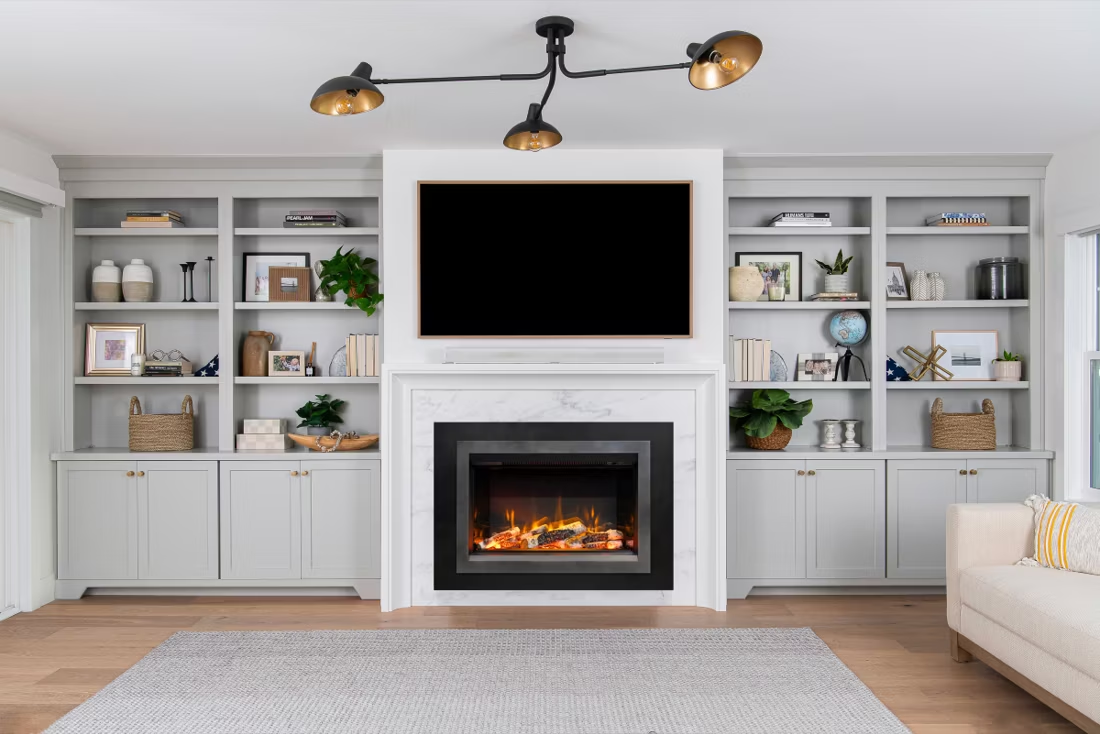
Yes—with an asterisk. Fireplaces are hot and TVs don't like heat. Either put a mantel between them to deflect rising warmth, or choose a fireplace with heat-management technology that creates a cool zone on the wall above—the wall stays around 125 degrees, barely warm, while the room still gets full heat. If you like clean lines and don't want a mantel, heat management is the answer.
Does an electric fireplace need a vent or chimney?
No—that's its superpower. An electric fireplace needs a wall and an outlet, period. No vent pipe, no gas line, no clearances to design around, which is why it works in bedrooms, offices, apartments, and walls where venting a gas or wood unit would be impractical or impossible. Installation is typically the simplest and least expensive of any fireplace type.
Can a fireplace actually lower my heating bill?
Yes—by creating a comfort zone. A furnace heats every square foot of the house just to warm the one room you're in; a gas fireplace on low burns roughly a sixth of the gas a typical furnace does. Set the furnace around 55–60 degrees as a baseline, then heat the rooms your family actually uses. Families who heat this way commonly save $20–$60 a month.
Does a fireplace add value to my home?
On average, a fireplace adds back to the home about the same amount you spent installing it. Add the monthly savings from heating the rooms you actually use instead of the whole house—often hundreds of dollars a year—and the value case is strong before you even count what a fire does for how your family uses the room.
Nearby Dealers
Hearth shops serving Black Earth and the surrounding area. Every listing shows whether it is a WhyFire partner, a dealer we have verified as authorized for the brands we recommend, or a local business carrying hearth products. No manufacturer pays for placement. How we verify dealers →
We’ve paused dealer listings for this connection today. Enter your zip or postal code above to find dealers near you, or come back tomorrow.
Popular Electric Brands
Where each brand came from, what's inside it today, and every current model. No brand pays to be here. Not every dealer carries every brand, so enter your zip code to see what's sold near Black Earth.
Fireplace Xtrordinair
Fireplace Xtrordinair, now often called FireplaceX, is the fireplace brand of Travis Industries, Inc., of Mukilteo, Washington.
5 electric models →DaVinci
DaVinci Custom Fireplaces is a brand of Travis Industries, Inc., of Mukilteo, Washington, the company behind Lopi and Fireplace Xtrordinair.
5 electric models →Kozy Heat
Kozy Heat was founded in 1976 by Dudley Hussong in Lakefield, Minnesota, and incorporated as Hussong Manufacturing Co., Inc. in 1978.
3 electric models →Forge & Flame
Forge & Flame is the stove brand Hearth & Home Technologies introduced in August 2023 to bring Vermont Castings, Harman, and Quadra-Fire under one name.
1 electric model →Electric Service in Black Earth
An electric fireplace's heater draws about 1,500 watts—pennies per hour at local rates.
Wisconsin Power & Light Co
Rock Energy Cooperative
Village Of Black Earth - (Wi)
Find your electric fireplace in Black Earth.
Tell us about the room you're heating and we'll help you find a trusted local dealer and send over a free Project Guide & Parts List—sized to your space and your electrical setup.
Find Your Fireplace →