
Real heat, no chimney, no gas line, no permit hassle.
An electric insert or wall unit adds instant zone heat to a Nutter Fort bedroom, addition, or older home in an afternoon. Find the right unit and connect with a trusted local dealer.
Every Project Starts From One of These Five Situations
The fastest way to add heat to a room that never quite warms up.
Nutter Fort sits at just over 1,000 feet in Harrison County, in a climate zone (5A) with a winter roughly on par with Madison, WI, with average lows settling around 22°F. That's cold enough to matter, but not the kind of extreme where a home needs a whole-house wood or pellet setup. It's the kind of climate where a lot of homes—especially the older housing stock common in this part of north-central West Virginia—have one or two rooms that central heat never quite reaches: a converted attic bedroom, a sunroom addition, a mobile home in one of the town's residential pockets. That's exactly the gap an electric fireplace is built to fill.
Most of Nutter Fort is served by Monongahela Power, with Harrison Rural Electric Association covering some of the surrounding county—and at a residential rate around $0.14 per kWh, running an electric insert for zone heat is cheap enough to leave on for hours without thinking twice. No chimney, no gas line, no venting, and in most cases no building permit at all—an electrician adds a dedicated circuit if the unit calls for one, and you're done. It's the lowest-friction way to get real supplemental warmth into a specific room, or simply the look and glow of a fire in a rental or a home where running a flue isn't practical.
Three steps. No salesperson until you're ready.
Tell us about your project
Your zip code, your situation, and the fuel you're leaning toward—or let the answers point you to one.
See what's actually available
The brands dealers within 100 miles genuinely carry—real options, never a catalog mirage.
Get your dealer & Project Guide
A trusted local dealer, plus the free Project Guide & Parts List that names every component of the job.
Frequently Asked Questions
How much does an electric fireplace installation cost in Nutter Fort?
A plug-in electric insert or freestanding unit—the kind that slides into an existing fireplace opening or sits in a media console—typically runs $150 to $600 for the unit itself, plug it into an existing outlet and you're heating that evening. A built-in wall unit or a mantel package that needs a dedicated 20-amp circuit run by an electrician usually lands between $800 and $2,500 installed, depending on how far the wiring has to run and whether a wall needs to be opened up. Either way, electric is the cheapest of the hearth fuels to install in a Nutter Fort home because there's no chimney, no gas line, and no masonry work involved.
Do I need a permit to install an electric fireplace in Nutter Fort?
In most cases, no—a plug-in electric insert or freestanding unit doesn't require a permit because there's no venting or gas work involved. If you're adding a built-in wall unit that requires a new dedicated circuit, that electrical work typically does need to be pulled through Harrison County's permitting process and completed by a licensed electrician, mainly so the wiring gets inspected. It's a much lighter lift than the building and mechanical permits required for a wood or gas installation—most electric projects are done in a day.
Can an electric fireplace actually heat a room in Nutter Fort's winters?
For zone heating, yes. A typical electric insert puts out around 5,000 BTU (roughly 1,500 watts), enough to comfortably warm a bedroom, home office, or small addition—the kind of space that struggles to hold heat when overnight lows average 22°F. What it won't do is replace central heat for an entire home; electric fireplaces are built as supplemental or occasional-use heat, not a whole-house solution. For a drafty older Harrison County home with one persistently cold room, that's usually exactly the job it needs to do.
What does it cost to run an electric fireplace here?
At Monongahela Power's residential rate of roughly $0.14 per kWh, a standard 1,500-watt electric fireplace running on its heat setting costs about 21 cents an hour to operate. Left running for a full evening—say 6 to 8 hours—that's roughly $1.25 to $1.70. Compare that to keeping a whole zone of a house heated by a furnace working overtime, and it's easy to see why electric inserts are popular for supplemental heat in one or two rooms rather than running the furnace harder to compensate.
Electric vs. gas—which is right for my Nutter Fort home?
Gas fireplaces and inserts are common in this area and deliver real heat output—enough to serve as a primary heat source for a living room in a cold winter—but they require a gas line, venting, and a more involved installation running well into the thousands of dollars. Electric fireplaces skip all of that: no gas line, no venting, no combustion byproducts, and a fraction of the install cost, but the tradeoff is lower heat output and a supplemental rather than primary role. If you're heating a whole main living space through a West Virginia winter, gas is usually the better fit. If you need warmth in a specific room, a rental, or a space where running gas or a flue isn't practical, electric wins on cost and simplicity.
What about a wood stove instead—Harrison County has plenty of firewood?
It's true that oak, hickory, maple, and cherry are all common locally, and Monongahela National Forest permits allow cutting for around $20 a cord from May through October. But a wood stove is a much bigger project—a chimney or Class A venting, hearth clearances, and a building permit—and for a lot of Nutter Fort homes, particularly smaller lots and older houses in town, that infrastructure isn't already in place. An electric insert gets you the visual warmth and glow of a fire without any of that construction, which is why it's often the more practical choice here even in a region with wood-burning heritage.
What's the difference between an electric insert, a built-in wall unit, and a freestanding electric stove?
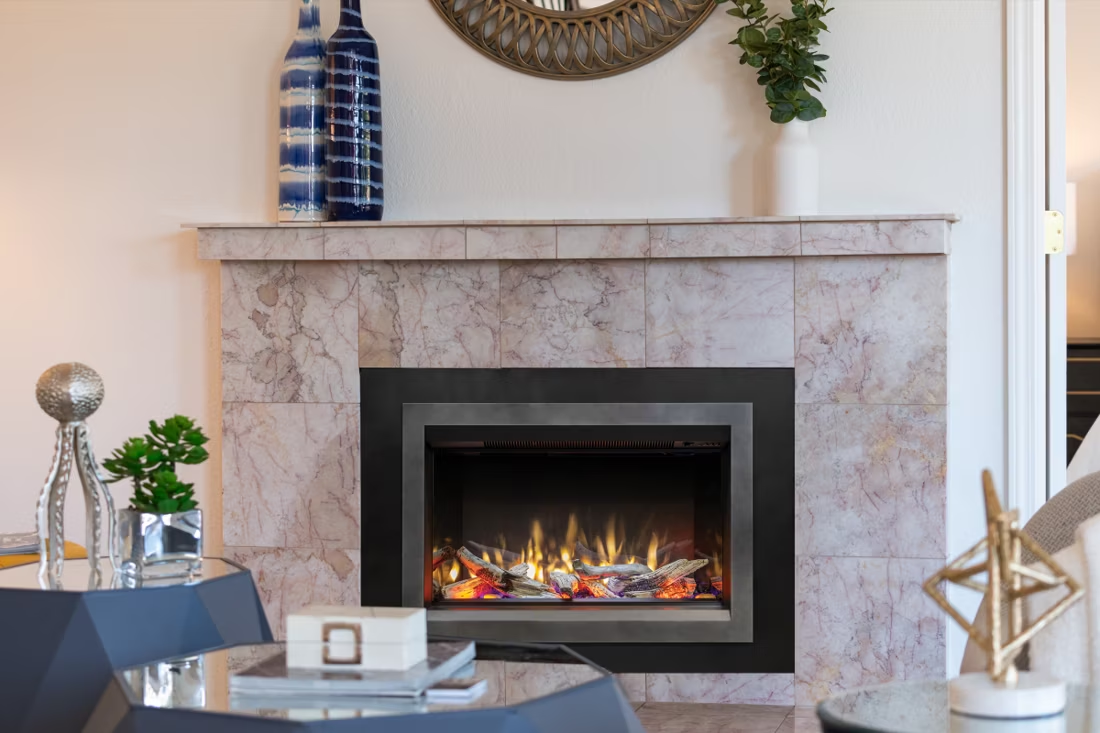
An electric insert is designed to slide into an existing fireplace opening, giving an old masonry fireplace a heat source and a flame effect without any venting work. A built-in wall unit is framed into new construction or a remodeled wall, usually wired to a dedicated circuit, and looks like a true linear fireplace. A freestanding electric stove sits on the floor like a wood stove and plugs into a standard outlet—no framing or electrical work required at all. For a Nutter Fort home with an existing fireplace opening, an insert is usually the simplest upgrade; for a room with no fireplace at all, a freestanding stove is the fastest path to heat.
Which electric utility serves Nutter Fort, and does it matter for a fireplace install?
Most of Nutter Fort is served by Monongahela Power, while Harrison Rural Electric Association covers some surrounding pockets of the county. It matters mainly if you're adding a built-in unit that needs a new dedicated circuit—your electrician will confirm your service panel has the capacity, and co-op customers occasionally have different inspection timelines than investor-owned utility customers. For a simple plug-in insert, it doesn't matter at all; any standard outlet on either provider's grid will run it.
Do electric fireplaces work during a power outage?
No—this is the one real tradeoff worth knowing. Electric fireplaces need power to run the heating element, blower, and flame effect, so during an outage they go dark along with everything else. That's different from a wood stove, which can be the one heat source in the house that keeps working when the lines go down—a real consideration in Harrison County, where winter storms occasionally knock out power for a day or more. If backup heat during outages matters to you, an electric fireplace should be a supplement to, not a replacement for, another heat source.
Can I put a TV above my fireplace?
Yes—with an asterisk. Fireplaces are hot and TVs don't like heat. Either put a mantel between them to deflect rising warmth, or choose a fireplace with heat-management technology that creates a cool zone on the wall above—the wall stays around 125 degrees, barely warm, while the room still gets full heat. If you like clean lines and don't want a mantel, heat management is the answer.
Does an electric fireplace need a vent or chimney?
No—that's its superpower. An electric fireplace needs a wall and an outlet, period. No vent pipe, no gas line, no clearances to design around, which is why it works in bedrooms, offices, apartments, and walls where venting a gas or wood unit would be impractical or impossible. Installation is typically the simplest and least expensive of any fireplace type.
How much should I budget for a fireplace?
For an average home—covering the fireplace, the vent pipe, and basic installation—a budget between $3,900 and $5,500 gives you a lot of options across wood, gas, and pellet. By the time you add finish work, gas line, and electrical, the average complete installation lands between $5,000 and $12,000 all-in. In a remodel or new build, a good rule is to put about 2.5% of the total project cost toward the fireplace.
Can a fireplace actually lower my heating bill?
Yes—by creating a comfort zone. A furnace heats every square foot of the house just to warm the one room you're in; a gas fireplace on low burns roughly a sixth of the gas a typical furnace does. Set the furnace around 55–60 degrees as a baseline, then heat the rooms your family actually uses. Families who heat this way commonly save $20–$60 a month.
Nearby Dealers
Hearth shops serving Nutter Fort and the surrounding area. Every listing shows whether it is a WhyFire partner, a dealer we have verified as authorized for the brands we recommend, or a local business carrying hearth products. No manufacturer pays for placement. How we verify dealers →
We’ve paused dealer listings for this connection today. Enter your zip or postal code above to find dealers near you, or come back tomorrow.
Popular Electric Brands
Where each brand came from, what's inside it today, and every current model. No brand pays to be here. Not every dealer carries every brand, so enter your zip code to see what's sold near Nutter Fort.
Fireplace Xtrordinair
Fireplace Xtrordinair, now often called FireplaceX, is the fireplace brand of Travis Industries, Inc., of Mukilteo, Washington.
5 electric models →DaVinci
DaVinci Custom Fireplaces is a brand of Travis Industries, Inc., of Mukilteo, Washington, the company behind Lopi and Fireplace Xtrordinair.
5 electric models →Kozy Heat
Kozy Heat was founded in 1976 by Dudley Hussong in Lakefield, Minnesota, and incorporated as Hussong Manufacturing Co., Inc. in 1978.
3 electric models →Forge & Flame
Forge & Flame is the stove brand Hearth & Home Technologies introduced in August 2023 to bring Vermont Castings, Harman, and Quadra-Fire under one name.
1 electric model →Electric Service in Nutter Fort
An electric fireplace's heater draws about 1,500 watts—pennies per hour at local rates.
Monongahela Power Co
Harrison Rural Elec Assn, Inc
Find your electric fireplace in Nutter Fort.
Tell us a bit about your home and the room you're trying to heat, and we'll put together a free Project Guide & Parts List—the right unit, the electrical work it needs, and a trusted local dealer to install it.
Find Your Fireplace →