
Find the right electric fireplace for your Palouse home.
No venting, no gas line, no chimney sweep—just clean ambient heat for homes, rentals, and apartments across Pullman, Colfax, and the rolling wheat country between. Find the right unit and connect with a trusted local dealer.
Every Project Starts From One of These Five Situations
Clean heat with no chimney, no gas line, and no smoke.
Whitman County spans roughly 2,150 square miles of rolling Palouse wheat hills in southeastern Washington, anchored by Pullman—home to Washington State University—and the county seat of Colfax. At 2,300 to 2,600 feet of elevation, winter lows here average around 26°F and the county has a winter heating season similar in length and severity to Fargo, North Dakota, putting it in the same general cold-climate range. Add the wind that sweeps unobstructed across open farmland, and a room can feel colder than the thermometer suggests. That combination of a large student rental population, older farmhouses, and newer subdivisions means demand for heat that doesn't require a masonry chimney, a gas line, or a wood pile.
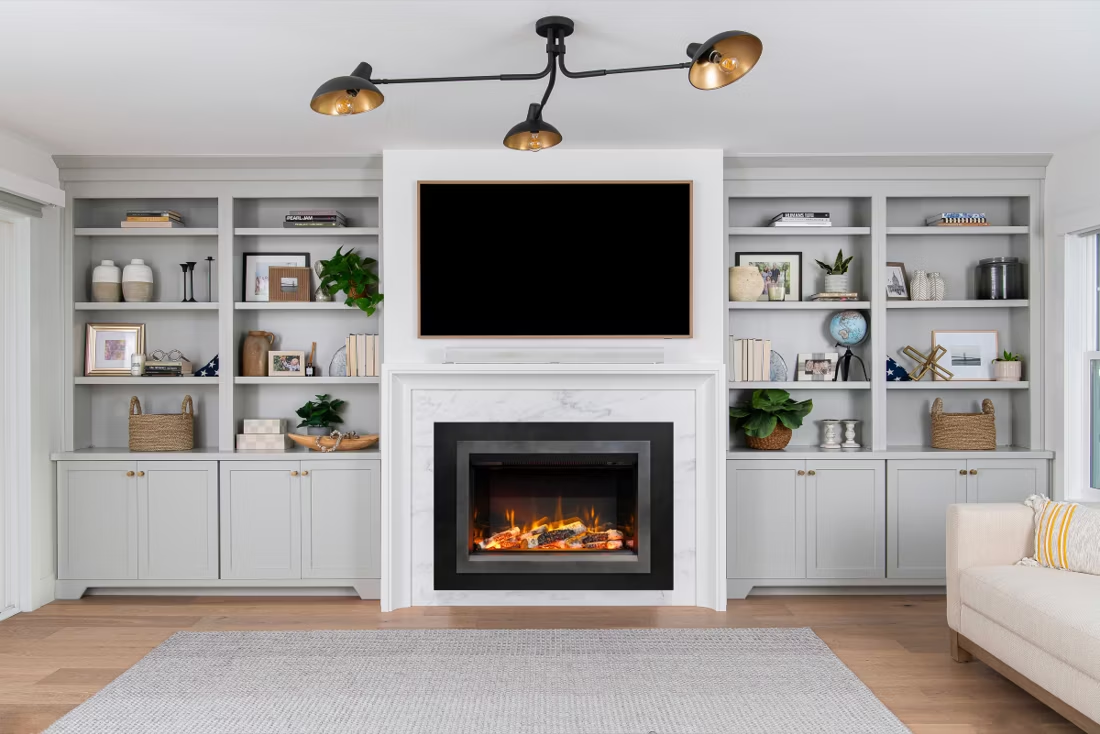
Electric fireplaces fit that gap well. A plug-in insert or built-in wall unit installs into an existing fireplace opening, a bookshelf, or a bedroom wall without any venting at all—which matters in a county where a meaningful share of housing near WSU is rental stock and landlords don't want gas work or chimney liability. Electric also has an edge locally during the Palouse's summer wildfire smoke season: it produces zero combustion byproducts, so it's the one hearth option that never adds to indoor particulate load when regional smoke is already thick outside. Whitman County's electric service, largely through Avista Utilities in and around Pullman and Colfax, comfortably supports both standard 120-volt plug-in units and the dedicated 240-volt circuits that higher-output built-ins need.
Three steps. No salesperson until you're ready.
Tell us about your project
Your zip code, your situation, and the fuel you're leaning toward—or let the answers point you to one.
See what's actually available
The brands dealers within 100 miles genuinely carry—real options, never a catalog mirage.
Get your dealer & Project Guide
A trusted local dealer, plus the free Project Guide & Parts List that names every component of the job.
Frequently Asked Questions
How much does an electric fireplace installation cost in Whitman County?
A basic plug-in electric insert or freestanding unit runs $150 to $600 for the unit itself, and it typically just plugs into an existing 120-volt outlet—no installation labor required beyond mounting. A built-in wall unit or a linear electric fireplace set into new framing runs higher, generally $1,500 to $3,500 once you include a licensed electrician running a dedicated 240-volt circuit, wall framing or trim carpentry, and the unit itself. Retrofitting an electric insert into an existing masonry fireplace opening in an older Colfax or Pullman farmhouse tends to land in the middle of that range, since the opening is already there but the wiring usually isn't.
What's the difference between a plug-in electric fireplace and a built-in electric insert?
A plug-in electric fireplace is a self-contained unit—freestanding, wall-mounted, or a simple insert—that runs off a standard 120-volt outlet and can be unplugged and moved if you relocate, which makes it a popular choice for WSU-area rentals in Pullman where tenants don't want to alter the unit's wiring. A built-in electric insert or linear fireplace is wired into a dedicated circuit, usually 240 volts for higher heat output, and is installed more permanently into a wall or existing fireplace opening. Built-ins generally throw more heat and offer a cleaner, flush look, but they require an electrician and, in most cases, a permit for the new circuit.
Will my electric fireplace work during a power outage?
No—and this is the honest tradeoff worth understanding before you buy. Electric fireplaces need grid power to run the heating element and, on most models, the flame-effect display. Whitman County sees its share of winter power outages from ice and high wind moving across open Palouse farmland, sometimes lasting hours in rural areas outside Pullman and Colfax. If backup heat during an outage matters to you, a wood stove or a gas unit with battery-backup ignition is a better primary choice, with electric reserved for supplemental warmth and ambiance the rest of the time.
Are electric fireplaces a good fit for WSU-area rentals and apartments in Pullman?
Yes—electric is generally the best hearth option for rental housing near Washington State University. A plug-in insert or wall-mounted unit requires no venting, no gas line, and no permanent alteration to the property, which is exactly what most landlords in the Pullman rental market will allow. Tenants can take a portable unit with them at lease-end, and there's no chimney or flue for a property owner to maintain between tenants. For owner-occupied homes, a built-in unit offers more heat output and a more finished look, but for rentals specifically, plug-in electric is the low-friction choice.
Do I need a permit for an electric fireplace in Whitman County?
A standard plug-in electric fireplace that uses an existing 120-volt outlet typically doesn't require a permit—it's treated like any other plug-in appliance. If you're installing a built-in unit that needs a new dedicated 240-volt circuit, that electrical work generally does require a permit and should be done by a licensed electrician, whether the home is inside Pullman or Colfax city limits or in unincorporated Whitman County. Most electricians who handle these installs will pull the permit as part of the job, so you don't have to coordinate it yourself.
How much does it cost to run an electric fireplace?
Most electric fireplaces draw around 1,500 watts on the heat setting (roughly 5,100 BTU), which is fairly standard whether it's a plug-in insert or a built-in unit. At typical eastern Washington electric rates through Avista Utilities, running a 1,500-watt unit for several hours an evening costs somewhere in the range of a dollar or two a day—meaningfully cheaper to operate than most people expect, though it's worth remembering that output is modest compared to a wood stove or gas insert. It works well as supplemental heat for a single room in a Palouse winter, but it's not going to carry an entire farmhouse through a 26-degree night on its own.
Electric vs. gas vs. wood—which is right for my Palouse home?
Wood offers the most heat per dollar and keeps working when the power doesn't, which matters given how ice and wind can knock out rural lines across Whitman County's open farmland—and with ponderosa pine, lodgepole pine, and Douglas fir all available locally through cutting permits from the Nez Perce-Clearwater National Forests, BLM Spokane District, or Idaho Panhandle National Forests, self-cut firewood is a realistic option for rural households. Gas delivers instant, consistent heat without wood handling. Electric is the cleanest and easiest to install, with zero venting and zero combustion emissions—a real advantage during Palouse wildfire smoke season—but it depends entirely on grid power and puts out the least heat of the three. Many Whitman County homes end up with a primary heat source (wood or gas) plus an electric unit in a secondary room, like a converted den or a bedroom, for supplemental warmth and ambiance.
Can an electric fireplace actually heat a whole room in a cold Whitman County winter?
For a well-insulated, average-sized bedroom or den, a 1,500-watt electric unit can serve as the primary heat source on milder days. But with winter lows averaging around 26°F and a winter heating season comparable in length and severity to a place like Fargo, North Dakota, electric alone typically isn't enough for a whole living area or an older, less-insulated farmhouse on the coldest nights. Most homeowners here use electric as supplemental heat layered on top of a furnace, wood stove, or gas fireplace rather than as the sole heat source for the home.
What size electric fireplace do I need?
Sizing an electric fireplace is mostly about the space you're trying to warm and the look you want, since wattage is fairly standardized around 1,500 watts across most models regardless of the unit's physical size. A compact 30- to 40-inch insert suits a bedroom or small den common in older Colfax homes, while a 50-inch or larger linear unit fits better as a focal point in an open-concept living room in newer Pullman construction. Because the heating capacity doesn't scale much with size, bigger units are chosen more for visual impact than for additional warmth—a local retailer can walk you through both the heat output and the sightline for your specific room.
Can I put a TV above my fireplace?
Yes—with an asterisk. Fireplaces are hot and TVs don't like heat. Either put a mantel between them to deflect rising warmth, or choose a fireplace with heat-management technology that creates a cool zone on the wall above—the wall stays around 125 degrees, barely warm, while the room still gets full heat. If you like clean lines and don't want a mantel, heat management is the answer.
Do electric fireplaces actually produce heat?
Yes—most put out around 4,800–5,000 BTUs from a standard outlet, which comfortably warms a bedroom, office, or den as a comfort-zone heater. What they won't do is carry a whole house the way wood, gas, or pellet can. Think of electric as ambiance-first with honest supplemental heat: flames on with no heat in July, flames plus warmth in January.
How much should I budget for a fireplace?
For an average home—covering the fireplace, the vent pipe, and basic installation—a budget between $3,900 and $5,500 gives you a lot of options across wood, gas, and pellet. By the time you add finish work, gas line, and electrical, the average complete installation lands between $5,000 and $12,000 all-in. In a remodel or new build, a good rule is to put about 2.5% of the total project cost toward the fireplace.
What is an in-home preview and do I need one?
It's a visit where a hearth professional measures your space, confirms the model you picked actually works in your home, and walks the specs—framing, gas line, venting, finish work—before anything is ordered. Some details you just can't know until you see the house. Never make a down payment without one; it's the single most-skipped step that burns buyers.
Stove and Fireplace Dealers in Whitman County
Listings include WhyFire partner dealers, dealers we have verified as authorized for the brands we recommend, and established local businesses that carry hearth products. Every listing shows which one it is. The ones marked Preferred run on WhyFire's software, so they can show you real pricing and book your appointment right here. No manufacturer pays for placement. How we verify dealers →
Pullman Heating
Hemphill Heating And Electric LLC
Panhandle Heating Solutions LLC
Moscow Building Supply
Find your electric fireplace in Whitman County.
Tell us a bit about your home and we'll match you with the right electric fireplace or insert, then send you a free Project Guide & Parts List—the exact parts for your project and a trusted local dealer to install it.
Find Your Fireplace →