
Clean, no-chimney electric heat for Lincoln County homes.
From Davenport to Sprague to Odessa, electric fireplaces give Lincoln County farmhouses and remodels a clean, zone-heat option with no venting or gas line required. Find the right unit and connect with a trusted local dealer.
Every Project Starts From One of These Five Situations
Zone heat that installs without a chimney or a gas line.
Lincoln County spreads about 2,300 square miles of wheat country across the Channeled Scablands between Spokane and the Columbia River, with roughly 5,700 residents scattered among Davenport, Sprague, Odessa, Harrington, Reardan, Almira, Wilbur, and Creston. With a long, cold winter season and a 19-degree average winter low, this stretch of eastern Washington runs colder and windier than most people assume of the state—closer in feel to the exposed, treeless winters of Fargo, ND than to the wet mild coast most outsiders picture. Wind across open wheat fields makes drafts and heat loss a real issue in older farmhouses, and that's part of why electric heat has found a steady place here alongside wood and propane.
Most of Lincoln County runs on rural electric cooperative service rather than a big investor-owned utility, and there's no natural gas distribution system out here—propane and wood carry most of the primary heating load. Electric fireplaces and inserts fill a different role: clean, no-emissions zone heat for a living room, a converted sunporch, or a manufactured home where running a chimney or a new gas line isn't practical. They're also useful during the wildfire-smoke stretches of late summer, when adding more combustion indoors is the last thing anyone wants, and during shoulder-season months when firing up the wood stove or propane furnace feels like overkill for a 20-degree evening drop.
Three steps. No salesperson until you're ready.
Tell us about your project
Your zip code, your situation, and the fuel you're leaning toward—or let the answers point you to one.
See what's actually available
The brands dealers within 100 miles genuinely carry—real options, never a catalog mirage.
Get your dealer & Project Guide
A trusted local dealer, plus the free Project Guide & Parts List that names every component of the job.
Frequently Asked Questions
How much does an electric fireplace installation cost in Lincoln County?
Cost depends heavily on the type of unit. A plug-in electric insert or freestanding electric stove that runs on a standard 120-volt outlet can be installed for the price of the unit itself, plus maybe an hour of an electrician's time if a dedicated circuit is recommended—often under $1,000 all in. A built-in wall unit with custom framing, a 240-volt circuit, and a finished surround is a bigger project, closer to $2,000-$3,500 once a licensed electrician and possibly a carpenter are involved. Homes on the co-op grid around Sprague or Odessa sometimes see a modest travel charge added by contractors based out of Spokane or Davenport.
What size electric fireplace or insert do I need for my home?
Electric units are rated in BTUs, and most top out around 5,000-10,000 BTUs—enough to noticeably warm a single room but not a whole farmhouse through Lincoln County's long, cold winters. Think of an electric fireplace as zone heat for a living room, bonus room, or bedroom rather than a replacement for your propane furnace or wood stove. For a drafty older home in Harrington or Wilbur, a higher-output model (or a heat-pump-style electric insert) will do more work per square foot than a purely decorative unit. A local dealer can walk through your room dimensions and insulation and steer you away from underpowered units.
Who installs electric fireplaces in Lincoln County?
For plug-in units, installation is often DIY—set it in place, plug it in. For hardwired or built-in units, you want a licensed Washington electrical contractor, since the work involves a dedicated circuit and sometimes new wiring through a wall. Local electricians serving Davenport, Sprague, and the smaller towns along Highway 2 and Highway 21 handle this routinely. If the install also involves building a surround or mantel, some hearth dealers coordinate the carpentry and the electrical work together so you're not managing two separate contractors.
What's the difference between an electric fireplace, insert, and stove?
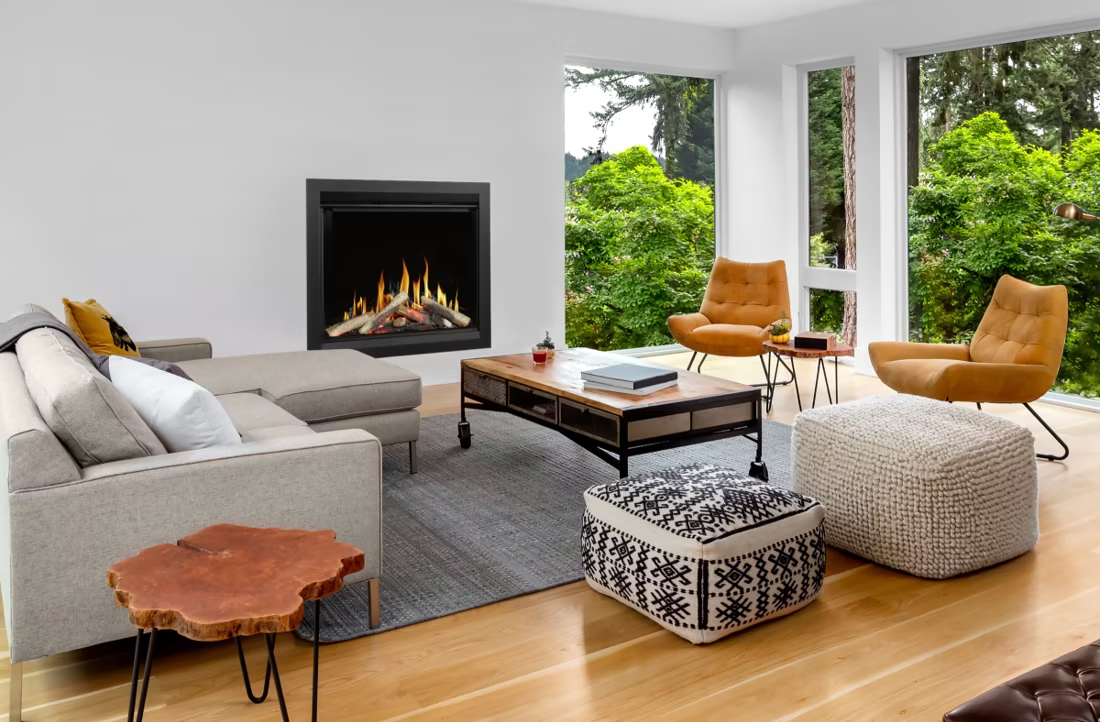
An electric fireplace is typically a wall-mounted or built-in unit designed to look like a traditional fireplace, often with a realistic flame display. An electric insert is sized to slide into an existing masonry or wood-stove firebox—a common choice for older Lincoln County farmhouses with a fireplace that's rarely used for wood anymore. An electric stove is a freestanding cabinet-style unit that mimics a wood or pellet stove's footprint without any venting requirement. All three plug into standard household power (some at 240V for higher output) and produce zero emissions, which matters during the county's wildfire-smoke season.
Do I need a permit to install an electric fireplace in Lincoln County?
Plug-in units generally don't require a permit since there's no new wiring or structural work involved. A hardwired or built-in unit that requires a new electrical circuit or wall framing typically does need an electrical permit, and if the project includes structural changes, a building permit through the Lincoln County Building Department. Most licensed electricians pull the electrical permit as a routine part of the job, so it's rarely something the homeowner has to manage directly.
What's the best electric fireplace for Lincoln County's climate?
Given the county's cold, windy winters and reliance on rural co-op power, the strongest electric options here are higher-output units—240-volt inserts or heat-pump-style electric stoves that can meaningfully warm a room rather than just add ambiance. Brands like Dimplex and Napoleon make electric inserts with enough output to serve as real supplemental heat in a drafty farmhouse living room. For homes that already lean on propane or wood as primary heat, a mid-range plug-in unit is often plenty—it's there for convenience and shoulder-season use, not to replace the main system.
Will my electric fireplace still work if the power goes out?
No—this is the honest tradeoff with electric heat, and it matters in Lincoln County. Winter ice storms and high winds across the open wheat country occasionally knock out service on the rural co-op grid, sometimes for hours at a stretch. An electric fireplace goes dark right along with everything else in the house. If you're relying on electric heat as anything more than a supplement, it's worth keeping a wood stove, propane heater, or generator as backup—a lot of Lincoln County homes already do exactly that, running electric for daily convenience and wood or propane for the nights the power actually drops.
How much does it cost to run an electric fireplace day to day?
Running cost depends on your co-op's rate and how many hours a day the unit runs, but a typical 1,500-watt electric fireplace costs somewhere in the range of a few dollars per day of steady use—noticeably cheaper per hour than running a propane furnace, but more expensive per BTU than burning free or low-cost cut firewood. Because Lincoln County is largely served by rural electric cooperatives rather than a large investor-owned utility, rates can vary somewhat by service area; your local dealer or co-op can give you an accurate per-kWh figure to run the math for your specific unit.
Electric vs. wood—which makes more sense for my Lincoln County home?
Wood remains a serious primary-heat option here—ponderosa pine, lodgepole pine, and Douglas fir are all common locally, and cutting permits through BLM Spokane District, Colville National Forest, or the Idaho Panhandle National Forests run as little as $5 to $20 per cord during the spring-through-fall season. Wood also keeps working when the power drops, which matters given the county's rural grid. Electric wins on cleanliness, zero maintenance, no chimney or wood handling, and instant on-off convenience—but it depends entirely on the grid staying up, and its heat output is modest compared to a wood stove sized for the long, cold winters here. Many Lincoln County households end up with both: wood or propane carrying the real heating load, electric handling a room that doesn't need—or can't fit—a chimney.
Can I put a TV above my fireplace?
Yes—with an asterisk. Fireplaces are hot and TVs don't like heat. Either put a mantel between them to deflect rising warmth, or choose a fireplace with heat-management technology that creates a cool zone on the wall above—the wall stays around 125 degrees, barely warm, while the room still gets full heat. If you like clean lines and don't want a mantel, heat management is the answer.
Do electric fireplaces actually produce heat?
Yes—most put out around 4,800–5,000 BTUs from a standard outlet, which comfortably warms a bedroom, office, or den as a comfort-zone heater. What they won't do is carry a whole house the way wood, gas, or pellet can. Think of electric as ambiance-first with honest supplemental heat: flames on with no heat in July, flames plus warmth in January.
Can I install a fireplace myself?
If you're putting a fire in your house on purpose, it's best to work with an expert. Unless you're genuinely experienced in framing, gas line, vent pipe, and the national code on clearances to combustibles, have a professional do it—and ideally the same company that sells you the fireplace, so warranty, service, and liability all live under one roof.
Can a fireplace actually lower my heating bill?
Yes—by creating a comfort zone. A furnace heats every square foot of the house just to warm the one room you're in; a gas fireplace on low burns roughly a sixth of the gas a typical furnace does. Set the furnace around 55–60 degrees as a baseline, then heat the rooms your family actually uses. Families who heat this way commonly save $20–$60 a month.
Stove and Fireplace Dealers in Lincoln County
Listings include WhyFire partner dealers, dealers we have verified as authorized for the brands we recommend, and established local businesses that carry hearth products. Every listing shows which one it is. The ones marked Preferred run on WhyFire's software, so they can show you real pricing and book your appointment right here. No manufacturer pays for placement. How we verify dealers →
Accent Stove & Spa
Tri State Distributors
Copper Creek Landscaping, Inc
Wing Stoves & More
Find your electric fireplace in Lincoln County.
Tell us a bit about your home and we'll put together a free Project Guide & Parts List—the right electric fireplace or insert for your space, the exact parts you'll need, and a trusted local dealer to install it.
Find Your Fireplace →