
Instant heat for Covington's mild, wet winters.
Instant, clean heat for King County's mild, damp winters—find the right gas fireplace or insert and connect with a trusted local dealer near Covington.
Every Project Starts From One of These Five Situations
Clean heat that keeps up with Puget Sound weather.
Covington sits in King County at just 386 feet elevation, in the mild marine climate of the Puget Sound lowlands (zone 4C). Winter lows average around 33°F—nothing like the sub-zero nights of Duluth, Minnesota—but the region's winter heating load means furnaces and secondary heat sources are running for a good six months of the year, October through April, under mostly gray, wet skies. Add in the late-summer wildfire smoke that's become a near-annual event across the Puget Sound region, and it's easy to see why more Covington homeowners lean toward gas over wood for their main hearth.
Puget Sound Energy, which delivers both electricity and natural gas across most of King County, keeps gas mains running to the majority of Covington neighborhoods, making a direct-vent gas fireplace or insert a straightforward add-on for most homes. A gas unit lights instantly, needs no seasoned Douglas fir or red alder stacked in the yard, and adds zero smoke or particulate during the air quality advisories that now shape late summer around Puget Sound. For homes on PSE's residential rate of roughly 14.6 cents per kWh, gas heat is also typically cheaper to run than electric resistance heat for the same BTU output.
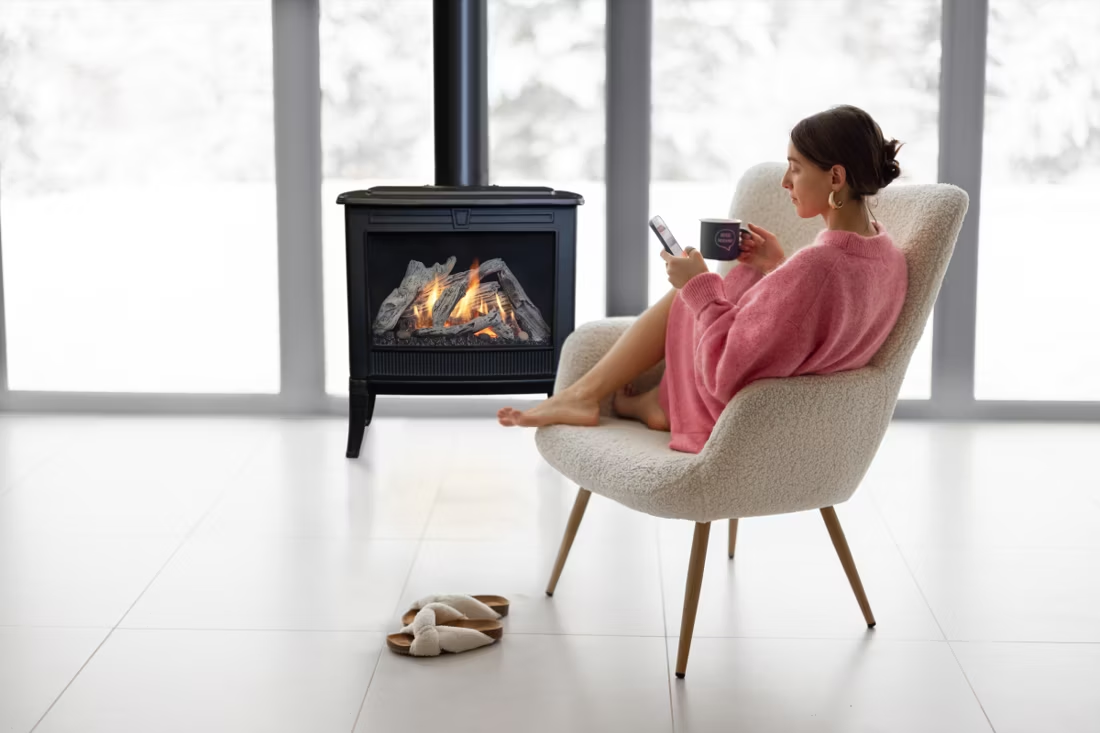
Three steps. No salesperson until you're ready.
Tell us about your project
Your zip code, your situation, and the fuel you're leaning toward—or let the answers point you to one.
See what's actually available
The brands dealers within 100 miles genuinely carry—real options, never a catalog mirage.
Get your dealer & Project Guide
A trusted local dealer, plus the free Project Guide & Parts List that names every component of the job.
Frequently Asked Questions
How much does a gas fireplace installation cost in Covington?
A typical gas fireplace installation in Covington runs $4,000 to $10,000, depending on whether it's a direct-vent insert going into an existing masonry fireplace, a new built-in unit for a remodel, or a freestanding gas stove. Homes already served by Puget Sound Energy's gas mains land on the lower end since no new service line is needed; homes that need a gas line extension from the meter, or a propane tank setup for properties outside PSE's gas footprint, run higher. A local hearth retailer will give you a firm number after an in-home walkthrough.
Can I convert my existing wood fireplace to gas?
Yes, and it's one of the more common projects local installers see in Covington, where a lot of homes built in the 1980s and 90s came standard with a wood-burning masonry fireplace that rarely gets used. A gas insert slides into that existing firebox and vents through a stainless liner run up the same chimney, typically for $4,000 to $8,500 depending on the insert and whether new gas piping has to be run to the fireplace. The conversion keeps your existing mantel and surround while trading ash, creosote, and wood storage for a switch or remote.
Do I need natural gas, or can I use propane?
Most of Covington falls within Puget Sound Energy's natural gas service area, so if your home already has a gas furnace, range, or water heater, adding a gas fireplace usually just means branching a line off the existing service. Some newer developments and properties on the edges of King County aren't yet connected to PSE's gas mains and rely on propane instead, either with an existing tank or a new tank installed through a regional propane supplier. Nearly every gas fireplace on the market can be configured for either fuel—your installer sets the orifice and regulator to match.
Will my gas fireplace still work during a power outage?
Most direct-vent gas fireplaces with intermittent pilot ignition (IPI) include a battery backup—usually AA batteries built into the unit—that keeps the fireplace lighting on demand even when the Puget Sound Energy grid is down. That matters in Covington, where winter windstorms off the Sound are a more common outage cause than snow. Valor fireplaces take a different approach: the pilot assembly generates its own electricity through the thermocouple, so there's no battery to remember at all. Worth asking about if backup heat during storm season is a priority for your household.
What's the difference between a gas fireplace, gas insert, and gas stove?
A gas fireplace is a built-in unit framed into a wall, usually chosen for new construction or a remodel. A gas insert is sized to slide into an existing masonry firebox—which describes a lot of the original wood fireplaces found in older Covington neighborhoods. A gas stove is a freestanding unit that sits out on the floor like a wood stove but runs on gas, a good fit for a room with no existing fireplace and no interest in framing one in. Most Covington homeowners upgrading an old wood fireplace go with an insert.
Do I need a permit to install a gas fireplace in Covington?
Yes. Within Covington city limits, the City of Covington's Community Development Department handles the building permit; just outside city limits in unincorporated King County, it's King County's Department of Local Services – Permitting Division. Either way, new gas fireplace installations need both a building permit and a gas piping permit, and the line work has to be signed off by a licensed gas fitter. Most local hearth retailers coordinate the permit and inspection as part of the installation, so you're not left chasing separate trades.
What's the difference between vented and vent-free gas fireplaces?
Vented direct-vent gas fireplaces draw outside air for combustion and exhaust the byproducts back outdoors through a sealed pipe—the standard, code-compliant choice everywhere, including Washington. Vent-free (unvented) units burn directly into room air, and Washington is one of the states, along with California and Colorado, where local jurisdictions frequently restrict or prohibit their use, especially in bedrooms and smaller rooms. In practice, nearly every gas fireplace installed around Covington is a direct-vent model—it's the safer option, and it's what local retailers stock and recommend.
How often should my gas fireplace be serviced?
An annual inspection is recommended for any gas fireplace or insert—a technician checks the burner, pilot assembly, venting, and gas connections, and cleans the glass. It's a much lighter lift than wood-stove chimney sweeping, but skipping it is still the most common reason gas units start smelling off or running rough. Expect to pay $150 to $250 for a standard annual service call from a local hearth or HVAC company serving the Covington area.
Gas vs. wood—which is right for my home?
Wood offers a lower cost per BTU if you're willing to source your own firewood—Mt. Baker-Snoqualmie and Olympic National Forest both sell personal-use cutting permits for $5 to $20 per cord during the May-to-October season, and Douglas fir, red alder, and lodgepole pine are all common locally. But wood also means stacking, ash, and creosote, plus the fact that burning is discouraged during the wildfire smoke events that now show up most late summers around Puget Sound. Gas skips all of that: instant on-off, no smoke contribution, and consistent heat at the flip of a switch or a remote. Most Covington homeowners choosing between the two end up picking gas for the main living space, keeping wood, if at all, as backup for extended power outages.
Is my gas fireplace wasting gas?
If it was installed more than 15 years ago, probably. Older gas fireplaces keep a standing pilot light burning all the time, and that little flame can cost a couple hundred dollars a year. Newer models use pilot-on-demand ignition—the pilot lights only when you use the fireplace and goes out when you turn it off.
Can I put a TV above my fireplace?
Yes—with an asterisk. Fireplaces are hot and TVs don't like heat. Either put a mantel between them to deflect rising warmth, or choose a fireplace with heat-management technology that creates a cool zone on the wall above—the wall stays around 125 degrees, barely warm, while the room still gets full heat. If you like clean lines and don't want a mantel, heat management is the answer.
Can a fireplace actually lower my heating bill?
Yes—by creating a comfort zone. A furnace heats every square foot of the house just to warm the one room you're in; a gas fireplace on low burns roughly a sixth of the gas a typical furnace does. Set the furnace around 55–60 degrees as a baseline, then heat the rooms your family actually uses. Families who heat this way commonly save $20–$60 a month.
How much should I budget for a fireplace?
For an average home—covering the fireplace, the vent pipe, and basic installation—a budget between $3,900 and $5,500 gives you a lot of options across wood, gas, and pellet. By the time you add finish work, gas line, and electrical, the average complete installation lands between $5,000 and $12,000 all-in. In a remodel or new build, a good rule is to put about 2.5% of the total project cost toward the fireplace.
Nearby Dealers
Hearth shops serving Covington and the surrounding area. Every listing shows whether it is a WhyFire partner, a dealer we have verified as authorized for the brands we recommend, or a local business carrying hearth products. No manufacturer pays for placement. How we verify dealers →
Good Earth Works
Rcs Fireplace
Dowell Company
Cressy Door & Fireplace
Fireside Hearth & Home-Auburn
Chimney And Fireplace Solutions
Aqua Quip
Rich's Stoves & Spas
Rich's For The Home
Economy Wiring
Benson, LLC
Rich’s Woodstoves & Spas
Cascade Fire Solutions
Rich’s Woodstoves & Spas
Aqua Rec Swimmin Hole And Fireside
Find your gas fireplace in Covington.
Tell us about your Covington home and we'll match you with a trusted local dealer and a free Project Guide & Parts List—the exact parts, vent kit, and next steps for your gas fireplace project.
Find Your Fireplace →