
Reliable Gas Heat for Sandy's Inversion Season.
Clean, instant heat for Wasatch Front winters—even on the days the valley air quality board says wood can't burn. Find the right unit and connect with a trusted local dealer.
Every Project Starts From One of These Five Situations
Built for the Salt Lake Valley's inversion winters.
Sandy sits at 4,780 feet in the Salt Lake Valley beneath the Wasatch Range, with winter lows averaging 23°F and a hefty winter heating load each year—colder than much of the Wasatch Front, though milder than truly extreme cold climates like Bozeman, MT. What makes Sandy's heating picture unusual isn't the temperature, it's the air. The Salt Lake Valley is a PM2.5 non-attainment area, and winter temperature inversions trap wood smoke close to the ground for days at a time. Utah's Division of Air Quality calls mandatory no-burn days during these events, and on red and sometimes yellow air days, solid-fuel devices—wood stoves, fireplaces, pellet stoves—are restricted unless they're a certified sole source of heat. That's a big part of why wood and pellet appliances are uncommon here and gas has become the default choice for both primary and supplemental heat.
Dominion Energy Utah provides natural gas service throughout Sandy, and most homes in the 84070/84090-84094 zip codes are already plumbed for it. One quirk worth knowing: Sandy's 4,780-foot elevation puts it above the 4,500-foot threshold where gas appliances require a high-altitude orifice kit to burn correctly—any qualified local installer will already be sizing for this. A direct-vent gas fireplace or insert gives Sandy homeowners heat that works on inversion days, zone heating that pairs well with central HVAC, and—with the right ignition system—a unit that still lights during a winter power outage.
Three steps. No salesperson until you're ready.
Tell us about your project
Your zip code, your situation, and the fuel you're leaning toward—or let the answers point you to one.
See what's actually available
The brands dealers within 100 miles genuinely carry—real options, never a catalog mirage.
Get your dealer & Project Guide
A trusted local dealer, plus the free Project Guide & Parts List that names every component of the job.
Frequently Asked Questions
How much does a gas fireplace installation cost in Sandy?
A typical gas fireplace or insert installation in Sandy runs roughly $3,500 to $10,000, depending on the unit, the venting path, and whether new gas line work is needed. A direct-vent insert into an existing masonry fireplace where a gas line is already nearby sits toward the lower end. New construction, a fresh gas line run from the meter, or a built-in unit requiring framing and finish work pushes toward the higher end. Because Sandy sits above 4,500 feet, factor in a high-altitude orifice kit as part of the install—a reputable local dealer will already have this built into their quote.
Can I convert my existing wood fireplace to gas?
Yes, and in Sandy it's often driven by more than just convenience—a gas insert isn't subject to the mandatory no-burn restrictions that apply to wood-burning appliances during winter inversion advisories. Most conversions install a gas insert into your existing masonry firebox, using a stainless liner run through your current chimney. Expect $4,000 to $9,000 depending on the insert and whether new gas line work is required. Homes already on Dominion Energy service with a line nearby are typically on the lower end.
Do I need natural gas, or can I use propane?
Most of Sandy, including the 84092, 84093, and 84094 zip codes, is served by Dominion Energy Utah's natural gas network, so if your home already has gas appliances, adding a fireplace is straightforward. Propane is the fallback for homes at the edges of the service area or up toward the Little Cottonwood and Big Cottonwood canyon approaches, where natural gas lines don't reach. Nearly every gas fireplace on the market can be configured for either fuel—your installer sets the correct orifice and regulator for whichever you have.
Will my gas fireplace work during a power outage?
Most modern gas fireplaces will, provided they use IPI (intermittent pilot ignition) with a battery backup—typically a set of AA batteries that automatically take over when line power drops, letting the unit light on demand exactly as it would with power. Valor units go a step further: their pilot assembly generates its own electricity through the thermocouple, so there's no battery to remember or replace. For Sandy homes where winter storms off the Wasatch Range occasionally knock out power for hours, that's worth asking your local dealer about directly.
What's the difference between a gas fireplace, gas insert, and gas stove?
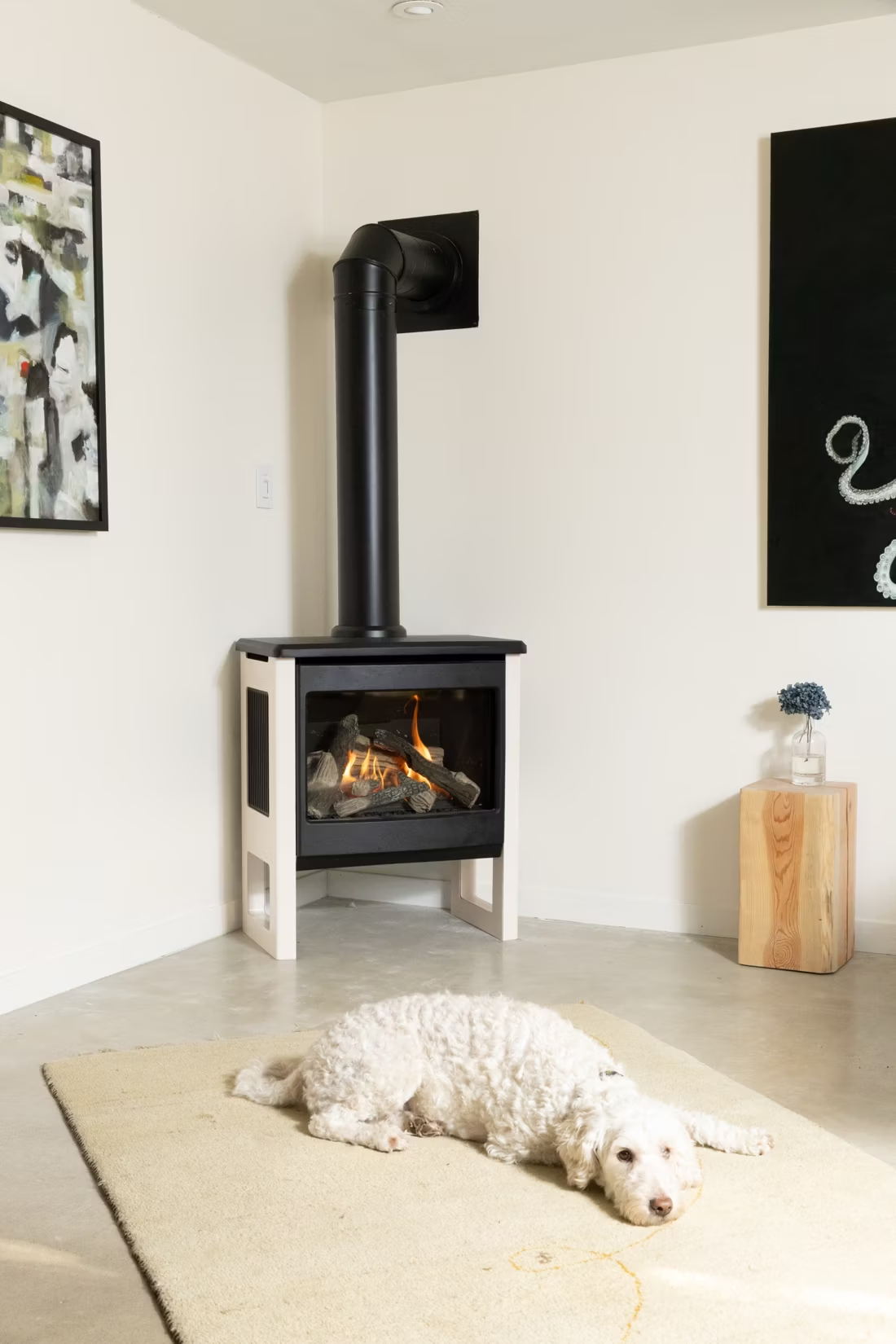
A gas fireplace is a fully built-in unit framed into a wall—the right call for new construction or a remodel. A gas insert slides into an existing masonry firebox and uses your current chimney as the vent path, which is the more common project in Sandy's older neighborhoods with existing wood-burning fireplaces that are now hard to use on inversion days. A gas stove is a freestanding unit that sits on the floor like a wood stove but runs on gas, useful in a room without an existing chimney or hearth.
Do I need a permit to install a gas fireplace in Sandy?
Yes—Sandy City requires a building permit for gas fireplace installations, along with a gas line permit if new piping is being run, and the gas work itself has to be done by a licensed gas-fitter. Most local hearth dealers handle the permitting and coordinate the gas-fitter as part of the install, so you're not left juggling separate trades and inspections yourself.
What's the difference between vented and vent-free gas fireplaces?
Vented (direct-vent) units pull combustion air from outside and exhaust it back outside through sealed venting, keeping combustion byproducts out of your living space entirely. Vent-free units burn directly into the room and are legal in Utah under specific room-sizing and oxygen-depletion-sensor rules, but they add moisture and combustion byproducts to indoor air. Given that the Salt Lake Valley is already a PM2.5 non-attainment area with periodic red air days, most local dealers steer Sandy homeowners toward direct-vent units—they perform just as well for heat output and don't add another variable to the valley's air quality concerns.
Does Sandy's elevation affect my gas fireplace installation?
It does. Sandy sits at 4,780 feet, above the roughly 4,500-foot line where gas appliances need to be de-rated with a high-altitude orifice kit to burn cleanly and safely. Skipping this step can lead to sooting, poor combustion, or a pilot that won't hold. Any installer familiar with Salt Lake Valley elevations will spec the correct kit for your model automatically—it's worth confirming they've accounted for it if you're getting quotes from an out-of-area retailer.
Gas vs. wood—which makes sense in Sandy?
Wood is technically available—pinyon, juniper, and aspen can be cut under Forest Service permits ($5-$20 per cord, May through October) from the Uinta-Wasatch-Cache National Forest—but wood-burning appliances face real restrictions here. Utah's Division of Air Quality calls mandatory no-burn days during winter inversions, when solid-fuel devices can't legally operate unless certified as a home's sole heat source. That makes wood a niche choice in Sandy rather than a primary heating strategy. Gas, by contrast, runs on inversion days, requires no fuel storage or ash cleanup, and delivers consistent heat through Dominion Energy's existing infrastructure—which is why it's the dominant hearth fuel across the Salt Lake Valley.
Why is my open fireplace making my house colder?
Open fireplaces suck—literally. As the fire burns, it consumes air your furnace already paid to heat and pulls it out through the chimney, so the house is actually colder after the fire goes out than before you lit it. An insert fixes this: it seals the chimney, puts fixed glass across the front, and turns that hole in your house into a real heat source.
Can I put a TV above my fireplace?
Yes—with an asterisk. Fireplaces are hot and TVs don't like heat. Either put a mantel between them to deflect rising warmth, or choose a fireplace with heat-management technology that creates a cool zone on the wall above—the wall stays around 125 degrees, barely warm, while the room still gets full heat. If you like clean lines and don't want a mantel, heat management is the answer.
Can a fireplace actually lower my heating bill?
Yes—by creating a comfort zone. A furnace heats every square foot of the house just to warm the one room you're in; a gas fireplace on low burns roughly a sixth of the gas a typical furnace does. Set the furnace around 55–60 degrees as a baseline, then heat the rooms your family actually uses. Families who heat this way commonly save $20–$60 a month.
How much should I budget for a fireplace?
For an average home—covering the fireplace, the vent pipe, and basic installation—a budget between $3,900 and $5,500 gives you a lot of options across wood, gas, and pellet. By the time you add finish work, gas line, and electrical, the average complete installation lands between $5,000 and $12,000 all-in. In a remodel or new build, a good rule is to put about 2.5% of the total project cost toward the fireplace.
Nearby Dealers
Hearth shops serving Sandy and the surrounding area.
(Sugar House) Alpine Fireplaces (In Breezeway Next To Theatres)
Hearth & Home Distributors Of Utah - Salt Lake City
Find your gas fireplace in Sandy.
Tell us a bit about your home and elevation, and we'll match you with a trusted local dealer and send over a free Project Guide & Parts List—the exact fireplace or insert, vent kit, and install plan for your Sandy home.
Find Your Fireplace →