
Clean, code-friendly heat for East Basin's high country nights.
At 6,513 feet with 16-degree winter lows and wildfire-smoke summers, East Basin homes need heat that does not add smoke to the equation. Find the right electric unit and connect with a trusted local dealer.
Every Project Starts From One of These Five Situations
The practical choice where wood and pellet stoves are the exception, not the rule.
East Basin sits in the Wasatch Back at 6,513 feet, deep in Summit County's pinyon, juniper, and aspen country, with 7,934 heating degree days—colder than Bozeman, Montana, and closing in on Fargo, North Dakota territory. You would think a mountain town surrounded by the Uinta-Wasatch-Cache National Forest, with cutting permits running $5 to $20 a cord from May through October, would be wood-stove country. In practice, most East Basin homes fall inside resort-area subdivisions with HOA covenants and design guidelines that restrict or outright prohibit solid-fuel appliances, and the wildfire risk in the surrounding pinyon-juniper forest makes insurers and county officials cautious about new wood and pellet installs.
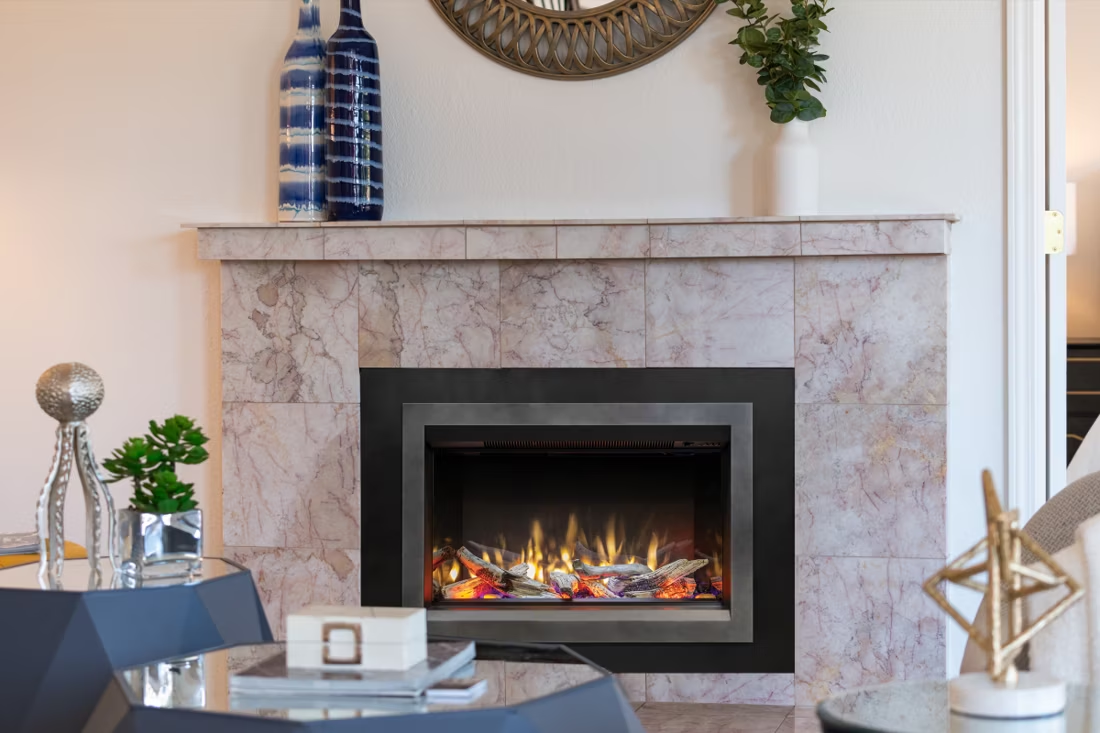
That leaves electric as the fireplace category that actually fits how East Basin is built and governed today. Rocky Mountain Power (PacifiCorp) serves the area at roughly 12.5 cents per kWh, there is no venting, chimney, or gas line to route, and no cutting permit or EPA certification paperwork to track. An electric fireplace or insert gives you real zone heat and ambiance in a specific room, with none of the wildfire-smoke irony of burning wood in a town that already deals with smoke drifting in most summers.
Three steps. No salesperson until you're ready.
Tell us about your project
Your zip code, your situation, and the fuel you're leaning toward—or let the answers point you to one.
See what's actually available
The brands dealers within 100 miles genuinely carry—real options, never a catalog mirage.
Get your dealer & Project Guide
A trusted local dealer, plus the free Project Guide & Parts List that names every component of the job.
Frequently Asked Questions
How much does an electric fireplace installation cost in East Basin?
A plug-in electric fireplace insert or wall-mount unit typically costs $200 to $1,500 for the appliance itself, with most East Basin homeowners landing between $300 and $800 for a mid-range model sized for a bedroom, den, or main living area. Because electric units need no venting, gas line, or masonry work, installation often just means plugging into an existing 120-volt outlet. If a dedicated outlet is needed, a licensed electrician typically charges $150 to $400 for that circuit. Larger built-in units requiring a 240-volt circuit, recessed framing, or a custom mantel surround usually run $2,000 to $3,500 with electrical and finish work included—still well under what a vented gas insert with chimney liner work would cost in this area.
If there's a national forest right here, why isn't wood heat common in East Basin?
The timber and permits are genuinely close—the Uinta-Wasatch-Cache National Forest issues personal-use cutting permits for $5 to $20 per cord from May through October, and pinyon, juniper, and aspen are all common locally. But East Basin's housing stock is dominated by resort-corridor subdivisions with HOA covenants and design review boards that restrict or ban solid-fuel wood stoves and pellet appliances outright, largely over wildfire risk in the surrounding pinyon-juniper terrain and resale concerns in a market with a lot of second homes. That combination is why wood and pellet show up as not-applicable for most East Basin projects even though a national forest sits right outside town.
How much does it cost to actually run an electric fireplace here?
Rocky Mountain Power (PacifiCorp) bills East Basin homes at roughly 12.5 cents per kWh. A typical 1,500-watt electric fireplace running its heater on high draws about 1.5 kWh per hour—around 19 cents an hour, or roughly $4.50 for eight hours of use over a month of regular evenings. Running the flame effect alone, without the heater element, pulls only 20 to 30 watts and costs pennies a day. Given East Basin's 7,934 heating degree days, most owners use their electric fireplace as supplemental zone heat for a favorite room rather than as a replacement for a whole-home furnace or heat pump.
Do I need a permit to install an electric fireplace in East Basin?
A freestanding or plug-in electric fireplace needs no building permit—it's treated as a plug-in appliance, not a fixed heating system. If you're having a unit hardwired into your electrical panel or adding a new dedicated circuit for a built-in model, that electrical work should go through a licensed electrician and may need a permit from the Summit County Building Department, especially for new construction or a larger remodel. There's no EPA certification, curtailment rule, or forest cutting permit involved—electric is by far the lightest-paperwork hearth option available in East Basin.
What's the difference between an electric insert, wall-mount, and built-in unit?
An electric insert is sized to slide into an existing fireplace opening—useful if East Basin's older cabin-style homes already have a masonry or zero-clearance firebox you want to convert without venting work. A wall-mount unit hangs like a flat-screen TV and needs only a nearby outlet, which is popular in condos and resort rentals where landlords want zero fire risk. A built-in or linear electric fireplace is recessed into new framing or a custom mantel wall, wired on a dedicated circuit, and used mostly in new construction or full remodels where the fireplace is part of the room design from the start. All three run on the same basic heating-element technology; the difference is really about what opening or wall you're working with.
Can an electric fireplace actually keep up with East Basin winters?
Not as a primary heat source—at 7,934 heating degree days and 16-degree average winter lows, East Basin needs a real furnace, boiler, or heat pump system to carry the whole house. What an electric fireplace does well is zone heating: a 1,500-watt unit can noticeably warm a bedroom, home office, or den, taking the load off central heating in the room you're actually using. If you want more heat output for a larger open room, look at units rated for larger square footage with a higher-wattage heater element rather than assuming size of the fireplace body translates to more warmth—the heater capacity is what matters, not the screen size.
I really want a wood-burning fireplace—is that off the table in East Basin?
Not entirely, but it's the exception rather than the norm here. A small number of East Basin homeowners with older properties outside HOA-governed subdivisions do still install EPA-certified wood stoves, and Uinta-Wasatch-Cache National Forest cutting permits remain available in season for anyone who wants to self-supply pinyon, juniper, or aspen. But most newer builds and resort-corridor lots fall under covenants that prohibit solid-fuel appliances, and county officials are cautious about new wood installs given the wildfire exposure in the surrounding forest. If wood ambiance matters to you, it's worth checking your specific lot's covenants before shopping—a local dealer can tell you quickly whether it's even an option for your address.
Electric vs. gas—which fits my East Basin home better?
Gas fireplaces (natural gas or propane, both used in this part of Summit County) put out more heat per unit and can serve as a legitimate secondary heat source during a power outage if you choose a battery-backup or self-powered ignition model. Electric fireplaces need no fuel line, tank, or venting at all, cost far less to install, and produce zero combustion byproducts—a real advantage during the wildfire smoke East Basin sees most summers, when you don't want to add any particulates indoors. For a primary living room where you want strong, consistent heat, gas is often worth the extra install cost. For bedrooms, rentals, condos, or homes where simplicity and zero emissions matter most, electric is usually the better fit.
How does Find My Fireplace actually help me in East Basin?
I'm not selling you a fireplace or shipping you a box—Find My Fireplace matches you with a trusted local dealer who knows East Basin's covenants, Summit County electrical requirements, and Rocky Mountain Power service realities firsthand. After a short questionnaire about your home and room, you get a free Project Guide & Parts List: a plan for your specific electric fireplace project, the exact parts involved, and the local dealer we recommend for installation. No big-box guesswork, no manufacturer kickbacks influencing the recommendation.
Does an electric fireplace need a vent or chimney?
No—that's its superpower. An electric fireplace needs a wall and an outlet, period. No vent pipe, no gas line, no clearances to design around, which is why it works in bedrooms, offices, apartments, and walls where venting a gas or wood unit would be impractical or impossible. Installation is typically the simplest and least expensive of any fireplace type.
Can I put a TV above my fireplace?
Yes—with an asterisk. Fireplaces are hot and TVs don't like heat. Either put a mantel between them to deflect rising warmth, or choose a fireplace with heat-management technology that creates a cool zone on the wall above—the wall stays around 125 degrees, barely warm, while the room still gets full heat. If you like clean lines and don't want a mantel, heat management is the answer.
What is an in-home preview and do I need one?
It's a visit where a hearth professional measures your space, confirms the model you picked actually works in your home, and walks the specs—framing, gas line, venting, finish work—before anything is ordered. Some details you just can't know until you see the house. Never make a down payment without one; it's the single most-skipped step that burns buyers.
How much should I budget for a fireplace?
For an average home—covering the fireplace, the vent pipe, and basic installation—a budget between $3,900 and $5,500 gives you a lot of options across wood, gas, and pellet. By the time you add finish work, gas line, and electrical, the average complete installation lands between $5,000 and $12,000 all-in. In a remodel or new build, a good rule is to put about 2.5% of the total project cost toward the fireplace.
Nearby Dealers
Hearth shops serving East Basin and the surrounding area. Every listing shows whether it is a WhyFire partner, a dealer we have verified as authorized for the brands we recommend, or a local business carrying hearth products. No manufacturer pays for placement. How we verify dealers →
Uintah Fireplace And Design
All Hours Plumbing, Drain Cleaning, Heating & Cooling
Delta Stone Products, Inc.
(Sugar House) Alpine Fireplaces (In Breezeway Next To Theatres)
Comfort Solutions
Bills Comfort Systems
Ignite Fireplace
Croft Fireplaces (Bountiful)
Standard Plumbing
Electric Service in East Basin
An electric fireplace's heater draws about 1,500 watts—pennies per hour at local rates.
Find your electric fireplace in East Basin.
Tell us about your home and we'll match you with the right electric fireplace or insert, plus a free Project Guide & Parts List and a trusted local East Basin dealer to install it correctly.
Find Your Fireplace →