
Find dependable heat before the next blue norther hits Wichita County.
Winters here average a mild 30°F low and a fairly light winter heating load overall—until an arctic front drops the bottom out overnight. A gas fireplace or insert covers both: everyday ambiance and real backup heat when the grid gets shaky.
Every Project Starts From One of These Five Situations
Mild winters, but you still want a backup plan.
Wichita County sits in climate zone 3A, home to roughly 122,800 people across Wichita Falls, Burkburnett, Iowa Park, and Electra. With a fairly light winter heating load overall and average winter lows near 30°F, most homes here need supplemental heat on relatively few nights a season—not a furnace-grade heating system running around the clock. What changes the equation is the blue norther: a fast-moving arctic front that can drop temperatures 30 to 40 degrees in a matter of hours. Winter Storm Uri in February 2021 showed North Texas homeowners exactly what happens when ERCOT-managed electric heat fails during one of those events—and gas appliances with standing pilot or battery-backed ignition kept running when the power didn't.
Wood heat has never really taken hold in Wichita County the way it has in colder parts of the country—the climate doesn't demand it, and there's no local air quality program restricting burning the way there is in wood-heavy regions. The oak, pecan, and mesquite that grow around the county are prized locally for smoking brisket and ribs, not for keeping a house warm through winter. Natural gas, on the other hand, is deeply embedded in this part of North Texas—the county sits within one of the state's oldest producing gas fields, and most homes in Wichita Falls, Burkburnett, and Iowa Park are already connected to natural gas service through Atmos Energy. Rural properties outside those service areas typically run on propane. For this climate and this infrastructure, a gas fireplace or insert is simply the more sensible fit than wood or pellet.
Three steps. No salesperson until you're ready.
Tell us about your project
Your zip code, your situation, and the fuel you're leaning toward—or let the answers point you to one.
See what's actually available
The brands dealers within 100 miles genuinely carry—real options, never a catalog mirage.
Get your dealer & Project Guide
A trusted local dealer, plus the free Project Guide & Parts List that names every component of the job.
Frequently Asked Questions
How much does a gas fireplace installation cost in Wichita County?
Most gas fireplace and insert installations in Wichita County run somewhere between $3,500 and $9,000, with the spread driven mainly by venting and gas line work rather than the appliance itself. A direct-vent insert going into an existing masonry fireplace in a Wichita Falls or Iowa Park home that's already plumbed for natural gas sits toward the lower end. A new built-in unit in a remodel—with fresh gas line runs, framing, and venting through an exterior wall—lands higher. Homes on propane, or properties needing a new tank set, should budget for the added cost of the tank and line work on top of the fireplace install. A local dealer will give you a firm number after seeing the space.
Can I convert my existing wood-burning fireplace to gas?
Yes, and it's a common project in the older ranch-style homes built around Wichita Falls, Burkburnett, and Electra during the mid-century oil boom years. A gas insert drops into the existing masonry firebox and vents through a stainless liner run up the original chimney, so you keep the look of the fireplace without hauling or storing wood you probably weren't burning much of anyway given how mild the winters run here. Cost typically falls in the $4,000 to $8,500 range depending on whether the home already has a gas line nearby or one needs to be extended to the fireplace location.
Do I need natural gas, or should I plan on propane?
If your home is inside Wichita Falls, Burkburnett, or Iowa Park city limits, you likely already have natural gas service through Atmos Energy, which makes adding a fireplace straightforward—your installer taps into the existing line. Outside those service areas, in unincorporated Wichita County or more rural stretches near Electra, propane is the standard option, either through an existing tank or a new one set by a local propane supplier. Nearly every gas fireplace model on the market can be configured for either fuel; the installer just sets the correct orifice and regulator for what you have.
Will my gas fireplace still work if the power goes out?
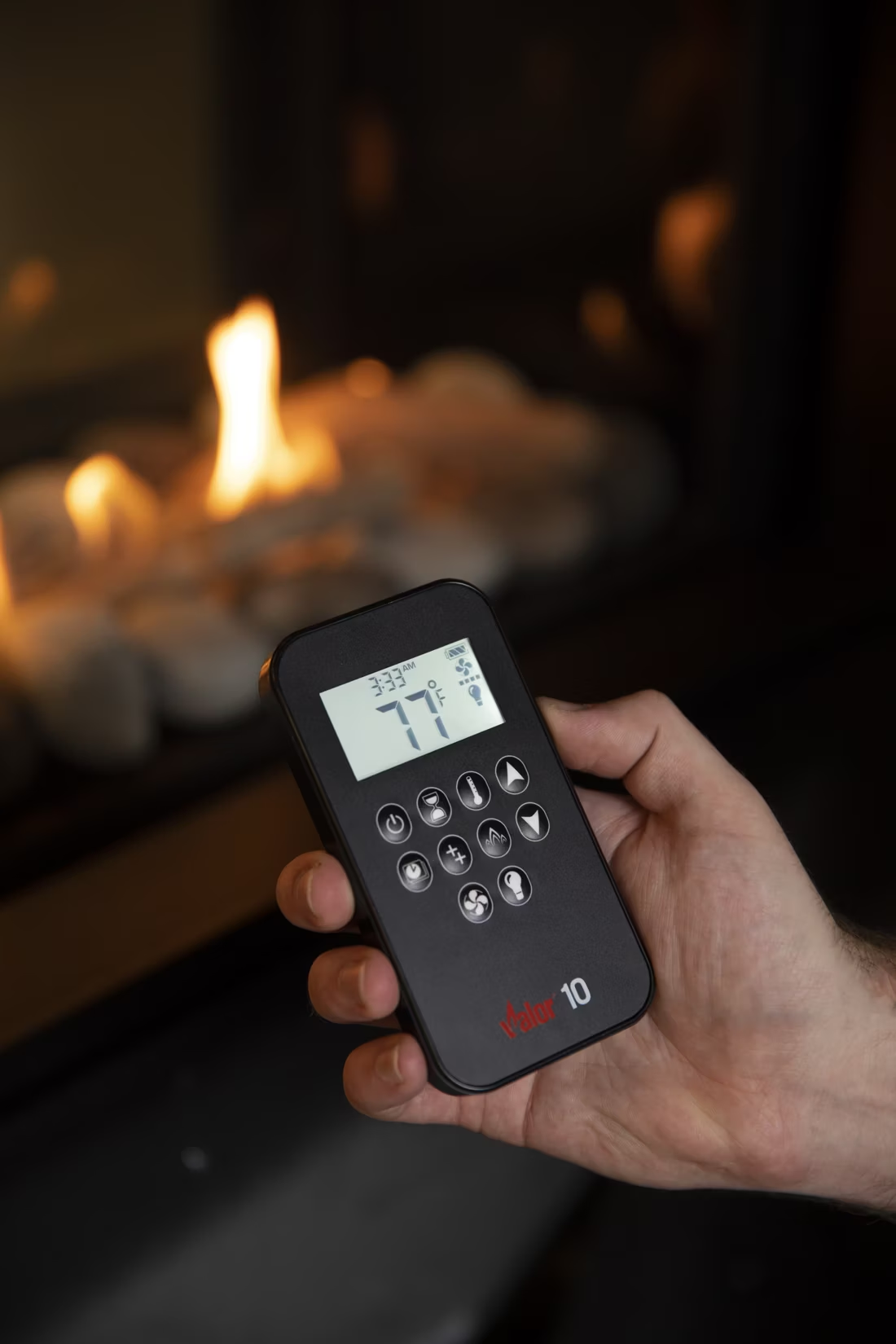
It depends on the ignition system, which matters more here than the mild average winter suggests. Wichita County residents saw firsthand during Winter Storm Uri that ERCOT-managed grid failures can hit hardest exactly when an arctic front is moving through. Units with intermittent pilot ignition (IPI) run on AA batteries as backup and will still light and heat with the power out, as long as the batteries are fresh. Valor fireplaces go a step further—their pilot assembly generates its own electricity through a thermocouple, so there's no battery to remember or replace. Ask your local dealer about ignition type specifically if outage backup matters to you.
Gas fireplace, insert, or gas stove—what's the difference?
A gas fireplace is a fully built-in unit framed into a wall, typically chosen for new construction or a remodel. A gas insert is sized to slide into an existing masonry firebox, which is the common route for the older brick fireplaces found throughout Wichita Falls and Iowa Park neighborhoods. A gas stove is a freestanding cabinet unit that sits directly on the floor, useful in rooms without any existing fireplace or chimney chase. For most Wichita County homeowners with a fireplace they don't use much, an insert is the straightforward upgrade; new rooms or additions are usually better suited to a built-in unit or freestanding stove.
Do I need a permit to install a gas fireplace in Wichita County?
Yes. Inside city limits, permits and inspections go through the applicable municipal building department—Wichita Falls, Burkburnett, and Iowa Park each handle their own. In unincorporated parts of Wichita County, the county building official's office covers it. New gas fireplace installs typically require both a building permit and a gas line permit, and the gas line work has to be done by a licensed gas-fitter. Most established hearth retailers coordinate all of this as part of the install, so you're not left managing separate trades and inspections yourself.
Are vent-free gas fireplaces allowed in Wichita County?
Yes—Texas doesn't carry the restrictions that states like California, Colorado, and Washington place on vent-free (ventless) gas units, so they're a legal option here as long as the room is sized appropriately and the unit has an oxygen depletion sensor. That said, direct-vent fireplaces remain the more common recommendation for whole-room heating performance and indoor air quality, since they draw combustion air from outside and exhaust it back out rather than releasing byproducts into the living space. Vent-free units tend to make more sense as supplemental units in smaller rooms. A local dealer can walk you through both given your specific room dimensions.
How often does a gas fireplace need to be serviced?
Plan on an annual inspection, ideally in early fall before the first blue norther of the season rolls through. A technician checks the burner, pilot assembly, venting, gas connections, and any battery backup, and cleans the glass and interior. This is a much lighter lift than chimney sweeping for a wood-burning unit, but it's the step that keeps the fireplace reliable on the handful of nights a year in Wichita County when you actually need it to perform. Most local gas appliance service providers charge in the $150 to $250 range for this visit.
Should I even consider a wood stove instead of gas here?
For most Wichita County homes, no—wood heat just doesn't match the climate. With only a fairly light winter heating load overall and winter lows averaging 30°F, a wood stove sized for serious heat output would be overkill most of the season, and the local wood culture (oak, pecan, mesquite) runs toward smoking meat, not home heating. A gas fireplace or insert handles the mild, intermittent heating need efficiently and doubles as backup warmth during the arctic fronts and grid events that occasionally hit North Texas. If ambiance without any heating need at all is the goal, an electric fireplace is also worth a look, since it needs no venting or gas line at all.
Can I put a TV above my fireplace?
Yes—with an asterisk. Fireplaces are hot and TVs don't like heat. Either put a mantel between them to deflect rising warmth, or choose a fireplace with heat-management technology that creates a cool zone on the wall above—the wall stays around 125 degrees, barely warm, while the room still gets full heat. If you like clean lines and don't want a mantel, heat management is the answer.
Why is a fireplace insert so efficient?
An insert does two things: it seals the chimney completely, so you stop losing air you already paid to heat, and it radiates warmth into the room through the firebox and glass. Most add a heat-exchange fan that pulls cool room air underneath, wraps it around the hot firebox, and pushes it back out warm. Your home is more efficient before you've even lit the first fire.
Can a fireplace actually lower my heating bill?
Yes—by creating a comfort zone. A furnace heats every square foot of the house just to warm the one room you're in; a gas fireplace on low burns roughly a sixth of the gas a typical furnace does. Set the furnace around 55–60 degrees as a baseline, then heat the rooms your family actually uses. Families who heat this way commonly save $20–$60 a month.
How much should I budget for a fireplace?
For an average home—covering the fireplace, the vent pipe, and basic installation—a budget between $3,900 and $5,500 gives you a lot of options across wood, gas, and pellet. By the time you add finish work, gas line, and electrical, the average complete installation lands between $5,000 and $12,000 all-in. In a remodel or new build, a good rule is to put about 2.5% of the total project cost toward the fireplace.
Stove and Fireplace Dealers in Wichita County
Listings include WhyFire partner dealers, dealers we have verified as authorized for the brands we recommend, and established local businesses that carry hearth products. Every listing shows which one it is. The ones marked Preferred run on WhyFire's software, so they can show you real pricing and book your appointment right here. No manufacturer pays for placement. How we verify dealers →
The Ember Shop, Inc.
Home Escapes & More
Find your gas fireplace in Wichita County.
Tell us a bit about your home and we'll match you with a trusted local dealer and send over a free Project Guide & Parts List—the right unit, the correct venting or gas line parts, and a plan built for Wichita County's mild-but-unpredictable winters.
Find Your Fireplace →