
Instant warmth for Wake Village's mild winters.
No chimney, no wood to split, no gas line—just plug-in or hardwired ambiance sized right for a Bowie County winter. Find the right unit and get matched with a trusted local dealer.
Every Project Starts From One of These Five Situations
Electric heat fits a mild Texas winter.
Wake Village sits at 352 feet in Bowie County, on the edge of Texarkana, in climate zone 3A. Winters here are mild by national standards—the average winter low is 33°F, and the town has a modest heating season overall, a fraction of what a place like Fargo, ND or Duluth, MN sees in a single hard winter. That climate reality matters for fireplace choice: most Wake Village homes don't need a 60,000-BTU wood stove to get through January. They need supplemental warmth for a handful of genuinely cold nights, plus the ambiance of a fire the rest of the season.
That's exactly what electric fireplaces deliver, and it's why they've become a popular choice for the town's roughly 5,900 residents. There's no chimney to build, no cutting permit to file, and no smoke to worry about—Wake Village has no air quality restrictions on burning, but plenty of homeowners still prefer to skip ash and creosote altogether. Power comes from either Southwestern Electric Power Company (SWEPCO) or Bowie-Cass Electric Cooperative depending on your address, with residential rates running about 12.6 to 13.5 cents per kWh—inexpensive enough that running a 1,500-watt insert for an evening costs pocket change.
Three steps. No salesperson until you're ready.
Tell us about your project
Your zip code, your situation, and the fuel you're leaning toward—or let the answers point you to one.
See what's actually available
The brands dealers within 100 miles genuinely carry—real options, never a catalog mirage.
Get your dealer & Project Guide
A trusted local dealer, plus the free Project Guide & Parts List that names every component of the job.
Frequently Asked Questions
How much does an electric fireplace installation cost in Wake Village?
Plug-in freestanding electric fireplaces or mantel packages typically run $150 to $600 for the unit itself, with no installation cost beyond plugging into an existing outlet. Built-in wall-mounted units or electric inserts that replace logs in an existing masonry firebox usually run $800 to $2,500 installed, and that jumps if a dedicated 240-volt circuit needs to be run by an electrician—add roughly $300 to $700 for that electrical work. Larger linear electric fireplaces with a custom surround or media wall build can reach $3,500 to $5,000. A local dealer can give you a firm number once they know whether you're converting an existing fireplace or starting from a bare wall.
Will an electric fireplace actually keep a room warm here?
For Wake Village's climate, yes—for the room it's in. Most electric fireplace inserts put out 4,000 to 5,000 BTU of supplemental heat, which is plenty to take the chill off a living room or bedroom on a 33°F night, the town's average winter low. What an electric unit won't do is replace your central heat pump or furnace on the coldest stretches of the year. Think of it as zone heat for the room you're actually using, paired with whatever HVAC system already handles the rest of the house—which is exactly how most homeowners here use them.
Do I need a permit to install an electric fireplace in Wake Village?
Most plug-in electric fireplaces need no permit at all—they're treated like any other appliance you'd plug into a wall outlet. If you're installing a built-in unit that requires a new dedicated circuit or panel work, that electrical work typically does require a permit and should be pulled by a licensed electrician. Check with the City of Wake Village building department before that kind of work begins; your local dealer's installer can usually tell you upfront whether your chosen unit needs new wiring or just an outlet.
What types of electric fireplaces are available for a Wake Village home?
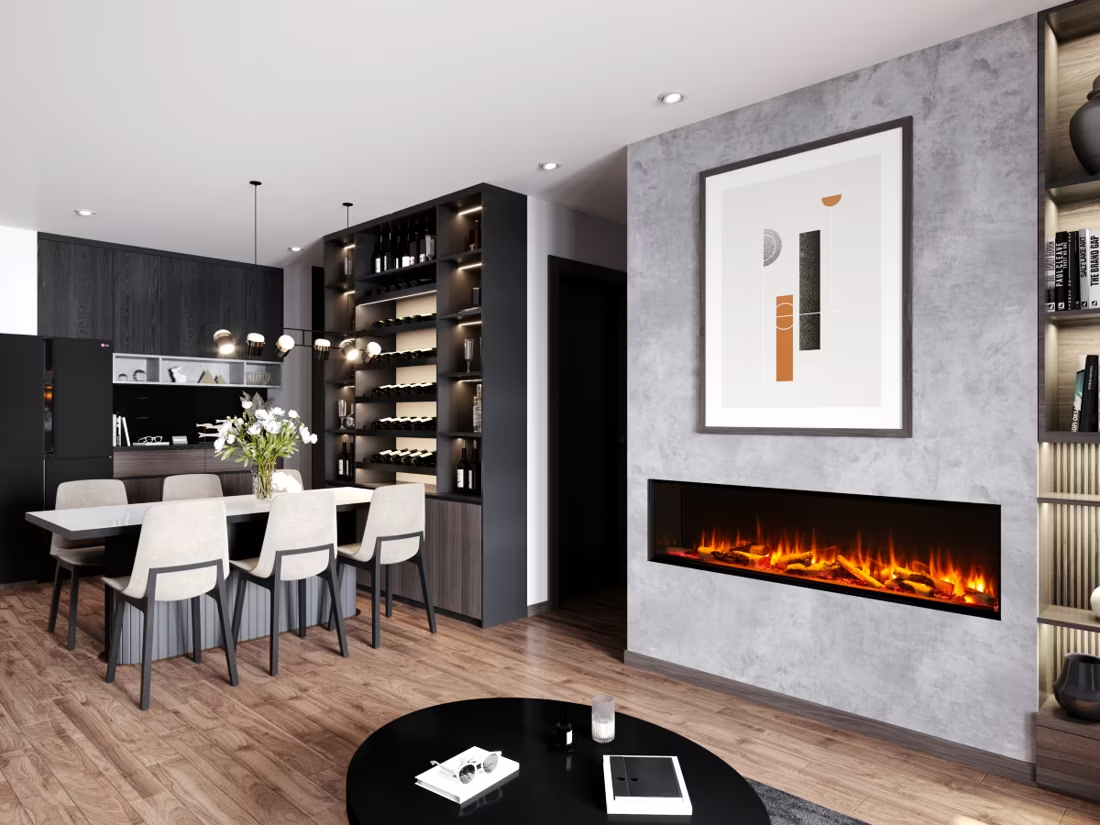
There are four common paths: a freestanding electric stove or mantel unit you place against a wall, a wall-mounted linear fireplace for a modern look, a built-in unit framed into new construction or a media wall, and an electric insert that slides into an existing wood-burning masonry firebox. That last option is popular in older Wake Village homes that already have a fireplace opening but whose owners no longer want to deal with cutting and hauling oak, pecan, or mesquite firewood—the insert reuses the existing opening and mantel while swapping in electric heat and flame effects.
How much does it cost to run an electric fireplace in Wake Village?
At SWEPCO's residential rate of about 13.46 cents per kWh, a 1,500-watt electric fireplace running on high costs roughly 20 cents an hour—about $1.40 for a full evening. Homes served by Bowie-Cass Electric Cooperative, at roughly 12.56 cents per kWh, run slightly cheaper still. Most owners run the flame effect without heat much of the time (which draws only a few watts), reserving the heater function for genuinely cold nights, which keeps monthly cost impact minimal even with daily use.
Do electric fireplaces need venting or a chimney?
No—this is one of the biggest advantages for Wake Village homes without an existing masonry fireplace. Electric units produce heat and a flame visual without combustion, so there's no smoke, no gas byproducts, and no venting requirement. That makes them installable almost anywhere with an outlet or circuit, including apartments, additions, and rooms where running a chimney or gas line would be impractical or expensive.
Will my electric fireplace work during a power outage?
No—electric fireplaces are entirely dependent on grid power, so they'll go dark along with everything else during an outage. East Texas ice storms occasionally knock out power for both SWEPCO and Bowie-Cass Electric Cooperative customers, so if backup heat during outages is a priority, a wood-burning stove or a fireplace with a battery-backed pilot is a better fit for that specific need. Many Wake Village homes actually pair the two: an electric unit for everyday ambiance and low-cost zone heat, plus a separate wood or gas option as a genuine outage backup.
Can I convert my existing wood fireplace to electric?
Yes, and it's a common project for older Wake Village homes with a masonry firebox. An electric insert slides into the existing opening, uses the existing mantel and surround, and typically installs in an afternoon since there's no chimney liner or gas line to run—just an outlet or a short circuit extension behind the unit. It's usually the least expensive fireplace conversion available, and it eliminates ash cleanup and the need to source oak, pecan, or mesquite firewood entirely.
Electric vs. wood—which makes more sense for my home?
Wood offers real backup heat during power outages, the lowest fuel cost if you're cutting or buying local oak, pecan, or mesquite, and the experience of an actual fire—but it means ash, chimney maintenance, and sourcing firewood. Electric offers instant on-off operation, zero maintenance, no venting requirements, and a lower running cost on Wake Village's electric rates for the mild heating load most homes actually need. Given the area's relatively short heating season and average winter lows in the low 30s, a lot of homeowners here find electric covers their day-to-day needs, with wood reserved for households that specifically want outage-proof backup heat.
Can I put a TV above my fireplace?
Yes—with an asterisk. Fireplaces are hot and TVs don't like heat. Either put a mantel between them to deflect rising warmth, or choose a fireplace with heat-management technology that creates a cool zone on the wall above—the wall stays around 125 degrees, barely warm, while the room still gets full heat. If you like clean lines and don't want a mantel, heat management is the answer.
Does an electric fireplace need a vent or chimney?
No—that's its superpower. An electric fireplace needs a wall and an outlet, period. No vent pipe, no gas line, no clearances to design around, which is why it works in bedrooms, offices, apartments, and walls where venting a gas or wood unit would be impractical or impossible. Installation is typically the simplest and least expensive of any fireplace type.
Does a fireplace add value to my home?
On average, a fireplace adds back to the home about the same amount you spent installing it. Add the monthly savings from heating the rooms you actually use instead of the whole house—often hundreds of dollars a year—and the value case is strong before you even count what a fire does for how your family uses the room.
How much should I budget for a fireplace?
For an average home—covering the fireplace, the vent pipe, and basic installation—a budget between $3,900 and $5,500 gives you a lot of options across wood, gas, and pellet. By the time you add finish work, gas line, and electrical, the average complete installation lands between $5,000 and $12,000 all-in. In a remodel or new build, a good rule is to put about 2.5% of the total project cost toward the fireplace.
Nearby Dealers
Hearth shops serving Wake Village and the surrounding area. Every listing shows whether it is a WhyFire partner, a dealer we have verified as authorized for the brands we recommend, or a local business carrying hearth products. No manufacturer pays for placement. How we verify dealers →
Acme Brick Company
Red River Lumber & Design Center
LaGrone Williams Hardware
Pro Sweeps
Electric Service in Wake Village
An electric fireplace's heater draws about 1,500 watts—pennies per hour at local rates.
Southwestern Electric Power Co
Bowie-Cass Electric Coop, Inc
Find your electric fireplace in Wake Village.
Tell us about your home and we'll put together a free Project Guide & Parts List—the right electric fireplace or insert for your space, the exact parts needed, and a trusted local dealer to install it.
Find Your Fireplace →