
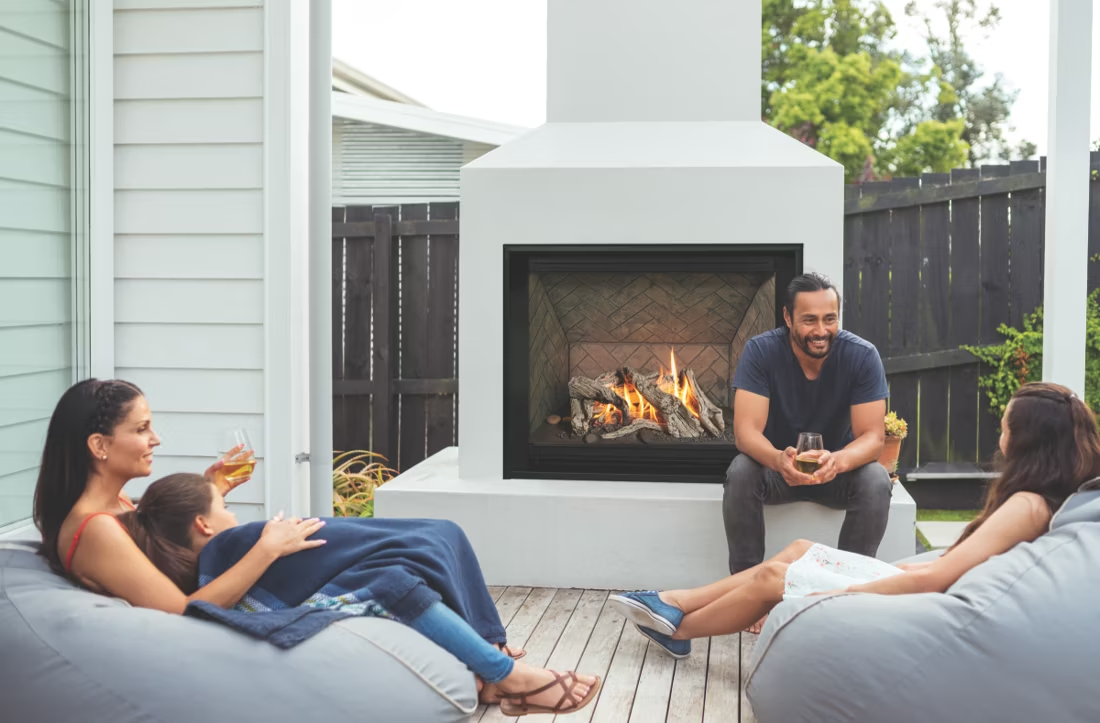
A gas fireplace built for Rio Grande Valley living.
San Juan winters rarely require real heat, but a gas fireplace still adds warmth on the occasional cold snap and genuine backup heat when a hard freeze knocks the grid out. We'll match you with a trusted local dealer who can size and install the right unit for your home.
Every Project Starts From One of These Five Situations
Warmth is optional here. Ambiance rarely is.
San Juan sits deep in the Rio Grande Valley at just over 100 feet of elevation, where the average winter low hovers around 49°F and the city has one of the lightest winter heating loads around—a fraction of what a place like Duluth, MN or Bismarck, ND sees in a single hard month. Wood-burning heat, common up north, simply doesn't have a job to do here; the oak, pecan, and mesquite that grow throughout Hidalgo County are prized for smoking brisket, not for keeping a house warm. Gas is a different story. It shows up in San Juan for the same reasons it shows up in warm cities everywhere: real flame, instant on-off convenience, and a finished look for a great room or primary living space, without asking anyone to load or clean up after a fire.
There's also a more serious reason gas has staying power here. Piped natural gas infrastructure is limited across much of Hidalgo County, and San Juan is no exception—most residential gas fireplace installations in the area run on propane, delivered and refilled by local suppliers rather than piped in from a utility main. That setup turned out to matter during Winter Storm Uri in February 2021, when large stretches of the ERCOT grid failed for days during a rare hard freeze. Homes with a properly installed gas fireplace on a propane tank had a working heat source when the electric grid—served locally by AEP Texas Central, Oncor, or Magic Valley Electric Cooperative depending on the block—did not.
Three steps. No salesperson until you're ready.
Tell us about your project
Your zip code, your situation, and the fuel you're leaning toward—or let the answers point you to one.
See what's actually available
The brands dealers within 100 miles genuinely carry—real options, never a catalog mirage.
Get your dealer & Project Guide
A trusted local dealer, plus the free Project Guide & Parts List that names every component of the job.
Frequently Asked Questions
How much does a gas fireplace installation cost in San Juan?
Expect somewhere in the range of $3,500 to $8,500 for a typical gas fireplace or insert installation in San Juan, with the final number driven mostly by whether you already have a propane tank in place and whether the unit is a direct-vent insert into an existing masonry opening versus a new built-in fireplace framed into a wall. Because San Juan's mild climate means installers aren't fighting deep freeze-proofing or complex chimney retrofits the way a colder-climate installer would, labor costs tend to run toward the lower end of what you'd see in a place like Buffalo, NY. A new propane tank setup, if you don't already have one, adds to the total.
Should I use propane or natural gas for my fireplace?
For most San Juan homes, the answer is propane. Piped natural gas service isn't broadly available across San Juan and the surrounding Hidalgo County communities, so the large majority of local gas fireplace installations run on propane from a local supplier rather than a utility gas main. If your home already has a propane tank for a range or water heater, adding a fireplace to that same line is usually the simplest and most cost-effective route. A local dealer can confirm what's actually feasible at your specific address before you commit to a unit.
Does a gas fireplace even make sense in a warm climate like San Juan?
It's a fair question in a city where the average winter low sits around 49°F and real heating need is rare. Most San Juan homeowners who install a gas fireplace are after the look and feel of real flame in a living room or primary suite, plus a hedge against the handful of nights each winter when temperatures actually drop into the 30s. Wood heat, by contrast, doesn't make sense here at all—there's no cold season to justify it, and oak, pecan, and mesquite in Hidalgo County are grown and sold almost exclusively for grilling and smoking rather than home heating. Gas fills the ambiance role wood would fill up north, without the smoke, ash, or maintenance.
Will my gas fireplace work if the power goes out?
Most modern gas fireplaces will, which matters more in South Texas than the mild average winter suggests. Units with IPI (intermittent pilot ignition) run on a small battery backup that kicks in automatically when grid power drops, so the fireplace lights and runs normally off the batteries. Valor fireplaces go a step further—their pilot generates its own electricity through the thermocouple, so there's no battery to remember at all. After Winter Storm Uri left large parts of the Rio Grande Valley without electricity for days in February 2021, that backup capability isn't a theoretical selling point for San Juan homeowners—it's a real reason to ask about ignition type before choosing a unit.
What's the difference between a gas fireplace, gas insert, and gas stove?
A gas fireplace is a fully built-in unit framed into a wall—common in the newer subdivisions going up throughout San Juan and the broader McAllen metro area. A gas insert drops into an existing masonry fireplace opening and uses that opening (plus new direct-vent piping) rather than requiring new framing, which suits the area's older homes with existing wood-burning fireplaces that are rarely, if ever, used for wood. A gas stove is a freestanding cabinet-style unit that can go almost anywhere with the right clearances and venting. For a San Juan home with an existing but unused masonry fireplace, an insert is usually the most direct upgrade.
Do I need a permit to install a gas fireplace in San Juan?
Yes. New gas fireplace installations typically require a building permit through the City of San Juan's permitting office, and any propane line work must be performed by an installer licensed through the Texas Railroad Commission, which regulates LP-gas installations statewide. Most local hearth dealers coordinate the permit, the gas line work, and the final inspection as part of the installation, so you're not left managing separate trades. If your property falls outside city limits in unincorporated Hidalgo County, the permitting path runs through the county rather than the city—worth confirming with your installer up front.
Should I get a vented or vent-free gas fireplace?
Vented (direct-vent) units draw combustion air from outside and exhaust it back outside through sealed venting—they're the safer, more universally recommended choice and the one most San Juan dealers will steer you toward. Vent-free units burn directly into the room and release some water vapor and combustion byproducts indoors, which is a bigger consideration in a hot-humid climate zone like San Juan's (Zone 2A), where indoor humidity is already something homeowners manage year-round with AC. Vent-free is legal in Texas with proper room sizing and oxygen depletion sensors, but for a Rio Grande Valley home, a direct-vent unit is usually the more comfortable long-term choice.
How often does a gas fireplace need to be serviced?
Plan on an annual inspection, even though San Juan's mild winters mean the unit likely isn't running as many hours per year as it would up north. A technician checks the burner, pilot assembly, gas connections, and venting, and cleans the glass and interior. This matters just as much for propane systems as natural gas—propane tanks, regulators, and lines should be checked as part of the same visit. Local hearth and propane service providers typically handle this for $150 to $250 per visit.
Gas vs. electric fireplace—which is right for a San Juan home?
Both are legitimate options in a climate this mild, and the choice usually comes down to what you want the fireplace to do. Gas delivers real flame, real heat output, and a backup heat source if propane is on hand during a grid outage like the one San Juan experienced during Winter Storm Uri. Electric fireplaces are simpler to install—often just a standard outlet, no gas line or venting required—and at the area's residential electric rate of roughly 10.2 cents per kWh, they're inexpensive to run occasionally. For homeowners prioritizing ambiance in a renovation or rental unit, electric is often the easier path. For a primary living space where real flame and outage backup matter, gas is usually the better long-term investment.
Why is a fireplace insert so efficient?
An insert does two things: it seals the chimney completely, so you stop losing air you already paid to heat, and it radiates warmth into the room through the firebox and glass. Most add a heat-exchange fan that pulls cool room air underneath, wraps it around the hot firebox, and pushes it back out warm. Your home is more efficient before you've even lit the first fire.
What's the difference between an insert and a zero-clearance fireplace?
An insert is a fireplace that slides into a pre-existing wood-burning fireplace—if you don't have one, there's nothing to insert it into. A zero-clearance fireplace is built into a framed wall, which makes it the answer for remodels and new construction. Simple test: existing masonry fireplace means insert; blank or framed wall means zero-clearance.
How much should I budget for a fireplace?
For an average home—covering the fireplace, the vent pipe, and basic installation—a budget between $3,900 and $5,500 gives you a lot of options across wood, gas, and pellet. By the time you add finish work, gas line, and electrical, the average complete installation lands between $5,000 and $12,000 all-in. In a remodel or new build, a good rule is to put about 2.5% of the total project cost toward the fireplace.
What is an in-home preview and do I need one?
It's a visit where a hearth professional measures your space, confirms the model you picked actually works in your home, and walks the specs—framing, gas line, venting, finish work—before anything is ordered. Some details you just can't know until you see the house. Never make a down payment without one; it's the single most-skipped step that burns buyers.
Nearby Dealers
Hearth shops serving San Juan and the surrounding area.
Find your gas fireplace in San Juan.
Tell us a bit about your home and we'll match you with a trusted local dealer and send over a free Project Guide & Parts List—the exact parts, venting, and recommended installer for your San Juan gas fireplace project.
Find Your Fireplace →