
Add Real Warmth Without the Chimney Setup.
Portland's mild Gulf Coast winters rarely call for a wood-burning stove—but an electric fireplace still adds ambiance and supplemental warmth on the occasional cold snap. Find the right unit and connect with a trusted local dealer.
Every Project Starts From One of These Five Situations
Heat that matches a Gulf Coast winter.
Portland sits at 37 feet of elevation on Corpus Christi Bay, in climate zone 2A, where winter lows average around 47 degrees and the city logs just 942 heating degree days a year—a fraction of what a place like Duluth, MN sees in a single month. That's not a climate that calls for a cordwood stove or a pellet hopper, and wood and pellet appliances are genuinely uncommon here for good reason: the sustained heat output just isn't needed. What Portland homes do want is instant, controllable warmth for the handful of genuinely chilly nights each winter, plus year-round ambiance in a family room, primary bedroom, or sunroom addition.
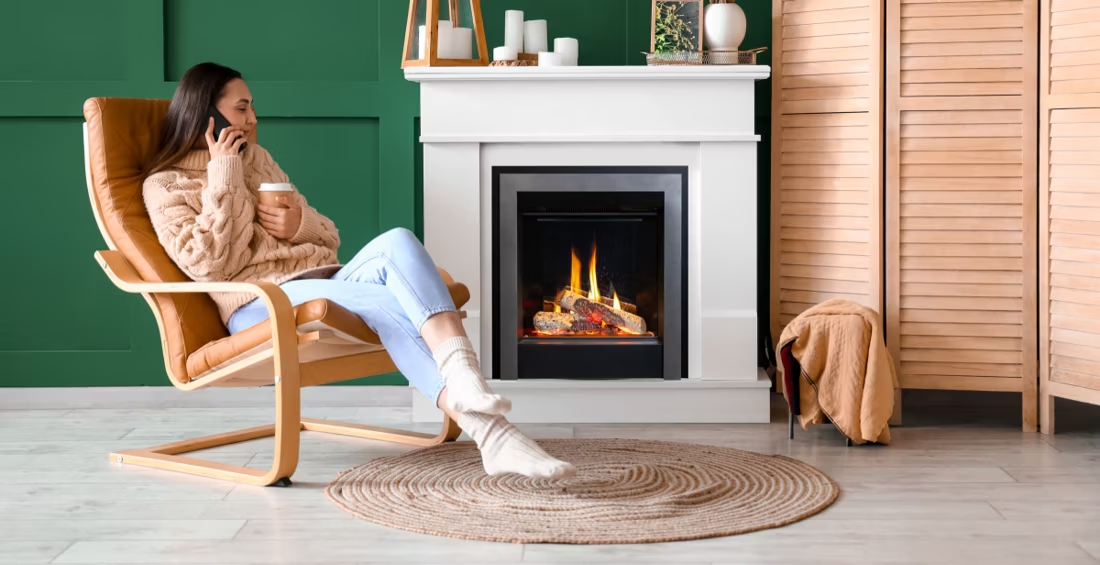
That's where electric fireplaces fit. There's no chimney to build, no gas line to run, and no combustion byproducts to vent—which matters in a humid coastal climate where masonry chimneys can trap moisture. AEP Texas Central Company and San Patricio Electric Cooperative both serve the Portland area at a residential rate of roughly 14 cents per kWh, so running a 1,500-watt unit costs only a few cents an hour. A local dealer can help you decide between a simple plug-in insert and a built-in wall unit wired to its own circuit.
Three steps. No salesperson until you're ready.
Tell us about your project
Your zip code, your situation, and the fuel you're leaning toward—or let the answers point you to one.
See what's actually available
The brands dealers within 100 miles genuinely carry—real options, never a catalog mirage.
Get your dealer & Project Guide
A trusted local dealer, plus the free Project Guide & Parts List that names every component of the job.
Frequently Asked Questions
How much does an electric fireplace installation cost in Portland?
A plug-in electric insert or freestanding unit typically runs $200 to $600 installed, since it uses an existing outlet and needs no electrical work. A built-in wall-mounted or linear electric fireplace that requires a dedicated 120V or 240V circuit, an electrician, and some framing or trim work generally runs $1,200 to $3,000 in Portland, depending on the unit size and how much finish carpentry is involved. Because there's no venting or chimney to account for, electric installs are consistently the least expensive fireplace project a homeowner in San Patricio County can take on.
Do I need a permit or an electrician for an electric fireplace?
A simple plug-in unit that draws from a standard household outlet doesn't require a permit. A built-in or wall-recessed electric fireplace on its own dedicated circuit does require an electrician, and depending on the scope of the work, the City of Portland Building Department or San Patricio County may require an electrical permit for the new circuit. A licensed local installer will typically pull any required permit as part of the job, which is one reason to work with a dealer rather than a DIY box-store install.
What's the difference between a plug-in electric fireplace and a built-in insert?
A plug-in unit is a freestanding stove, mantel package, or media-console fireplace that you set in place and plug into an outlet—no modification to your home required, and it can be moved later. A built-in insert or linear wall unit is recessed into a wall or existing fireplace opening, wired to a dedicated circuit, and finished with trim or tile for a custom look. For a Portland home without an existing fireplace, a plug-in unit is the fastest and cheapest way to add supplemental heat and ambiance; a built-in is the better choice when you want a fireplace to look and feel like a permanent architectural feature.
How much does it cost to run an electric fireplace in Portland?
At the local residential rate of about $0.1399 per kWh from AEP Texas Central or San Patricio Electric Cooperative, a typical 1,500-watt electric fireplace costs roughly 21 cents an hour to run on full heat, or a fraction of that with the heater off and just the flame effect running. Given how few genuinely cold nights Portland sees each winter, most homeowners find the annual heating cost negligible—the bigger factor in most households' decision is the look of the unit and how well it fits the room, not the electric bill.
How much heat can an electric fireplace actually put out?
Most residential electric fireplaces top out around 5,000 to 9,000 BTU, enough to comfortably warm a single room of 300 to 400 square feet—not a whole house. That ceiling is a non-issue in Portland, where the 942 annual heating degree days mean most homes rarely need more than a bit of supplemental warmth on winter mornings. Homeowners looking to heat an entire home should still look at central HVAC or a gas system; electric fireplaces here are chosen for zone heating and ambiance, not as a primary heat source.
Will my electric fireplace still work during a power outage?
No—unlike a wood stove, an electric fireplace needs grid power (or a generator) to run. That's worth planning around in a Gulf Coast community like Portland, where tropical storms and hurricanes can knock out power for days at a time. If you want a heat source that keeps working when AEP Texas or San Patricio Electric Cooperative's lines go down, a propane or natural gas unit is a better backup option; many local homeowners pair a gas fireplace for storm-season reliability with an electric unit elsewhere in the house for everyday ambiance.
Should I get an electric fireplace or a gas fireplace instead?
Gas is the more common choice for homeowners in Portland who want a fireplace as a real backup heat source, since natural gas and propane units keep running through a power outage and put out considerably more BTU. Electric fireplaces win on installation simplicity and cost—no gas line, no venting, and a fraction of the install price—plus they're the only realistic option for interior walls, apartments, or rooms far from an existing gas line. Given how mild Portland's winters run, many homeowners choose electric purely for the look and ambiance, reserving a gas unit or central HVAC for the rare hard freeze.
Why don't more homes in Portland use wood or pellet stoves?
With only 47-degree average winter lows and 942 heating degree days a year, Portland simply doesn't have the sustained cold that makes a wood or pellet stove worth the investment—the appliance would sit unused most of the year. That said, oak, pecan, and mesquite are all available regionally for the occasional homeowner who wants an outdoor fire pit or a wood-burning fireplace purely for ambiance rather than heat. For year-round indoor use, electric and gas remain the practical options in this climate.
What electric fireplace brands are available through local dealers?
Local hearth dealers serving the Corpus Christi Bay area typically carry brands like Dimplex, Napoleon, and Amantii, which cover everything from mantel packages and stove-style units to fully custom linear wall inserts with realistic flame technology. Availability varies by dealer and by season, so the most reliable way to see what's actually in stock and installable in Portland is to get matched with a local retailer who can walk you through current models in person.
Can I put a TV above my fireplace?
Yes—with an asterisk. Fireplaces are hot and TVs don't like heat. Either put a mantel between them to deflect rising warmth, or choose a fireplace with heat-management technology that creates a cool zone on the wall above—the wall stays around 125 degrees, barely warm, while the room still gets full heat. If you like clean lines and don't want a mantel, heat management is the answer.
Does an electric fireplace need a vent or chimney?
No—that's its superpower. An electric fireplace needs a wall and an outlet, period. No vent pipe, no gas line, no clearances to design around, which is why it works in bedrooms, offices, apartments, and walls where venting a gas or wood unit would be impractical or impossible. Installation is typically the simplest and least expensive of any fireplace type.
Can I install a fireplace myself?
If you're putting a fire in your house on purpose, it's best to work with an expert. Unless you're genuinely experienced in framing, gas line, vent pipe, and the national code on clearances to combustibles, have a professional do it—and ideally the same company that sells you the fireplace, so warranty, service, and liability all live under one roof.
Can a fireplace actually lower my heating bill?
Yes—by creating a comfort zone. A furnace heats every square foot of the house just to warm the one room you're in; a gas fireplace on low burns roughly a sixth of the gas a typical furnace does. Set the furnace around 55–60 degrees as a baseline, then heat the rooms your family actually uses. Families who heat this way commonly save $20–$60 a month.
Nearby Dealers
Hearth shops serving Portland and the surrounding area. Every listing shows whether it is a WhyFire partner, a dealer we have verified as authorized for the brands we recommend, or a local business carrying hearth products. No manufacturer pays for placement. How we verify dealers →
C.c. Chimney
Martini Brick
Kitchen & Bath Showplace
The Design Haus Of Victoria
Victoria Builder Supply Co Inc.
Electric Service in Portland
An electric fireplace's heater draws about 1,500 watts—pennies per hour at local rates.
Aep Texas Central Company
San Patricio Electric Coop Inc
Find your electric fireplace in Portland.
Tell us a bit about your home and we'll match you with a trusted local dealer and send over a free Project Guide & Parts List—the right unit, the wiring needs, and what it takes to get it installed in your Portland home.
Find Your Fireplace →