
Real fireplace warmth, no chimney required.
Hopkins County's winters are mild—average lows around 34°F and just 2,514 heating degree days a year—which makes electric fireplaces and inserts an easy, no-venting way to add real ambiance and supplemental warmth from Sulphur Springs to Como and Cumby. Find the right unit and connect with a trusted local dealer.
Every Project Starts From One of These Five Situations
Electric heat fits Hopkins County's mild winters perfectly.
Hopkins County—dairy country centered on Sulphur Springs, with a population under 18,000 spread across small towns like Como, Cumby, Tira, and Sulphur Bluff—sits in climate zone 3A. Winters here are short and mild: average lows hover around 34°F and the county logs only about 2,514 heating degree days a year, a fraction of what colder states rack up. That's a very different heating picture than the wood-heavy tradition many longtime residents grew up with, splitting oak, pecan, or mesquite for a fireplace that ran hard three or four months a year.
For most Hopkins County homes, the fireplace's real job now is ambiance and light supplemental warmth on the handful of genuinely cold nights each winter—not carrying the whole heating load. Electric inserts and stoves deliver that without a flue, without gas line work, and without the upkeep of a wood-burning setup. They install into an existing masonry fireplace opening in an afternoon, plug into a standard outlet or a dedicated 120V/240V circuit depending on the model, and give you flame effect and heat on demand—a good fit whether you're updating a ranch home outside Sulphur Springs or finishing a room addition where running a chimney isn't practical.
Three steps. No salesperson until you're ready.
Tell us about your project
Your zip code, your situation, and the fuel you're leaning toward—or let the answers point you to one.
See what's actually available
The brands dealers within 100 miles genuinely carry—real options, never a catalog mirage.
Get your dealer & Project Guide
A trusted local dealer, plus the free Project Guide & Parts List that names every component of the job.
Frequently Asked Questions
How much does an electric fireplace installation cost in Hopkins County?
Most electric fireplace and insert installations in Hopkins County run in the $400 to $1,500 range. A simple plug-in insert that drops into an existing masonry fireplace opening is on the low end—often just the cost of the unit plus an hour or two of labor. Built-in wall units or larger inserts that need a dedicated 240V circuit run higher, since an electrician has to add or extend wiring. Because there's no venting or gas line to run, electric installs are consistently the fastest and least expensive fireplace option in the county—local dealers can usually quote a firm price after a quick look at your existing opening and electrical panel.
What size electric fireplace or insert do I need for my home?
Given Hopkins County's mild winter load—around 2,514 heating degree days and average lows near 34°F—most homes here don't need a high-output unit to feel a difference. A standard 1,500-watt insert (roughly 5,000 BTU equivalent) comfortably takes the chill off a single living room or den, which covers most local use cases. Larger open-concept spaces or homes using the fireplace as a real supplemental heat source on the county's coldest nights may want a wider insert with a higher-wattage heater core. Local dealers will look at your room size and existing fireplace opening and recommend a unit sized for actual use rather than overselling wattage you won't need in this climate.
Can I convert my existing wood-burning fireplace to electric?
Yes, and it's one of the most common projects for older homes around Sulphur Springs and throughout the county that were originally built around a wood-burning hearth. An electric insert slides into the existing masonry opening, no chimney liner or gas line needed, and typically installs in a few hours. It eliminates the work of seasoning and hauling oak, pecan, or mesquite firewood while keeping the look of the original fireplace. This is a popular option for homeowners who want the mantel and surround they already have without the maintenance a wood-burning setup requires.
Do I need a permit to install an electric fireplace in Hopkins County?
In most cases, no—a plug-in electric insert or freestanding unit doesn't require a building permit since there's no venting, chimney work, or gas line involved. If your project involves adding a new dedicated electrical circuit or larger panel work, an electrical permit through the Hopkins County building department may apply, and your electrician will typically handle that as part of the job. This is one of the reasons electric fireplaces are the simplest fireplace option to add to an existing Hopkins County home—there's far less code and inspection overhead than a wood or gas installation.
Will my electric fireplace still work if the power goes out?
No—and this is worth being honest about. Electric fireplaces run entirely on household power, so a grid outage means no flame effect and no heat, unlike a wood stove that keeps working regardless. Texas's ERCOT grid has shown real vulnerability during severe winter weather events, most notably the February 2021 freeze, so Hopkins County homeowners who want fireplace heat that survives a power outage should consider keeping a wood-burning option in at least one room, or pairing an electric fireplace with a backup heat plan for the rare ice storm. For day-to-day ambiance and supplemental warmth in normal winter weather, electric performs reliably.
What's the difference between an electric fireplace, insert, and wall-mount unit?
An electric insert is built to slide into an existing masonry fireplace opening, using the surround and mantel you already have—the most common choice for older Hopkins County homes converting from wood. A built-in electric fireplace is designed to be framed into a wall during a remodel or new construction, giving a more custom, flush look. A wall-mount unit hangs directly on a wall like a piece of art or a TV and needs no fireplace opening at all, which works well for newer homes or rooms that never had a hearth. All three plug into standard household power or a dedicated circuit depending on wattage, with no venting required for any of them.
What's the best electric fireplace for Hopkins County's climate?
Because Hopkins County's heating need is modest—mild lows around 34°F and roughly 2,514 heating degree days a year—most homeowners here do well with a mid-range insert or wall-mount unit in the 1,400 to 1,500-watt class, which is the ceiling for most standard household circuits anyway. Look for models with an adjustable thermostat and a realistic LED flame effect, since ambiance is usually the primary use case in this climate rather than carrying the heat load. Homes that want the fireplace to genuinely offset the furnace on the county's coldest nights should ask a local dealer about larger-capacity inserts with a 240V hookup, which push more usable heat into the room.
How much does it cost to run an electric fireplace?
A typical 1,500-watt electric fireplace costs roughly 15 to 20 cents per hour to run on heat mode at current Texas electricity rates, and far less if you're only running the flame effect without the heater engaged. For a Hopkins County home using the fireplace for evening ambiance and occasional supplemental heat rather than as a primary heat source, that translates to a modest addition to your monthly electric bill—generally cheaper to operate than portable space heaters of similar wattage, and with none of the ash, creosote, or chimney maintenance that comes with wood.
Electric vs. wood—which is right for my Hopkins County home?
Wood is the traditional choice in this part of Texas, with oak, pecan, and mesquite all common locally, and it offers real BTU output plus the ability to keep heating during a power outage. But with Hopkins County's mild climate—average lows near 34°F and just 2,514 heating degree days—most homes don't need wood's heat output to stay comfortable, and the wood-splitting, ash cleanup, and chimney upkeep are real costs of their own. Electric wins for convenience, cleanliness, and cost of installation, and it's a strong fit for homes where the fireplace is mainly used for ambiance and light supplemental heat a few weeks a year. Homes concerned about ERCOT grid reliability during rare ice storms sometimes keep a wood-burning option in one room as a backup while going electric everywhere else.
Can I put a TV above my fireplace?
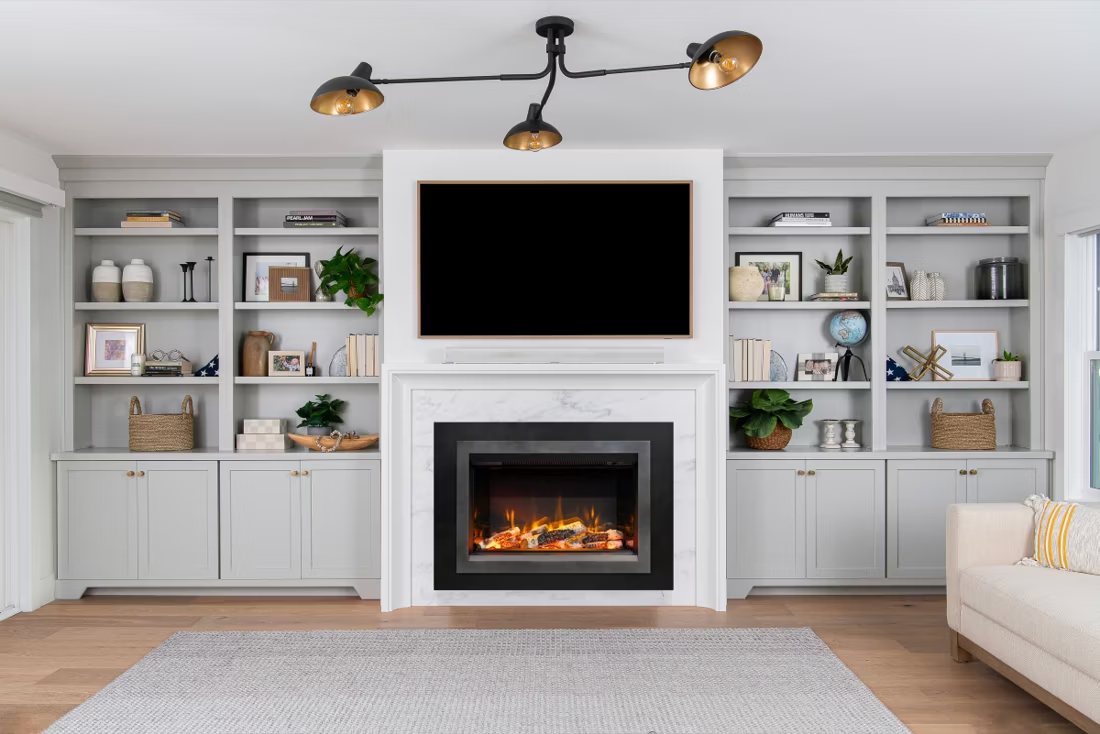
Yes—with an asterisk. Fireplaces are hot and TVs don't like heat. Either put a mantel between them to deflect rising warmth, or choose a fireplace with heat-management technology that creates a cool zone on the wall above—the wall stays around 125 degrees, barely warm, while the room still gets full heat. If you like clean lines and don't want a mantel, heat management is the answer.
Does an electric fireplace need a vent or chimney?
No—that's its superpower. An electric fireplace needs a wall and an outlet, period. No vent pipe, no gas line, no clearances to design around, which is why it works in bedrooms, offices, apartments, and walls where venting a gas or wood unit would be impractical or impossible. Installation is typically the simplest and least expensive of any fireplace type.
How much should I budget for a fireplace?
For an average home—covering the fireplace, the vent pipe, and basic installation—a budget between $3,900 and $5,500 gives you a lot of options across wood, gas, and pellet. By the time you add finish work, gas line, and electrical, the average complete installation lands between $5,000 and $12,000 all-in. In a remodel or new build, a good rule is to put about 2.5% of the total project cost toward the fireplace.
What is an in-home preview and do I need one?
It's a visit where a hearth professional measures your space, confirms the model you picked actually works in your home, and walks the specs—framing, gas line, venting, finish work—before anything is ordered. Some details you just can't know until you see the house. Never make a down payment without one; it's the single most-skipped step that burns buyers.
Stove and Fireplace Dealers in Hopkins County
Listings include WhyFire partner dealers, dealers we have verified as authorized for the brands we recommend, and established local businesses that carry hearth products. Every listing shows which one it is. The ones marked Preferred run on WhyFire's software, so they can show you real pricing and book your appointment right here. No manufacturer pays for placement. How we verify dealers →
Youngs Brothers Buck Stove
Fireside Corner
Find your electric fireplace in Hopkins County.
Tell us a bit about your home and we'll match you with the right electric fireplace or insert, plus a free Project Guide & Parts List with the exact parts and a recommended local Hopkins County dealer.
Find Your Fireplace →