
Fast, clean heat for Childress's sudden cold fronts.
Childress winters run mild most of the season, but a blue norther can drop the temperature 30 degrees in an afternoon. A gas fireplace gives you instant heat on demand—find the right unit and find a trusted local dealer.
Every Project Starts From One of These Five Situations
Gas fills the gap between mild Panhandle winters and the occasional deep freeze.
Childress sits in the Rolling Plains of the Texas Panhandle, at about 1,930 feet elevation along US 287. With an average winter low near 29°F and a heating season that's just a fraction as long as colder climates see, this isn't a place that needs a wood stove running for six months like a home in Bismarck, ND. What it does need is a heat source that can respond fast when a blue norther pushes through and the temperature falls 30 or 40 degrees in a few hours.
There's no significant local firewood or wood-pellet retail infrastructure here—Childress County is cattle and cotton country, not timber country, and oak, pecan, and mesquite are far more common on a smoker than in a fireplace. That makes gas the practical default for most homeowners. Because Childress is a small town, plenty of homes outside the core city limits run on propane rather than piped natural gas, so knowing which fuel serves your address matters before you pick a unit. Electric fireplaces are also a straightforward, low-cost option here, with AEP Texas North Company serving in-town customers and South Plains Electric Cooperative and Lighthouse Electric Cooperative covering the surrounding rural county.
Three steps. No salesperson until you're ready.
Tell us about your project
Your zip code, your situation, and the fuel you're leaning toward—or let the answers point you to one.
See what's actually available
The brands dealers within 100 miles genuinely carry—real options, never a catalog mirage.
Get your dealer & Project Guide
A trusted local dealer, plus the free Project Guide & Parts List that names every component of the job.
Frequently Asked Questions
How much does a gas fireplace installation cost in Childress?
Most gas fireplace and insert installations run somewhere between $3,500 and $9,000 in a town this size, with the low end covering a direct-vent insert into an existing masonry fireplace where gas service is already run to the house, and the higher end covering new construction or a remodel that needs framing, venting, and a fresh gas or propane line. If your home runs on propane rather than piped natural gas, factor in the cost of a tank—either a lease from a local propane supplier or an owned tank, which adds to the upfront cost but is common practice around Childress County. A local dealer will give you a firm number after seeing your home and your existing fuel setup.
Does my Childress home have natural gas, or do I need propane?
It depends on where you're located. Homes closer to the center of Childress may have access to piped natural gas, but a meaningful share of homes in and around Childress County—especially outside the city core—run on propane, which is the norm across much of the rural Texas Panhandle. Before you shop for a fireplace, check with your gas provider or a local propane retailer to confirm what's actually available at your address. Nearly every gas fireplace and insert on the market can be configured for either fuel, so this affects your setup cost more than your model choice.
Do I need a permit to install a gas fireplace in Childress?
Most gas fireplace installations require a building permit, and any new gas line work needs to be pulled by a licensed gas-fitter—that's true whether you're inside city limits or in unincorporated Childress County. Contact the City of Childress or Childress County building department to confirm requirements for your specific address before work starts. A reputable local installer will typically handle this paperwork as part of the job rather than leaving you to coordinate it yourself.
Vented or vent-free—which makes sense for a Childress home?
Vented (direct-vent) gas fireplaces draw combustion air from outside and exhaust it back outside, which makes them the safer, more universally code-compliant choice and the one most local dealers install by default. Vent-free units burn directly into the room and are legal in Texas, but they come with strict room-sizing and ventilation rules, and they release some combustion byproducts indoors. Given that Childress has no local air quality restrictions to navigate either way, the decision usually comes down to whether you have an existing chimney or vent path to use—a direct-vent insert into an existing masonry fireplace is often the simplest and most cost-effective route.
Will a gas fireplace keep working if the power goes out?
Most modern gas fireplaces will, which matters on the Panhandle where ice storms and high-wind events occasionally knock out power along with a cold front. Units with intermittent pilot ignition (IPI) run on battery backup—usually AA batteries inside the unit—that kick in automatically and let the fireplace light on demand even with no electricity. Valor fireplaces take a different approach: the pilot's thermocouple generates its own electricity, so there are no batteries to remember at all. Ask your local dealer about the ignition system on any model you're considering if outage backup matters to you.
What's the difference between a gas fireplace, insert, and stove?
A gas fireplace is a fully built-in unit framed into a wall—the right choice for new construction or a remodel. A gas insert slides into an existing masonry fireplace opening and uses the existing chimney as its vent path, which is the more common project in older Childress homes that already have a wood-burning fireplace they'd like to convert. A gas stove is a freestanding unit, similar in footprint to a wood stove, that can go almost anywhere with the right clearances. For most homes here with an existing fireplace, an insert is the simpler and less invasive upgrade.
How do I size a gas fireplace for a Childress home?
Because Childress's winters are relatively mild—that average low near 29°F is nothing like a home in Fargo, ND running its heat source around the clock from October through April—most homeowners here don't need a large, primary-heat-rated unit. A mid-size direct-vent insert or fireplace is usually enough to comfortably heat a main living area and take the edge off during a cold front, with central HVAC or a space heater covering the rest of the house. A local dealer will size the unit to your square footage and room layout during a walkthrough rather than relying on a generic chart.
Gas vs. electric fireplace—which is the better fit here?
Gas delivers real heat output and works during a power outage (with the right ignition system), which matters when a blue norther arrives alongside high winds. Electric fireplaces are far cheaper to install—often $400 to $1,500—plug into a standard outlet, and produce zero emissions, but they rely entirely on grid power and won't help during an outage. Local electric rates run from about 10.35¢ per kWh with AEP Texas North Company to as high as 14.59¢ with the rural cooperatives, South Plains Electric and Lighthouse Electric, so run costs are modest either way. For a secondary living space or a home that just wants ambiance with minimal install hassle, electric is a reasonable choice; for real backup heat during storms, gas has the edge.
Why isn't wood a bigger option in Childress?
Wood-burning fireplaces and stoves are technically installable anywhere, but Childress doesn't have the local firewood economy or forested land access that supports wood heat in places like the Cascades or the Rockies. Oak, pecan, and mesquite are all locally available, but they're typically bought by the bundle for grilling and smoking rather than by the cord for heating a house. Combined with mild winters that rarely demand all-day heat, gas—or propane where natural gas isn't available—ends up being the more practical, lower-maintenance choice for the vast majority of homeowners here.
Why is a fireplace insert so efficient?
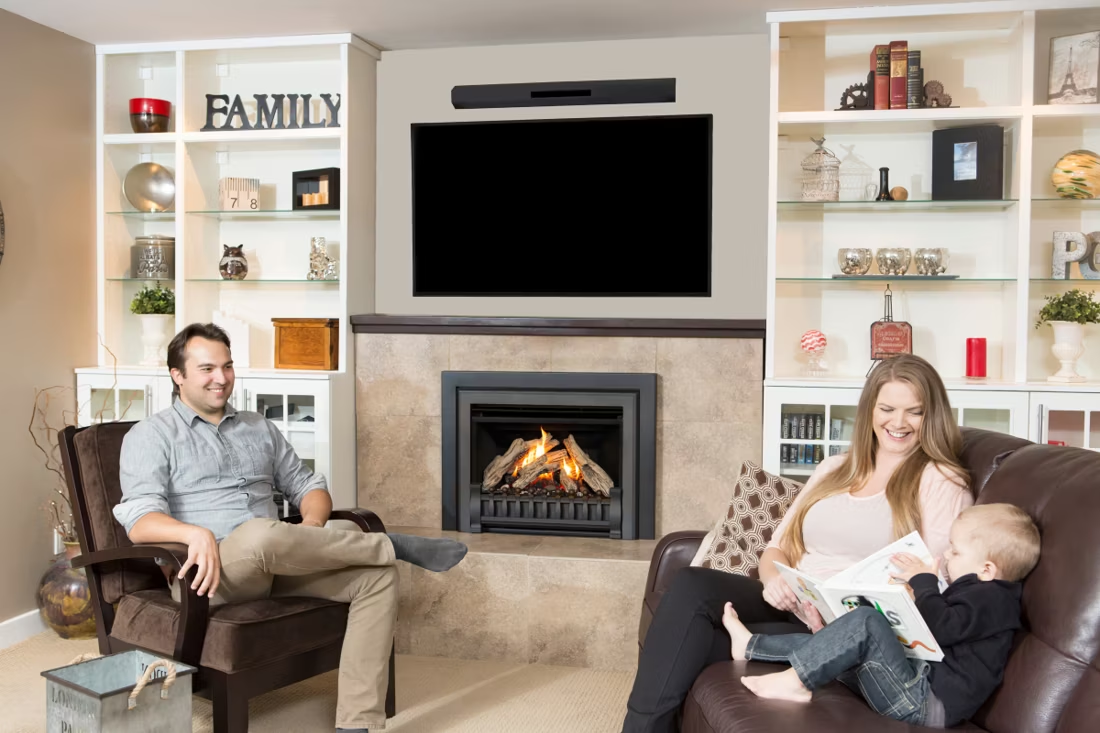
An insert does two things: it seals the chimney completely, so you stop losing air you already paid to heat, and it radiates warmth into the room through the firebox and glass. Most add a heat-exchange fan that pulls cool room air underneath, wraps it around the hot firebox, and pushes it back out warm. Your home is more efficient before you've even lit the first fire.
Why is my open fireplace making my house colder?
Open fireplaces suck—literally. As the fire burns, it consumes air your furnace already paid to heat and pulls it out through the chimney, so the house is actually colder after the fire goes out than before you lit it. An insert fixes this: it seals the chimney, puts fixed glass across the front, and turns that hole in your house into a real heat source.
Can a fireplace actually lower my heating bill?
Yes—by creating a comfort zone. A furnace heats every square foot of the house just to warm the one room you're in; a gas fireplace on low burns roughly a sixth of the gas a typical furnace does. Set the furnace around 55–60 degrees as a baseline, then heat the rooms your family actually uses. Families who heat this way commonly save $20–$60 a month.
Does a fireplace add value to my home?
On average, a fireplace adds back to the home about the same amount you spent installing it. Add the monthly savings from heating the rooms you actually use instead of the whole house—often hundreds of dollars a year—and the value case is strong before you even count what a fire does for how your family uses the room.
Popular Gas Brands
Where each brand came from, what's inside it today, and every current model. No brand pays to be here. Not every dealer carries every brand, so enter your zip code to see what's sold near Childress.
Kozy Heat
Kozy Heat was founded in 1976 by Dudley Hussong in Lakefield, Minnesota, and incorporated as Hussong Manufacturing Co., Inc. in 1978.
28 gas models →Fireplace Xtrordinair
Fireplace Xtrordinair, now often called FireplaceX, is the fireplace brand of Travis Industries, Inc., of Mukilteo, Washington.
25 gas models →Town & Country
Town & Country Fireplaces is the luxury gas fireplace brand of Pacific Energy Fireplace Products Ltd., of Duncan, British Columbia.
14 gas models →Lopi
Lopi is a wood, pellet, and gas stove brand founded by Kurt Rumens in Bellevue, Washington, in 1979.
7 gas models →Forge & Flame
Forge & Flame is the stove brand Hearth & Home Technologies introduced in August 2023 to bring Vermont Castings, Harman, and Quadra-Fire under one name.
6 gas models →Vermont Castings
Vermont Castings was founded in 1975 by Duncan Syme, the designer, and his brother-in-law Murray Howell, the business partner, in Randolph, Vermont.
6 gas models →Find your gas fireplace in Childress.
Tell us a bit about your home and your fuel setup—natural gas or propane—and we'll help you find the right gas fireplace, insert, or stove, plus a free Project Guide & Parts List from a trusted local dealer.
Find Your Fireplace →