
Instant heat for Carthage's mild winters, no wood pile required.
Clean, on-demand gas heat built for East Texas—plus a battery-backup option that kept plenty of Panola County homes warm during the 2021 freeze. Find the right unit and connect with a trusted local dealer.
Every Project Starts From One of These Five Situations
Gas fits Carthage's mild winters and gas-country heritage.
Carthage sits in the Piney Woods of deep East Texas, in climate zone 3A, where winters are mild by national standards—the average winter low is 36°F and the city has a light overall heating load each year, a fraction of what a city like Duluth, Minnesota racks up in a single hard month. At 298 feet of elevation, hard freezes are the exception, not the rule. But they do happen: the February 2021 winter storm that crippled the Texas grid hit Panola County hard, with SWEPCO and the local electric cooperatives reporting multi-day outages. That week did more to sell direct-vent gas fireplaces with battery-backup ignition around here than a decade of ordinary sales pitches.
There's a certain irony to installing a gas fireplace in Panola County: this is Carthage Gas Field country, one of the largest onshore natural gas fields in the United States, sitting practically underfoot. Despite that, not every address in the 75633 zip code is on a natural gas main—many homes outside the city core, and much of rural Panola County, run on propane tanks instead. Either fuel works fine in a modern direct-vent fireplace or insert; the installer just sets the orifice and regulator for whichever supply reaches your address. For rooms without gas service at all, electric fireplaces are a real option too, since Southwestern Electric Power Co. and the local cooperatives—Deep East Texas Electric Co-op and Rusk County Electric Co-op—keep residential rates around 13 cents per kWh.
Three steps. No salesperson until you're ready.
Tell us about your project
Your zip code, your situation, and the fuel you're leaning toward—or let the answers point you to one.
See what's actually available
The brands dealers within 100 miles genuinely carry—real options, never a catalog mirage.
Get your dealer & Project Guide
A trusted local dealer, plus the free Project Guide & Parts List that names every component of the job.
Frequently Asked Questions
How much does a gas fireplace installation cost in Carthage?
A typical gas fireplace or insert installation in Carthace runs roughly $3,500 to $9,000, depending on the unit, the venting path, and whether your address is on natural gas or propane. A direct-vent insert dropped into an existing masonry fireplace with fuel already run to the hearth sits at the low end. New construction, a fresh propane tank set and line run, or a built-in unit that needs framing and venting through a wall pushes toward the higher end. Because Panola County has a real mix of natural gas and propane households, get your quote after confirming which fuel actually serves your property—it changes the scope of the job.
Can I convert my existing wood fireplace to gas?
Plenty of older Carthage homes still have a masonry fireplace built for burning local oak, pecan, or mesquite—the same species that fuel backyard smokers all over Panola County. Converting one to gas usually means installing a direct-vent or vent-free gas insert that either uses the existing chimney with a liner or vents its own sealed pipe through the wall. Expect $3,500 to $7,500 for the conversion, plus any gas or propane line work if the fireplace wasn't previously plumbed for fuel. You keep the mantel and the masonry look and trade splitting wood for a switch or remote.
Do I need natural gas to install a gas fireplace, or can I use propane?
It depends on your address. Panola County produces enormous volumes of natural gas—the Carthage Gas Field is one of the largest onshore fields in the country—but that doesn't mean every home sits on a distribution line. Homes inside Carthage proper are more likely to have natural gas service; homes further out in rural Panola County typically run on propane delivered by a local supplier and stored in a tank on the property. Most gas fireplace models can be configured for either fuel with the correct orifice kit, so the choice usually comes down to what's already running to your house rather than which fireplace you want.
Will my gas fireplace work during a power outage?
Yes, and after February 2021 it's a question a lot more Carthage homeowners ask upfront. Fireplaces with intermittent pilot ignition (IPI) run on a small battery backup that keeps the pilot lighting even when the SWEPCO or local co-op grid goes down—you flip the switch or use the remote and it lights like normal. Valor fireplaces take a different approach: the pilot's thermocouple generates its own electricity, so there's no battery to remember or replace. For a county that saw multi-day outages during the 2021 freeze, that kind of self-sufficient ignition is worth asking about specifically.
What's the difference between a gas fireplace, gas insert, and gas stove?
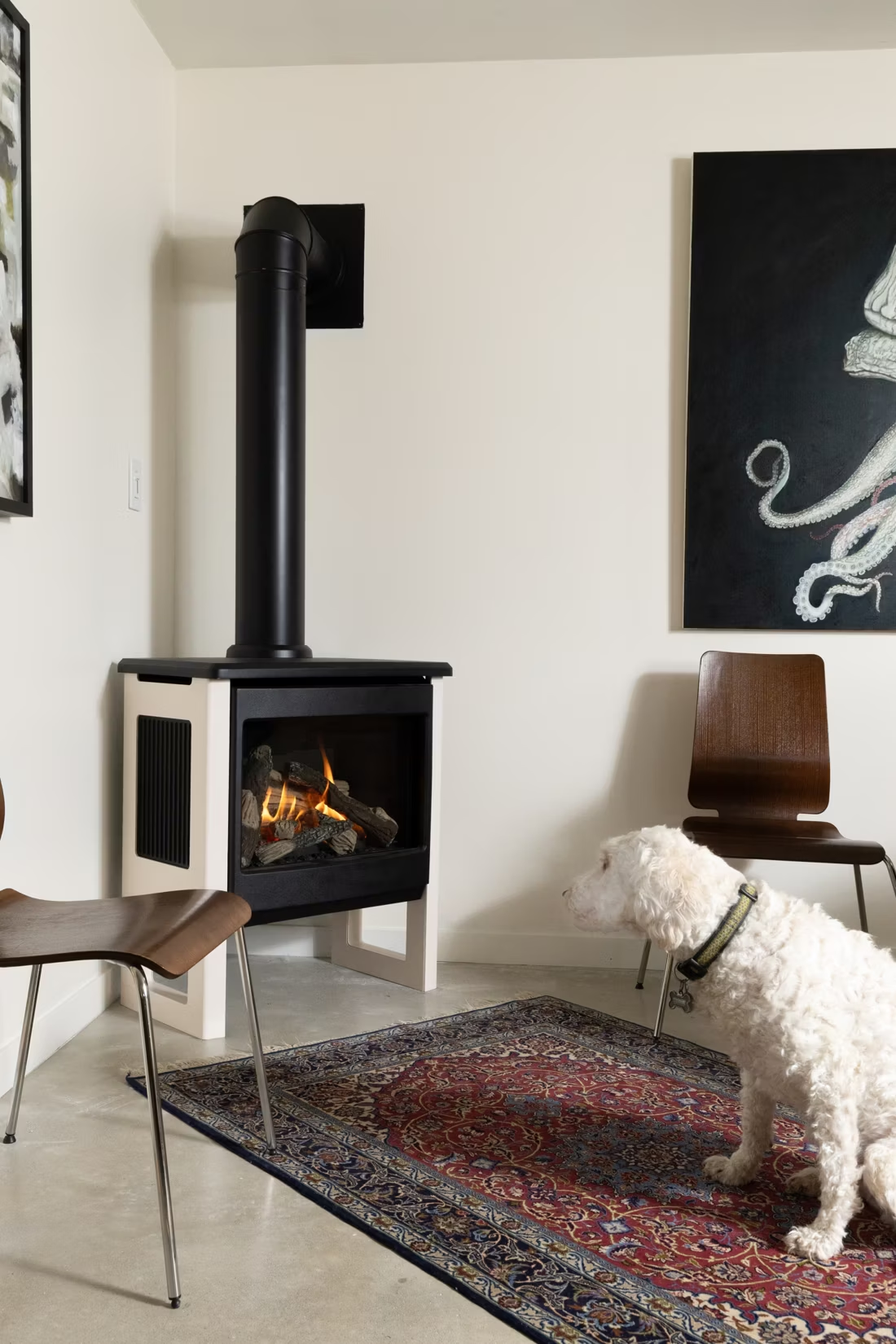
A gas fireplace is a fully built-in unit framed into a wall—the right call for new construction or a remodel. A gas insert drops into an existing masonry firebox, using the lined chimney as its vent path, and is the most common upgrade for older Carthage homes that already have a traditional wood fireplace. A gas stove is a freestanding, cast-iron-look unit that sits on the floor and vents through a wall or existing flue, a good fit for a den or add-on room that never had a fireplace. Most Carthage retrofits end up being inserts, simply because so many local homes already have the masonry firebox to work with.
Do I need a permit to install a gas fireplace in Carthage?
Yes. The City of Carthage building department, or Panola County for addresses outside city limits, requires a permit for gas fireplace installation, and any new gas or propane line needs to be run by a licensed gas-fitter or your propane supplier's certified installer. A reputable local hearth dealer will pull the permit and coordinate the fuel-line work and inspection as part of the install, so you're not left juggling separate contractors.
What's the difference between vented and vent-free gas fireplaces?
Vented direct-vent units draw combustion air from outside and exhaust it back outside through a sealed pipe—they're the standard recommendation and work in every room, in every home. Vent-free (ventless) gas fireplaces burn without any outside venting at all, releasing a small amount of moisture and combustion byproducts into the room; Texas permits them, and they're a popular supplemental option in Carthage for a den or sunroom that doesn't already have a flue. Given the mild 3A climate here, a properly sized vent-free unit can genuinely take the edge off a cold snap without the cost of running new venting—but it's still worth asking your local dealer whether a vented unit makes more sense for your room.
How often should my gas fireplace be serviced?
Plan on an annual inspection, typically $150 to $250, where a technician checks the burner, pilot assembly, venting, and gas connections and cleans the glass. Carthage's mild winters mean gas fireplaces here often see lighter seasonal use than in colder states, but the annual check still matters—a dirty pilot or a degraded gas connection doesn't usually announce itself until it fails.
Gas vs. electric—which is right for my home?
With Southwestern Electric Power Co. and the local electric cooperatives running Carthage-area residential rates around 13 cents per kWh—cheaper than a lot of the country—an electric fireplace or insert is a genuinely reasonable option here, especially for a room that doesn't already have gas or propane service. Electric units install in an afternoon with no venting or gas line at all, run for a few cents an hour, and produce real supplemental warmth, though not the same BTU output as a gas insert. Gas still wins for whole-room heating and for keeping a fireplace running during a grid outage, which East Texas has seen firsthand. Plenty of local homes end up with both: gas in the main living space, electric in a bedroom or office.
Is my gas fireplace wasting gas?
If it was installed more than 15 years ago, probably. Older gas fireplaces keep a standing pilot light burning all the time, and that little flame can cost a couple hundred dollars a year. Newer models use pilot-on-demand ignition—the pilot lights only when you use the fireplace and goes out when you turn it off.
What's the difference between an insert and a zero-clearance fireplace?
An insert is a fireplace that slides into a pre-existing wood-burning fireplace—if you don't have one, there's nothing to insert it into. A zero-clearance fireplace is built into a framed wall, which makes it the answer for remodels and new construction. Simple test: existing masonry fireplace means insert; blank or framed wall means zero-clearance.
Can a fireplace actually lower my heating bill?
Yes—by creating a comfort zone. A furnace heats every square foot of the house just to warm the one room you're in; a gas fireplace on low burns roughly a sixth of the gas a typical furnace does. Set the furnace around 55–60 degrees as a baseline, then heat the rooms your family actually uses. Families who heat this way commonly save $20–$60 a month.
How much should I budget for a fireplace?
For an average home—covering the fireplace, the vent pipe, and basic installation—a budget between $3,900 and $5,500 gives you a lot of options across wood, gas, and pellet. By the time you add finish work, gas line, and electrical, the average complete installation lands between $5,000 and $12,000 all-in. In a remodel or new build, a good rule is to put about 2.5% of the total project cost toward the fireplace.
Nearby Dealers
Hearth shops serving Carthage and the surrounding area. Every listing shows whether it is a WhyFire partner, a dealer we have verified as authorized for the brands we recommend, or a local business carrying hearth products. No manufacturer pays for placement. How we verify dealers →
Custom-Bilt Cabinet & Supply
Fireplace Specialties
Find your gas fireplace in Carthage.
Tell us a bit about your home and fuel setup, and we'll match you with the right gas fireplace, insert, or stove—plus a free Project Guide & Parts List with the exact vent kit and parts your local dealer will need.
Find Your Fireplace →