
Reliable gas heat for Carson County's high-plains winters.
Instant, no-fuss warmth for Panhandle, Groom, White Deer, and Skellytown homes—matched with a trusted local dealer who knows what actually vents and installs correctly out here.
Every Project Starts From One of These Five Situations
The ground beneath Carson County holds one of the largest gas fields in the country.
Carson County sits on the high plains of the Texas Panhandle, home to about 4,500 people spread across Panhandle (the county seat), Groom, White Deer, and Skellytown, with Amarillo the nearest metro roughly 25 miles west. Winters here average a 24°F overnight low and around 4,086 heating degree days—milder on paper than the northern Rockies or upper Midwest, but blue northers and ice events can drop temperatures fast and hard, and the February 2021 winter storm that knocked out power across much of the Texas Panhandle is still a fresh memory for a lot of homeowners here.
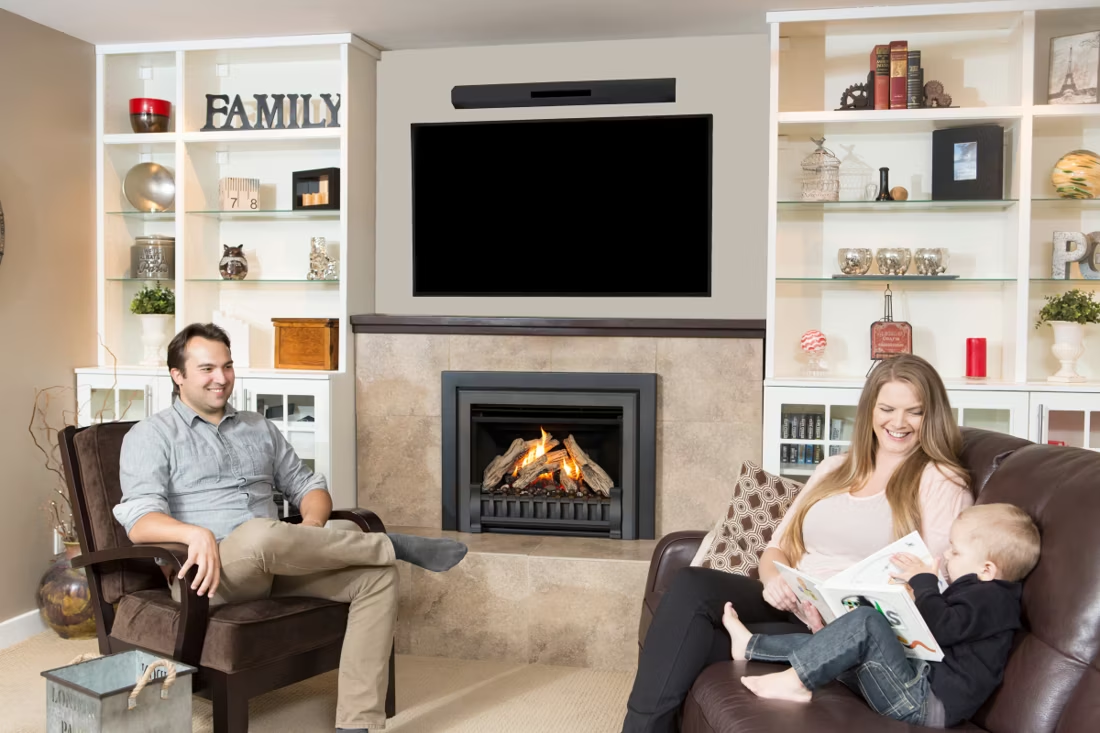
Carson County is part of the historic Panhandle Field, one of the largest natural gas fields ever discovered in North America, and that heritage shows up in the infrastructure: Atmos Energy runs natural gas service through Panhandle, Groom, White Deer, and Skellytown, so most in-town homeowners already have gas at the meter. Outside city limits, ranch and rural homes typically rely on a propane tank instead—production wells under the ground don't automatically mean a residential gas line at the house. Either way, a gas fireplace or insert gives Carson County homes instant zone heat that pairs well with central HVAC, without the ash and wood handling that comes with a traditional hearth.
Three steps. No salesperson until you're ready.
Tell us about your project
Your zip code, your situation, and the fuel you're leaning toward—or let the answers point you to one.
See what's actually available
The brands dealers within 100 miles genuinely carry—real options, never a catalog mirage.
Get your dealer & Project Guide
A trusted local dealer, plus the free Project Guide & Parts List that names every component of the job.
Frequently Asked Questions
How much does a gas fireplace installation cost in Carson County?
A direct-vent gas insert going into an existing fireplace with a gas line already at the house is the least expensive path—often in the $4,000 to $6,500 range. A new built-in gas fireplace with framing and a fresh gas run for a remodel or new construction typically lands higher, and rural homes outside Panhandle, Groom, White Deer, or Skellytown that need a new propane tank installed will usually see the highest end of the range. A local dealer will give you a firm number after seeing your home, but knowing whether you're on Atmos Energy natural gas or propane changes the estimate significantly before anyone even shows up.
Can I convert my existing wood fireplace to gas?
Yes, and it's a common project for older homes in Panhandle and Groom with an existing masonry fireplace that's mostly used for ambiance. A gas insert drops into that opening and uses the existing chimney (with a stainless liner) as the vent path, which keeps the cost down compared to a new build-out. If your home has been burning local oak, pecan, or mesquite for years, a lot of homeowners keep the wood-burning option in a second room and add gas to the main living space for daily convenience.
Should I use natural gas or propane for my fireplace?
If your home is inside Panhandle, Groom, White Deer, or Skellytown, you're likely already on Atmos Energy natural gas service, which makes adding a fireplace straightforward—no tank, no delivery schedule. If you're on a ranch or acreage outside those town limits, propane is the standard fallback even in a county that sits on top of one of the country's biggest gas fields; the wells don't put a line at your house. Propane requires either an existing tank or a new tank install from a regional supplier, and most gas fireplace models can be configured for either fuel by your installer.
Will my gas fireplace work if the power goes out?
Most modern gas fireplaces with IPI (intermittent pilot ignition) run on a battery backup that kicks in automatically when power drops, so the fireplace still lights and heats the room. Valor units go a step further—the pilot's thermocouple generates its own electricity, so there's no battery to remember at all. That distinction matters in Carson County: the rolling blackouts during the February 2021 winter storm hit the Panhandle hard, and a fireplace that only works when the grid does isn't much of a backup plan. Ask your local dealer about the ignition system on any unit you're considering.
What's the difference between a gas fireplace, gas insert, and gas stove?
A gas fireplace is a fully built-in unit framed into a wall, typically chosen for new construction or a remodel. A gas insert fits into an existing masonry fireplace opening and uses the existing chimney as its vent, which is the common route for older homes in Panhandle and Groom. A gas stove is a freestanding cabinet-style unit that sits on the floor like a wood stove but burns gas—a good option for a room without any existing fireplace or chimney. Which one fits depends on what's already in the wall, and a local dealer can tell you quickly which path is cheaper for your specific house.
Do I need a permit to install a gas fireplace in Carson County?
It depends on where you are. Inside Panhandle, Groom, White Deer, or Skellytown, the city office typically requires a permit for gas line work and any structural changes. Carson County doesn't run countywide building codes for unincorporated ranch and acreage properties, so a permit may not be required there—but the gas line itself still needs a licensed gas-fitter regardless of jurisdiction, and skipping that step is not a corner worth cutting. Most established local dealers know exactly which towns require what and handle the paperwork as part of the install.
What's the difference between vented and vent-free gas fireplaces?
Vented (direct-vent) gas fireplaces draw combustion air from outside and exhaust it back outside through a sealed vent—they run cleaner and are code-compliant everywhere, including Texas. Vent-free units burn gas directly into the room without external venting; they're legal in Texas but come with strict room-sizing rules and require an oxygen depletion sensor. With no air quality restrictions in Carson County, either option is on the table, but most local dealers steer homeowners toward direct-vent units for the cleaner indoor air and more realistic flame.
How often should my gas fireplace be serviced?
Plan on an annual inspection, ideally before the first cold front of the season rolls through the Panhandle. A technician checks the burner, pilot assembly, gas connections, and venting, and cleans the glass. It's a quick visit compared to chimney sweeping on a wood-burning unit, but it matters just as much for safety—especially on units that see heavy use as the main heat source in a smaller ranch home.
Gas vs. wood—which makes more sense in Carson County?
Gas wins on convenience: instant on-off heat, no ash, and no wood to source. Wood still has a following here, partly because oak, pecan, and mesquite are locally familiar species and a lot of ranch land gets cleared of mesquite anyway, giving landowners a steady supply without needing a Forest Service permit—Carson County doesn't have the public timberland that drives wood-permit culture in mountain states. Pellet stoves using regional brands like Forest Energy or Lignetics are a middle option that some homeowners consider, though they need electricity to run the auger, which is a real drawback during the kind of outages the Panhandle has seen in recent winter storms. For most in-town homes on Atmos Energy service, gas is the easier daily-use choice, with wood kept as backup heat on the ranch.
What's the difference between an insert and a zero-clearance fireplace?
An insert is a fireplace that slides into a pre-existing wood-burning fireplace—if you don't have one, there's nothing to insert it into. A zero-clearance fireplace is built into a framed wall, which makes it the answer for remodels and new construction. Simple test: existing masonry fireplace means insert; blank or framed wall means zero-clearance.
Why is my open fireplace making my house colder?
Open fireplaces suck—literally. As the fire burns, it consumes air your furnace already paid to heat and pulls it out through the chimney, so the house is actually colder after the fire goes out than before you lit it. An insert fixes this: it seals the chimney, puts fixed glass across the front, and turns that hole in your house into a real heat source.
Can I install a fireplace myself?
If you're putting a fire in your house on purpose, it's best to work with an expert. Unless you're genuinely experienced in framing, gas line, vent pipe, and the national code on clearances to combustibles, have a professional do it—and ideally the same company that sells you the fireplace, so warranty, service, and liability all live under one roof.
How much should I budget for a fireplace?
For an average home—covering the fireplace, the vent pipe, and basic installation—a budget between $3,900 and $5,500 gives you a lot of options across wood, gas, and pellet. By the time you add finish work, gas line, and electrical, the average complete installation lands between $5,000 and $12,000 all-in. In a remodel or new build, a good rule is to put about 2.5% of the total project cost toward the fireplace.
Stove and Fireplace Dealers in Carson County
Listings include WhyFire partner dealers, dealers we have verified as authorized for the brands we recommend, and established local businesses that carry hearth products. Every listing shows which one it is. The ones marked Preferred run on WhyFire's software, so they can show you real pricing and book your appointment right here. No manufacturer pays for placement. How we verify dealers →
West Texas Brick
Reid's Appliance Services
Panhandle Outdoor Living & Fireplaces
Boyd's Equipment
Find your gas fireplace in Carson County.
Tell us about your home and whether you're on Atmos Energy natural gas or propane, and we'll match you with a trusted local dealer and a free Project Guide & Parts List—the exact parts, vent kit included, for your Carson County gas fireplace project.
Find Your Fireplace →