
Effortless warmth for Williamson County's mild winters.
Brentwood's winters rarely demand a fire for survival, but gas delivers instant, clean ambiance and real supplemental heat on the coldest nights. Find the right unit and connect with a trusted local dealer.
Every Project Starts From One of These Five Situations
Built for comfort, not survival heat.
Brentwood sits at about 721 feet in the rolling hills south of Nashville, with a mixed-humid climate (Zone 4A) that sees a fairly mild, short winter heating season with lows around 26°F. That's a fraction of what a place like Minneapolis, MN sees, which means most homes here don't need a wood-burning appliance to survive the season—they need a clean, reliable heat source for the handful of genuinely cold weeks and a good-looking focal point the rest of the year.
Most Brentwood subdivisions were built with gas service already run to the home for the furnace and water heater, and Piedmont Natural Gas serves the majority of Williamson County, which makes adding or converting a fireplace to gas straightforward for most homeowners. Many original masonry, wood-burning fireplaces from the area's 1990s and 2000s-era construction boom get converted to gas logs or gas inserts specifically because gas requires no wood storage, no ash cleanup, and no chimney sweeping—a real advantage in the manicured, HOA-governed neighborhoods common throughout Brentwood.
Three steps. No salesperson until you're ready.
Tell us about your project
Your zip code, your situation, and the fuel you're leaning toward—or let the answers point you to one.
See what's actually available
The brands dealers within 100 miles genuinely carry—real options, never a catalog mirage.
Get your dealer & Project Guide
A trusted local dealer, plus the free Project Guide & Parts List that names every component of the job.
Frequently Asked Questions
How much does a gas fireplace installation cost in Brentwood?
A typical gas fireplace installation in Brentwood runs between $4,000 and $9,500. A direct-vent gas insert going into an existing masonry fireplace where a gas line is already nearby sits toward the lower end. A new built-in gas fireplace for a remodel or a great-room addition—with framing, venting through an exterior wall, and a new gas line run from the meter—lands toward the higher end. Homes on larger Williamson County lots with a longer gas line run from the street or meter can push above that range. A local retailer will confirm the number after seeing your home.
Can I convert my existing wood-burning fireplace to gas?
Yes, and it's one of the most common projects for Brentwood homes built with an original wood-burning masonry fireplace. A gas insert or a vented gas log set uses your existing chimney as the venting path, often with a stainless liner added. Given how mild Brentwood winters are, most homeowners here choose this route specifically to keep the fireplace as a design feature and occasional heat source without the wood handling, ash, and chimney maintenance that come with the original wood setup. Expect $4,000 to $8,500 depending on whether new gas line work is needed to reach the fireplace.
Do I need natural gas, or should I use propane?
Piedmont Natural Gas serves most of Brentwood, so if your home already has natural gas for the furnace, water heater, or range, adding a fireplace on that same line is usually the simplest and cheapest path. Some newer developments or homes on larger acreage at the edges of Williamson County may be outside the natural gas footprint—in those cases, a propane tank installation through a local propane supplier is the standard workaround, and most gas fireplace models can be configured to run on either fuel with the correct orifice.
Will my gas fireplace still work if the power goes out?
Most modern gas fireplaces with IPI (intermittent pilot ignition) run on a small battery backup, so they'll light and operate normally during a power outage from Nashville Electric Service without missing a beat—just remember to swap the batteries occasionally. Valor fireplaces take it a step further: their pilot assembly generates its own electricity through the thermocouple, so there's no battery to maintain at all. Fans and blowers built into some inserts do require grid power to run, so ask your local dealer which features stay live during an outage if that matters to you.
What's the difference between a gas fireplace, gas insert, and gas stove?
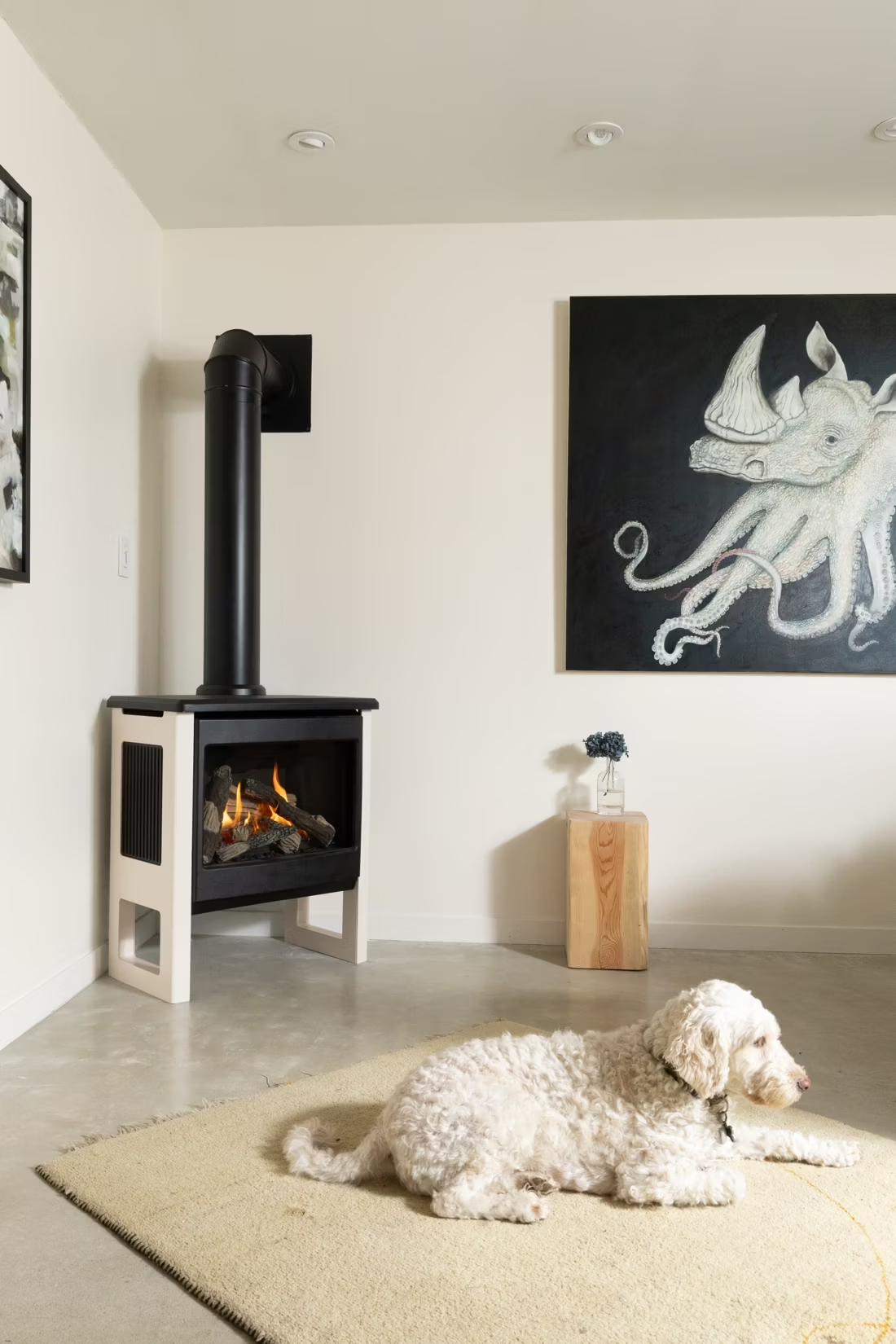
A gas fireplace is a fully built-in unit framed into a wall—the common choice for new construction and additions throughout Brentwood's newer subdivisions. A gas insert slides into an existing masonry fireplace opening, which fits the many original wood-burning fireplaces found in the area's 1990s and 2000s-built homes. A gas stove is a freestanding cabinet-style unit that doesn't require an existing fireplace opening at all. For most Brentwood homeowners upgrading an existing hearth, an insert is the straightforward answer; for new spaces, a built-in fireplace is more common.
Do I need a permit to install a gas fireplace in Brentwood?
Yes—the City of Brentwood Building and Codes Department requires both a building permit and a licensed gas-fitter sign-off for new gas line work and fireplace installations within city limits. Unincorporated parts of Williamson County fall under the county building department instead. Most established hearth retailers pull these permits as part of the install and coordinate the gas-fitter directly, so you typically aren't managing separate trades yourself.
Should I get a vented or vent-free gas fireplace?
Vented (direct-vent) fireplaces pull combustion air from outside and exhaust it back outside through sealed venting—they're the standard, code-compliant choice everywhere, including Brentwood. Vent-free units burn without any outside venting and release some combustion byproducts into the room; Tennessee permits them with room-size and oxygen-sensor requirements, but they're a harder sell in Brentwood's larger, well-sealed newer homes where indoor air quality matters. Nearly every installer in the area will point new customers toward a direct-vent unit unless there's a specific reason a vent-free model is the only option for the space.
How often does a gas fireplace need to be serviced?
Plan on an annual inspection, ideally in early fall before the first cold snap. A technician checks the burner, pilot or ignition system, gas connections, and venting, and cleans the glass and interior—a much quicker visit than a wood chimney sweep. Local gas appliance service providers in the Brentwood and greater Nashville area typically charge $150 to $250 for this visit, and it's the easiest way to catch a failing thermocouple or dirty burner before it becomes a no-heat call in January.
Why does almost everyone in Brentwood choose gas over wood or pellet?
Wood and pellet appliances are genuinely rare here—Brentwood has no public land cutting permits nearby, no winter air-quality restrictions driving pellet adoption, and HOA covenants in many subdivisions discourage the wood storage and stovepipe that come with a wood setup. Regional pellet brands like Lignetics and Hamer Pellet Fuel are available if someone wants that route, but with only a fairly mild, short winter heating season, most Brentwood homeowners don't need the BTU output or off-grid backup that makes wood worthwhile in colder climates. Gas gives you the fireplace experience with none of that overhead, which is why it's the default choice for nearly every project in the area.
Why is a fireplace insert so efficient?
An insert does two things: it seals the chimney completely, so you stop losing air you already paid to heat, and it radiates warmth into the room through the firebox and glass. Most add a heat-exchange fan that pulls cool room air underneath, wraps it around the hot firebox, and pushes it back out warm. Your home is more efficient before you've even lit the first fire.
What's the difference between radiant and convective fireplace heat?
Most fireplaces are a thin metal box—they heat fine, but you rely on the fan to move the warmth into the room. Radiant models use a thick cast-ceramic firebox, about an inch and a quarter thick, that soaks up the fire's heat and radiates roughly 25–30% more warmth into the room with no fan running. If you watch TV in the same room or want heat in a power outage, radiant is worth asking about.
How much should I budget for a fireplace?
For an average home—covering the fireplace, the vent pipe, and basic installation—a budget between $3,900 and $5,500 gives you a lot of options across wood, gas, and pellet. By the time you add finish work, gas line, and electrical, the average complete installation lands between $5,000 and $12,000 all-in. In a remodel or new build, a good rule is to put about 2.5% of the total project cost toward the fireplace.
Can I install a fireplace myself?
If you're putting a fire in your house on purpose, it's best to work with an expert. Unless you're genuinely experienced in framing, gas line, vent pipe, and the national code on clearances to combustibles, have a professional do it—and ideally the same company that sells you the fireplace, so warranty, service, and liability all live under one roof.
Nearby Dealers
Hearth shops serving Brentwood and the surrounding area. Every listing shows whether it is a WhyFire partner, a dealer we have verified as authorized for the brands we recommend, or a local business carrying hearth products. No manufacturer pays for placement. How we verify dealers →
Ashbusters Chimney Service
Nashville Fireplace Dist.
Allegiance Chimney Solutions
A/c Plus Heating & Cooling, Inc.
Find your gas fireplace in Brentwood.
Tell us a bit about your home and we'll put together a free Project Guide & Parts List—the right gas fireplace or insert, the vent kit it needs, and a trusted local dealer in Williamson County to install it.
Find Your Fireplace →