
Instant, clean heat for Saxon's mild Piedmont winters.
No chimney, no gas line, no hauled wood—just plug-in or hardwired warmth sized right for your Spartanburg County home. Find the right unit and connect with a trusted local dealer.
Every Project Starts From One of These Five Situations
The right fit for a climate that rarely gets extreme.
Saxon sits in the upstate Piedmont of Spartanburg County at just under 850 feet, in climate zone 3A, where winter lows average around 32 degrees and the overall winter heating load is fairly light for the year. That's a fraction of what a place like Duluth, MN sees in a single winter, and it's exactly why full-time wood heat and pellet stoves see so little demand here—the region simply doesn't generate the sustained cold that makes bulk fuel storage and daily stoking worth the hassle. Electric fireplaces, by contrast, are a natural fit: quick supplemental warmth on the handful of genuinely cold nights, and ambiance for the rest of the season.
Duke Energy Carolinas serves electric service throughout the Saxon area at a residential rate around 13.9 cents per kWh, which keeps running costs for an electric fireplace modest even at full heat output. Because there's no venting, no gas line, and no combustion byproducts to manage, installation is far simpler than a wood or gas project—often a matter of a dedicated circuit and a mantel or insert frame rather than a full masonry or venting overhaul. For homes with an old, rarely-used wood fireplace, that simplicity is a big part of the appeal.
Three steps. No salesperson until you're ready.
Tell us about your project
Your zip code, your situation, and the fuel you're leaning toward—or let the answers point you to one.
See what's actually available
The brands dealers within 100 miles genuinely carry—real options, never a catalog mirage.
Get your dealer & Project Guide
A trusted local dealer, plus the free Project Guide & Parts List that names every component of the job.
Frequently Asked Questions
How much does an electric fireplace installation cost in Saxon?
Most electric fireplace projects in Saxon run between $300 and $3,000. A freestanding, plug-in electric stove or insert on the low end needs little more than an existing outlet. A wall-mounted or built-in unit with a custom surround, or an insert converting an old masonry wood fireplace, runs higher—especially if an electrician needs to add a dedicated 120V or 240V circuit, which typically adds $150 to $400. Local dealers will walk your specific setup before quoting a firm number.
Do I need a permit to install an electric fireplace in Saxon?
For a plug-in, freestanding unit, generally no permit is required—it's treated like any other appliance. For a built-in unit that requires new wiring or a dedicated circuit, Spartanburg County Building Codes Enforcement typically requires an electrical permit, and the work should be done by a licensed electrician regardless of whether a permit is pulled. Most local dealers coordinate this as part of the installation.
How much does it cost to run an electric fireplace in Saxon?
At the Duke Energy Carolinas residential rate of roughly 13.9 cents per kWh, a typical electric fireplace drawing 1,500 watts on its heat setting costs around 21 cents per hour to run. Flip the heater off and run flame-effect only (most units draw well under 100 watts in that mode) and the cost drops to a fraction of a cent per hour. Given how mild Saxon's winters run—average lows around freezing rather than deep into the single digits—many owners use the heat function only occasionally and rely on it mostly for ambiance.
Electric vs. gas—which is right for my Saxon home?
Gas fireplaces are common in this part of Spartanburg County, running on natural gas where available or propane elsewhere, and they deliver more raw heat output plus operation during power outages—a real advantage if an ice storm knocks out electricity. Electric fireplaces cost less to install, require no venting or gas line, and give you precise control over heat and flame independently, which is handy for a mild climate like Saxon's where you may want the visual of a fire without the added warmth most of the year. If backup heat during outages matters to your household, ask a local dealer about pairing a gas unit in a main living space with electric elsewhere.
Can I put an electric insert into my existing wood fireplace?
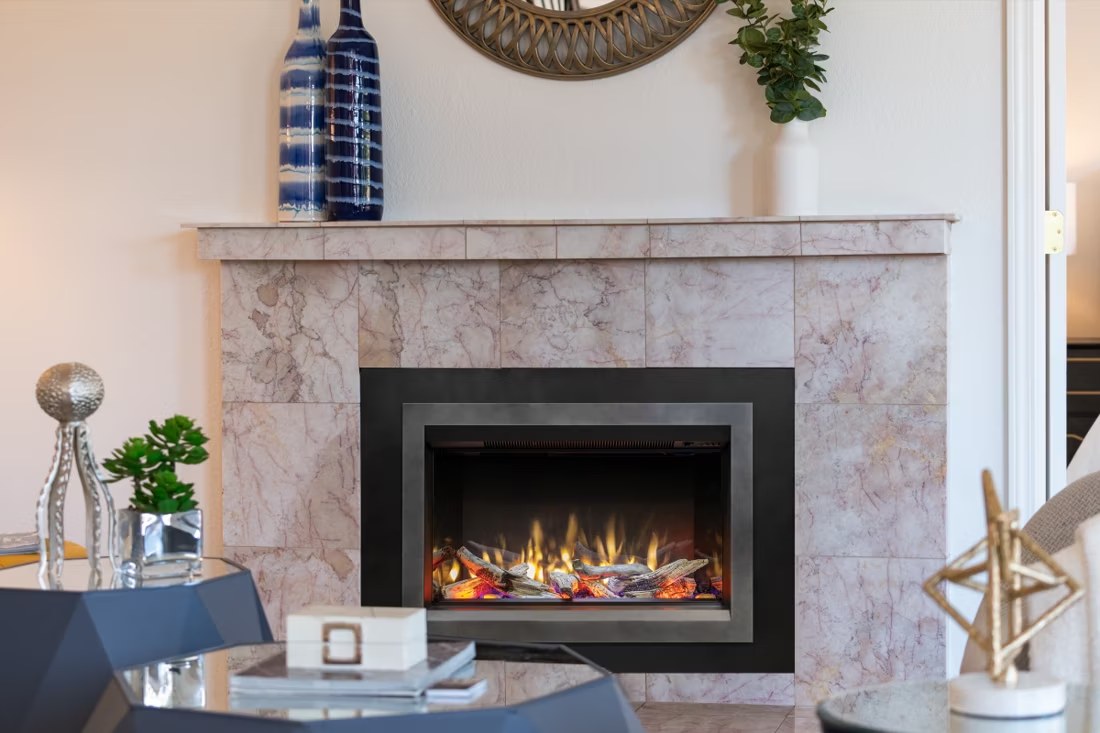
Yes, and it's one of the more popular projects for older Saxon homes with a masonry fireplace that no longer sees regular wood use. An electric insert slides into the existing firebox opening, uses the mantel and surround you already have, and needs no chimney work or venting—just power. Given how uncommon daily wood-burning has become in this climate, it's an easy way to keep the fireplace as a room's focal point without the smoke, ash, or annual chimney sweep.
What are good electric fireplace brands to look for?
Dimplex, Napoleon, and Amantii are widely available through hearth dealers in the upstate and cover the range from simple plug-in inserts to large linear built-ins with realistic flame technology. For a straightforward mantel-style unit, most mid-range models from these brands perform well; for a modern linear look built into a wall, look at Amantii or Napoleon's wider units. A local dealer can show you the flame technology in person, which matters more for electric units than almost any spec sheet.
Will my electric fireplace work during a power outage?
No—electric fireplaces require power to operate, unlike a wood stove or a battery-backed gas unit. In Saxon, extended outages are relatively uncommon given the mild winter climate (a fairly light winter heating load for the year, well below harder-hit northern regions), and most outages that do occur are storm-related and short. If backup heat during outages is a priority, ask a local dealer about pairing your electric fireplace with a propane or natural gas unit in your primary living space.
Is wood or pellet heat an option in Saxon instead of electric?
Technically yes, but neither is common here. Saxon's mild climate and the absence of any air quality restrictions mean there's little practical need for the sustained daily heat wood or pellet stoves are built for—most local homes that have an old fireplace use it occasionally rather than for real heating. Pellet brands like Lignetics and Hamer Pellet Fuel are available regionally, but the infrastructure and dealer support for pellet appliances is thin in Spartanburg County compared to electric or gas. For most Saxon homeowners, electric or gas is the more practical and better-supported choice.
What size electric fireplace do I need for my room?
Electric fireplace sizing is more about visual scale and room layout than actual heat output, since even the largest units are limited to about 1,500 watts of supplemental heat. A 30" to 40" insert or wall unit suits a standard living room mantel; a linear 50"-plus unit works better as a focal wall feature in an open-concept space. Because heat output is capped by the same 1,500-watt limit regardless of size, sizing mainly comes down to fitting the opening (for an insert) or the wall (for a built-in)—a local dealer can measure your space and talk through options during a quick consultation.
Can I put a TV above my fireplace?
Yes—with an asterisk. Fireplaces are hot and TVs don't like heat. Either put a mantel between them to deflect rising warmth, or choose a fireplace with heat-management technology that creates a cool zone on the wall above—the wall stays around 125 degrees, barely warm, while the room still gets full heat. If you like clean lines and don't want a mantel, heat management is the answer.
Do electric fireplaces actually produce heat?
Yes—most put out around 4,800–5,000 BTUs from a standard outlet, which comfortably warms a bedroom, office, or den as a comfort-zone heater. What they won't do is carry a whole house the way wood, gas, or pellet can. Think of electric as ambiance-first with honest supplemental heat: flames on with no heat in July, flames plus warmth in January.
How much should I budget for a fireplace?
For an average home—covering the fireplace, the vent pipe, and basic installation—a budget between $3,900 and $5,500 gives you a lot of options across wood, gas, and pellet. By the time you add finish work, gas line, and electrical, the average complete installation lands between $5,000 and $12,000 all-in. In a remodel or new build, a good rule is to put about 2.5% of the total project cost toward the fireplace.
Can I install a fireplace myself?
If you're putting a fire in your house on purpose, it's best to work with an expert. Unless you're genuinely experienced in framing, gas line, vent pipe, and the national code on clearances to combustibles, have a professional do it—and ideally the same company that sells you the fireplace, so warranty, service, and liability all live under one roof.
Nearby Dealers
Hearth shops serving Saxon and the surrounding area. Every listing shows whether it is a WhyFire partner, a dealer we have verified as authorized for the brands we recommend, or a local business carrying hearth products. No manufacturer pays for placement. How we verify dealers →
Western Carolina Stone
Superior Plus Propane D/b/a Freeman Gas - Spartanburg
Carolina Hearth & Patio
Phillips-Lawing Fuel, Inc.
Chim Cheree Chimney Sweep
Prince Propane Gas
Craft Stove Store And Patio
Viridien Patio + Fireplace
Phillips- Lawing Fuel, Inc- Mooresboro
Diamond B Energies
Electric Service in Saxon
An electric fireplace's heater draws about 1,500 watts—pennies per hour at local rates.
Duke Energy Carolinas, LLC
Find your electric fireplace in Saxon.
Tell us a bit about your home and we'll match you with a trusted local dealer and send over your free Project Guide & Parts List—the exact parts, including any electrical work, for your Saxon electric fireplace project.
Find Your Fireplace →