
Find the right fireplace for your Spartanburg County home.
Wood, gas, pellet, and electric fireplace resources for every city and community in Spartanburg County—from downtown Spartanburg to Landrum and Cowpens. Find the right unit and connect with a trusted local hearth retailer.
Every Project Starts From One of These Five Situations
Moderate winters, real wood heritage, across Spartanburg County, South Carolina.
Spartanburg County sits in the upstate foothills of South Carolina, with roughly 3,015 heating degree days a year and average winter lows around 32°F—a fraction of what a place like Duluth or Fargo sees, but still enough cold-weather stretches to make a working fireplace worth having. Oak, pine, and hickory are the common woodlot species here, and open burning and wood heat remain part of everyday life for a lot of rural and semi-rural households across the county's 285,000-plus residents. There's no regional air quality non-attainment designation or winter inversion pattern here—burning restrictions are largely a non-issue compared to western basin counties.
What you'll find on this hub: hearth retailers, service technicians, and fuel suppliers serving every community in the county—from the city of Spartanburg out to Inman, Landrum, Chesnee, Woodruff, and Duncan. Pick your fuel below to drill into specifics—local dealers, installation costs, recommended units, and the resources that match your project. Whether you're heating a brick ranch off I-26 or a farmhouse near the Broad River, this is the starting point.
Four fuels. One honest answer for Spartanburg County.
Wood
81 models available near Spartanburg County.
Find your wood stove →Gas
365 models available near Spartanburg County.
Find your gas fireplace →Pellet
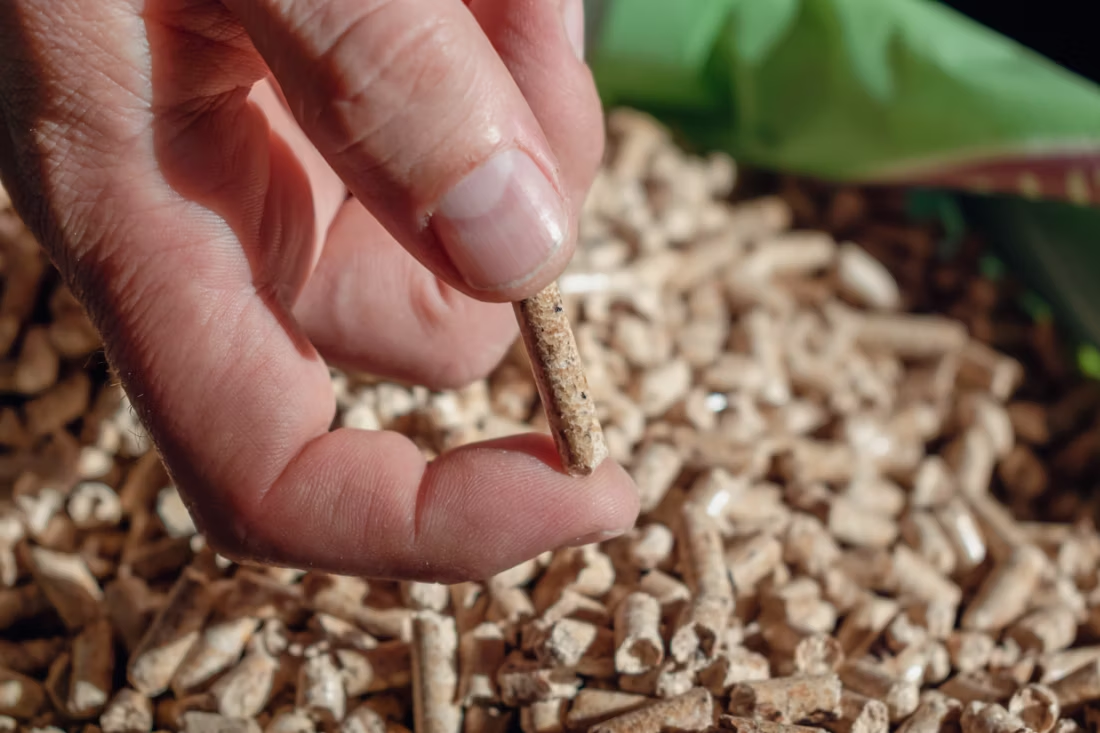
See what's available near Spartanburg County.
Find your pellet stove →Electric
11 models available near Spartanburg County.
Find your electric fireplace →Three steps. No salesperson until you're ready.
Tell us about your project
Your zip code, your situation, and the fuel you're leaning toward—or let the answers point you to one.
See what's actually available
The brands dealers within 100 miles genuinely carry—real options, never a catalog mirage.
Get your dealer & Project Guide
A trusted local dealer, plus the free Project Guide & Parts List that names every component of the job.
Frequently Asked Questions
Which fuel works best in Spartanburg County?
It depends on your home and how much heat you actually need. With winter lows averaging around 32°F and only about 3,015 heating degree days a year, Spartanburg County doesn't demand the same all-night, single-digit-burn performance you'd need in a place like Bozeman or Burlington—so the decision here is often more about ambiance, backup heat, and lifestyle than survival heating. Wood stoves and inserts burning local oak, pine, or hickory are popular for that classic fireside feel and as a hedge against Duke Energy or Blue Ridge Electric outages during ice storms. Gas is the convenience pick for homes with natural gas service—push-button start, no wood stacking, clean glass-front units. Pellet stoves are a solid middle ground, with regional supply from Lignetics and Hamer Pellet Fuel keeping fuel costs predictable. Electric fireplaces work well as supplemental heat in bedrooms, dens, or apartments where running a flue isn't practical. Most Spartanburg County homeowners land on gas or electric for everyday convenience, with wood as the backup or the centerpiece for a den or cabin-style room.
Do I need a permit to install a fireplace in Spartanburg County?
In most cases, yes. New wood stoves, wood inserts, gas fireplaces, gas inserts, gas stoves, and pellet stoves typically require a building permit, and gas installations need a separate gas line permit handled by a licensed gas-fitter. Within the city limits of Spartanburg, permits are issued through the City of Spartanburg's building division; in unincorporated parts of the county—including much of the area around Boiling Springs, Duncan, and Chesnee—permits go through Spartanburg County Building Codes. Electric fireplaces usually skip the permit process unless the installation involves hardwiring a built-in unit into a new circuit. Most local hearth retailers handle the permit paperwork as part of the installation, so it's rarely something you have to manage yourself.
Are there wood-burning or air quality restrictions in Spartanburg County?
No—Spartanburg County has no air quality non-attainment designation and no winter inversion pattern that triggers burn advisories, unlike basin communities out west. That said, new wood stove installations still need to meet current EPA emissions standards, and a properly installed, code-compliant unit burning seasoned oak or hickory will run cleaner and more efficiently than an old smoke-dragon anyway. If you're near the Nantahala-Pisgah National Forests boundary and plan to source firewood from public land, check with the local ranger district on cutting permits before you head out with a chainsaw.
Can one local hearth retailer handle all four fuel types?
Many Spartanburg County hearth retailers carry three or four fuel types, since demand here spans everything from classic wood inserts to low-maintenance electric units. A multi-fuel dealer can walk you through working displays of wood, gas, pellet, and electric side by side, which matters if you're not yet sure whether you want the ambiance of a real wood fire or the convenience of a gas unit that starts with a remote. If a retailer specializes—say, focusing mainly on gas and electric for a subdivision-heavy service area, or on wood and pellet for more rural customers near Chesnee or Landrum—that's noted on the fuel-specific pages so you know what you're walking into before you call.
How does service work in the more rural parts of Spartanburg County?
Most chimney sweeps, gas techs, and pellet stove technicians are based in or near the city of Spartanburg and travel out to surrounding towns—Inman and Landrum to the north, Woodruff and Enoree to the south, Chesnee toward the county line. Rural service calls sometimes carry a modest travel fee, but the distances here are shorter than in sprawling western counties, so it's rarely a major factor. Fall (September–November) is the easiest window to book routine chimney sweeps and gas inspections before winter demand picks up; waiting until a cold snap hits usually means a longer wait for service.
What's the typical cost range for fireplace installation across all fuel types in Spartanburg County?
Costs vary by fuel and by how much venting or gas line work is involved. Wood stove or insert installation: roughly $3,500–$8,000 for a typical retrofit into an existing masonry chimney. Gas fireplace, insert, or stove: roughly $3,500–$9,000, with the lower end for straightforward conversions where gas service already runs to the home. Pellet stove or insert: roughly $3,500–$6,500 for a typical install. Electric fireplace: $200–$3,000 for the unit itself, plus $300–$1,000 in labor for anything beyond a simple plug-and-play wall unit. For more detail tied to local retailer pricing, see the county + fuel pages above.
Can a fireplace actually lower my heating bill?
Yes—by creating a comfort zone. A furnace heats every square foot of the house just to warm the one room you're in; a gas fireplace on low burns roughly a sixth of the gas a typical furnace does. Set the furnace around 55–60 degrees as a baseline, then heat the rooms your family actually uses. Families who heat this way commonly save $20–$60 a month.
Can I install a fireplace myself?
If you're putting a fire in your house on purpose, it's best to work with an expert. Unless you're genuinely experienced in framing, gas line, vent pipe, and the national code on clearances to combustibles, have a professional do it—and ideally the same company that sells you the fireplace, so warranty, service, and liability all live under one roof.
How much should I budget for a fireplace?
For an average home—covering the fireplace, the vent pipe, and basic installation—a budget between $3,900 and $5,500 gives you a lot of options across wood, gas, and pellet. By the time you add finish work, gas line, and electrical, the average complete installation lands between $5,000 and $12,000 all-in. In a remodel or new build, a good rule is to put about 2.5% of the total project cost toward the fireplace.
What are the biggest mistakes people make buying a fireplace?
Five come up constantly: budgeting for the unit but not the full job (vent, gas line, electrical, finish work); drowning in options instead of starting from style and fuel; buying without an in-home preview; handing installation to a handyman instead of a pro; and giving up out of sheer indecision. Every one is avoidable with a clear plan—step one, step two, step three.
Stove and Fireplace Dealers in Spartanburg County
Listings include WhyFire partner dealers, dealers we have verified as authorized for the brands we recommend, and established local businesses that carry hearth products. Every listing shows which one it is. The ones marked Preferred run on WhyFire's software, so they can show you real pricing and book your appointment right here. No manufacturer pays for placement. How we verify dealers →
Superior Plus Propane D/b/a Freeman Gas - Spartanburg
Western Carolina Stone
Carolina Hearth & Patio
Phillips-Lawing Fuel, Inc.
Chim Cheree Chimney Sweep
Prince Propane Gas
Craft Stove Store And Patio
Viridien Patio + Fireplace
Diamond B Energies
Phillips- Lawing Fuel, Inc- Mooresboro
Find your fireplace in Spartanburg County.
Pick your fuel below and we'll match you with a trusted local dealer plus a free Project Guide & Parts List—a plan for your project with the exact parts, including the vent kit, and our recommended local installer.
Find Your Fireplace →