
Steady heat for White City's -20°C prairie winters.
White City sits on the open prairie east of Regina, where winter lows average -20.1°C and the heating season runs long. A pellet stove gives you thermostat-level heat without a woodpile. I'll match you with a trusted local dealer who knows what's installable on your street.
Every Project Starts From One of These Five Situations
Automated heat for a season that doesn't let up.
At 606 metres on the open Regina Plains, White City gets the full force of a prairie winter with little to break the wind. An average low of -20.1°C, with routine drops well past that during a January cold snap, means the heating season here stretches five months or more, closer to what Regina or Saskatoon residents deal with than a milder pocket of the province. That's a long stretch to be feeding a firebox by hand, which is exactly the gap a pellet stove fills.
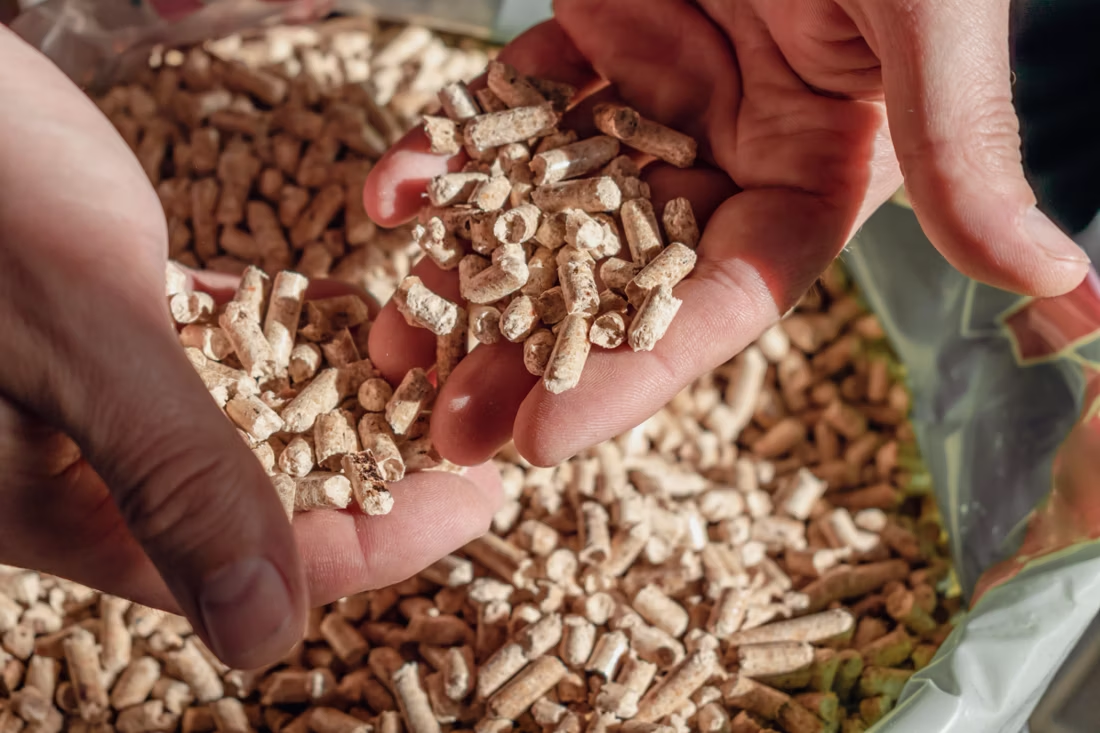
SaskEnergy runs natural gas to most of White City, and SaskPower serves electric heat at $0.159 per kWh, so pellet appliances aren't the only option on the block. But they carve out a real niche: a hopper-fed pellet stove burns cleaner and more consistently than cordwood while costing less to install than most gas builds. Local bags from La Crete Sawmills and Pinnacle Premium run $400-$575 CAD a ton and are stocked through the Regina-area supply chain, which matters since White City itself doesn't have a mill on its doorstep. For homeowners near the northern forest fringe who'd rather not cut and split trembling aspen, paper birch, jack pine, or white spruce every fall, a pellet stove delivers similar radiant warmth with a bag instead of a chainsaw.
Three steps. No salesperson until you're ready.
Tell us about your project
Your postal code, your situation, and the fuel you're leaning toward—or let the answers point you to one.
See what's actually available
The brands dealers within 100 miles genuinely carry—real options, never a catalog mirage.
Get your dealer & Project Guide
A trusted local dealer, plus the free Project Guide & Parts List that names every component of the job.
Frequently Asked Questions
How much does a pellet stove installation cost in White City?
Most pellet installs in White City run $6,000-$10,000 CAD. An insert dropping into an existing chimney chase or a straightforward wall-through vent for a freestanding stove sits toward the low end. A new build or a room without existing venting, chimney chase, or nearby power for the hopper's auger and blower pushes toward the top. Every install needs a permit through the municipal building department, and most local dealers fold that paperwork into the quote.
What size pellet stove do I need for a White City home?
With average lows near -20.1°C and a heating season that runs from October into April, most White City homes need more than a supplemental unit in the main living space. Many of the newer executive-style homes here run 1,800 to 2,600 square feet with open floor plans, which typically calls for a stove in the medium-to-large output range rather than the smallest units built for a single room. A local dealer will size it against your actual square footage, ceiling height, and insulation rather than a rule of thumb.
Do I need a permit to install a pellet stove in White City?
Yes. New installations go through the municipal building department, and the appliance and its venting must meet CSA B365 installation code. Pellet stoves don't fall under the WETT inspection scope the way wood stoves do, since WETT is specific to wood-burning appliances, but Saskatchewan insurers still commonly ask for documentation showing the unit was installed to manufacturer specifications and CSA B365 before they'll write or renew a policy. A dealer who installs pellet units regularly in this area will have that paperwork ready without you having to chase it down.
Where do I buy pellets near White City, and what do they cost?
La Crete Sawmills and Pinnacle Premium are the two regional brands most commonly stocked through Regina-area suppliers, running $400-$575 CAD a ton depending on the season and how early you buy. Given a five-month-plus heating season, a household burning a pellet stove as a primary heat source can go through 2 to 3 tons over the winter, so buying early in the fall before demand spikes is the standard local move. Pellets need dry, covered storage, a garage or shed corner works, but they shouldn't sit directly on a concrete floor where moisture can wick in.
Will my insurance require a WETT inspection for a pellet stove?
Not technically. WETT (Wood Energy Technology Transfer) certification applies to wood-burning appliances, and pellet stoves are regulated separately under CSA B365 and the manufacturer's own listing. That said, some Saskatchewan insurers still ask for proof of a proper CSA-compliant install before covering a pellet appliance, especially on older homes. A local dealer who's done pellet installs around White City and Regina will know exactly what documentation your particular insurer wants and can hand it over at the time of install.
Pellet vs. wood—which makes more sense for a White City property?
Wood has a real cost advantage here: the Saskatchewan Ministry of Environment's Forest Service Branch issues free cutting permits for dead-and-down timber for personal use, year-round, and species like trembling aspen, paper birch, jack pine, and white spruce are available through the northern forest fringe that supplies most of the region's cut-your-own firewood. But that means splitting, stacking, hauling, and a chimney to sweep. A pellet stove trades that labour for a $400-$575 a ton bag purchase and a hopper that feeds itself, at a lower install cost than most gas builds. Households with the time and equipment to cut their own wood often stick with it; those who want the ambiance without the woodlot tend to land on pellet.
Pellet vs. gas—which should I choose with SaskEnergy available in White City?
SaskEnergy serves most of White City with natural gas, and a gas fireplace or insert typically runs $6,000-$15,000 CAD installed, higher than a comparable pellet setup at $6,000-$10,000, but gas gives you push-button heat with essentially no fuel handling. A pellet stove costs less upfront and burns a fuel that's cheaper per unit of heat than natural gas in most winters, plus it delivers a visible flame that a lot of homeowners prefer over a sealed gas unit. The trade-off is that pellets need refilling and periodic ash cleanup, where gas needs neither.
How much maintenance does a pellet stove need through a White City winter?
Plan on emptying the ash pan every few days during steady winter use and a deeper clean of the burn pot, auger, and venting every few weeks, more often if you're running the stove as a primary heat source through the full five-month season. A professional service visit in September, before the first real cold snap, is the standard local recommendation, checking the exhaust motor, gaskets, and hopper mechanism so nothing fails on a night when it's -25°C outside.
Will a pellet stove still work if the power goes out?
No, not without a backup power source. Pellet stoves rely on electricity for the auger that feeds fuel and the blower that pushes heat into the room, and prairie storms around White City can knock out SaskPower service for hours at a time in a bad winter. Some homeowners run a small battery backup or generator sized for the stove's low draw; others keep a wood stove or gas fireplace elsewhere in the house as a no-power fallback. It's worth discussing with your dealer if outage resilience matters more than convenience for your household.
Why do fireplace quotes vary so much?
Because a fireplace is an iceberg—there's more behind the wall than in front of it. A low quote often covers only the unit; the full scope includes vent pipe, gas line or electrical, framing, and the tile or stone that has to come off and go back on. Make every bidder price the whole job. If a dealer can't speak to the full scope with confidence, that's your signal to keep looking.
Is it worth replacing an old fireplace that still sort of works?
Ask three questions: Is it ugly? Is it drafty? Does it actually work? Most old fireplaces fail at least two. Beyond looks, an old unit leaks air around the damper year-round and—if it's gas with a standing pilot—quietly burns a couple hundred dollars a year. A modern replacement seals the wall, heats the room, and changes how the whole space gets used.
How often does a pellet stove need cleaning?
A clean pellet stove is a happy pellet stove. Plan on cleaning the burn pot about once a week when you're burning regularly—ash and clinkers gum up the air holes just like a pellet barbecue. Most pellet stove problems trace back to skipped cleaning that nobody explained up front. Some designs make it easy with a trapdoor burn pot: pull a lever and the gunk drops into the ash pan.
Why is a fireplace insert so efficient?
An insert does two things: it seals the chimney completely, so you stop losing air you already paid to heat, and it radiates warmth into the room through the firebox and glass. Most add a heat-exchange fan that pulls cool room air underneath, wraps it around the hot firebox, and pushes it back out warm. Your home is more efficient before you've even lit the first fire.
Nearby Dealers
Hearth shops serving White City and the surrounding area. Every listing shows whether it is a WhyFire partner, a dealer we have verified as authorized for the brands we recommend, or a local business carrying hearth products. No manufacturer pays for placement. How we verify dealers →
Aquifer Distributing
Universal Plumbing & Heating Inc
Timberstone Distribution Regina
Pellet Brands Stocked Around White City
Typical price runs $400-$575 per ton—buy early-season for the best rates. Manufacturers will point you to the nearest stocking dealer.
La Crete Sawmills
Pinnacle Premium
Get your free Project Guide & Parts List for a White City pellet project.
Tell me about your home and whether you're leaning pellet, gas through SaskEnergy, or wood, and I'll match you with a trusted local dealer and send a free Project Guide & Parts List with the exact vent kit and parts your project needs.
Find Your Fireplace →