
The simplest fireplace upgrade for a fly-in Hudson Bay community.
Puvirnituq sits on the Hudson Bay coast in Nunavik with no road link south and winter lows averaging -27.8°C. An electric fireplace needs no chimney, no sealift-delivered fuel, and no combustion venting—just a circuit tied into the power you already have. I'll match you with a dealer who understands what actually ships and installs this far north.
Every Project Starts From One of These Five Situations
No chimney, no fuel barge, no waiting on the weather.
Puvirnituq is a Nunavik community accessible only by air or by summer sealift, which changes the math on almost every heating decision. At sea level with a climate zone of 8 and winter lows averaging -27.8°C—colder and more isolated than Whitehorse, YT ever gets—the heating season here runs most of the year, not just the calendar winter. Every home already runs on electric heat delivered through Hydro-Québec's local network, so an electric fireplace or insert is less a new system than an add-on to infrastructure that's already in the wall.
Hydro-Québec's residential rate of roughly $0.078 per kWh applies here even though Puvirnituq runs on an isolated, locally-generated network rather than the main southern grid—Quebec's postage-stamp pricing holds regardless. That low rate, paired with a typical electric install running $500 to $1,600, makes an electric unit the low-friction option in a place where wood and pellets have to travel a very long way. Puvirnituq sits well north of the treeline, so any cordwood or bagged pellets need to come in by air cargo or on the summer sealift alongside everything else the community imports—a real cost and timing constraint that electric simply sidesteps. Natural gas isn't a factor at all up here; Énergir's distribution network stays well south of Nunavik, so gas appliances would mean flying in propane, which almost nobody does for a fireplace.
Three steps. No salesperson until you're ready.
Tell us about your project
Your postal code, your situation, and the fuel you're leaning toward—or let the answers point you to one.
See what's actually available
The brands dealers within 100 miles genuinely carry—real options, never a catalog mirage.
Get your dealer & Project Guide
A trusted local dealer, plus the free Project Guide & Parts List that names every component of the job.
Frequently Asked Questions
How much does an electric fireplace installation cost in Puvirnituq?
Most installs run $500 to $1,600 CAD, and the spread comes down to the unit, not the fuel logistics that drive up wood or pellet projects here. A plug-in electric insert or wall-mount unit on a standard household circuit sits at the low end. A built-in unit that needs a dedicated 240V circuit and some wall framing work costs more, mainly in electrician time—and in Puvirnituq, scheduling a qualified electrician sometimes means working around who's in the community that month rather than around the job itself.
Is electric really the practical choice here, or should I look at wood or pellet instead?
For most Puvirnituq homes, electric is the practical default. Wood and pellet appliances run $6,000 to $12,000 installed even before you factor in getting cordwood or bagged pellets—brands like Granules LG, Energex, or Trebio—up here by air freight or on the summer sealift, which adds real cost and means planning fuel a season ahead. An electric fireplace ties into power that's already running to every outlet in the house, with no combustion appliance to feed or vent. The tradeoff is that electric heat depends entirely on the grid staying up, so it's worth thinking about what backup you have if the local generating station has an outage.
Do I need a permit to install an electric fireplace in Puvirnituq?
You'll still go through the municipal building department for the installation, but an electric unit skips the combustion-specific requirements that apply to wood—there's no CSA B365 wood-appliance code to satisfy and no WETT inspection to arrange for insurance, since there's no chimney or flue involved. The electrical work itself needs to meet the Canadian Electrical Code as adopted in Quebec, which is one more reason to have a licensed electrician handle the circuit rather than a DIY hookup.
Will an electric fireplace still work if the power goes out?
No—an electric fireplace is entirely dependent on Hydro-Québec's local network staying energized, and Nunavik communities like Puvirnituq run on smaller, isolated generating stations rather than the main southern grid, so outages here can behave differently than in a city on the interconnected system. If you're relying on the fireplace for real supplemental heat rather than ambiance, it's worth asking your dealer about a battery backup for the electronics and thinking through what happens to the room during a multi-hour outage in a -27.8°C stretch, since your primary electric baseboard heat would be affected the same way.
How much heat can I actually expect from an electric fireplace in this climate?
Most electric fireplace inserts and built-ins top out around 1,500 watts of supplemental heat, which is enough to take the edge off a living room but isn't a replacement for your home's primary electric heating system on a night when it's -28°C outside. In Puvirnituq, where the heating season runs the better part of the year, homeowners generally install an electric fireplace for the visual warmth and the ambiance it adds to a room, while continuing to rely on baseboard or central electric heat for the actual load. A local dealer can tell you honestly whether a given model is worth counting on for real heat in your specific room.
What electric fireplace brands can a dealer actually get to Puvirnituq?
There isn't a Nunavik-specific brand list the way there is for regional pellet suppliers, but widely available Canadian electric fireplace lines—Dimplex, Napoleon, and SimpliFire among them—regularly ship north through Quebec hearth dealers who already handle freight logistics for remote communities. The bigger question than brand is usually lead time: ask your dealer to build shipping by air cargo or the next sealift window into your timeline rather than assuming it arrives like a southern Quebec order.
What should I expect for installation timing and freight in a fly-in community?
Plan further ahead than you would in Montréal or Val-d'Or. Small electric units can sometimes come in as air cargo reasonably quickly, but larger built-in inserts or anything ordered in bulk for a renovation often moves more economically on the summer sealift, which has a fixed seasonal window. A dealer used to working with Nunavik clients will usually ask about your target install date early and work backward from whichever freight method fits, rather than promising a fast turnaround that the logistics can't actually support.
How much maintenance does an electric fireplace need?
Very little, which is part of the appeal here. There's no chimney to sweep, no gas line to service, and no combustion byproducts to worry about—an occasional wipe of the glass and a check that the fan or blower isn't collecting dust is typically all it needs. Compare that to a wood stove burning through a nine-month-plus heating season, which would need an annual inspection and regular attention to keep creosote in check; electric removes that maintenance cycle entirely.
Are there any efficiency programs or rebates worth checking before I buy?
Hydro-Québec runs efficiency programs such as Éconologis aimed at northern and remote households, and it's worth a call before you commit to a specific unit to see what currently applies to Nunavik communities, since program details shift from year to year. Because electric heat is already the standard here rather than an upgrade path from another fuel, the bigger financial lever for most Puvirnituq households is simply choosing a well-insulated, properly sized unit so it draws power efficiently through a very long heating season rather than chasing a rebate on the fireplace itself.
How much does an electric fireplace cost to run?
With the heater on, a typical unit draws about 1,500 watts—at average electric rates that's roughly 20 cents an hour. Run the flame effect alone and it costs pennies; the flames are LED-driven and use about as much power as a light bulb. There's no pilot light, no fuel delivery, and essentially no maintenance.
What fireplace styles should I know before shopping?
Four cover most of the market: screen-front traditional (mesh front, open feel, fits craftsman homes), traditional door set (the classic look you grew up with), modern linear (wide, low, the statement piece for entertaining), and clean face contemporary (no trim—your tile or stone runs right to the fire's edge). Walk in knowing those four terms and you're ahead of most buyers.
Can I put a TV above my fireplace?
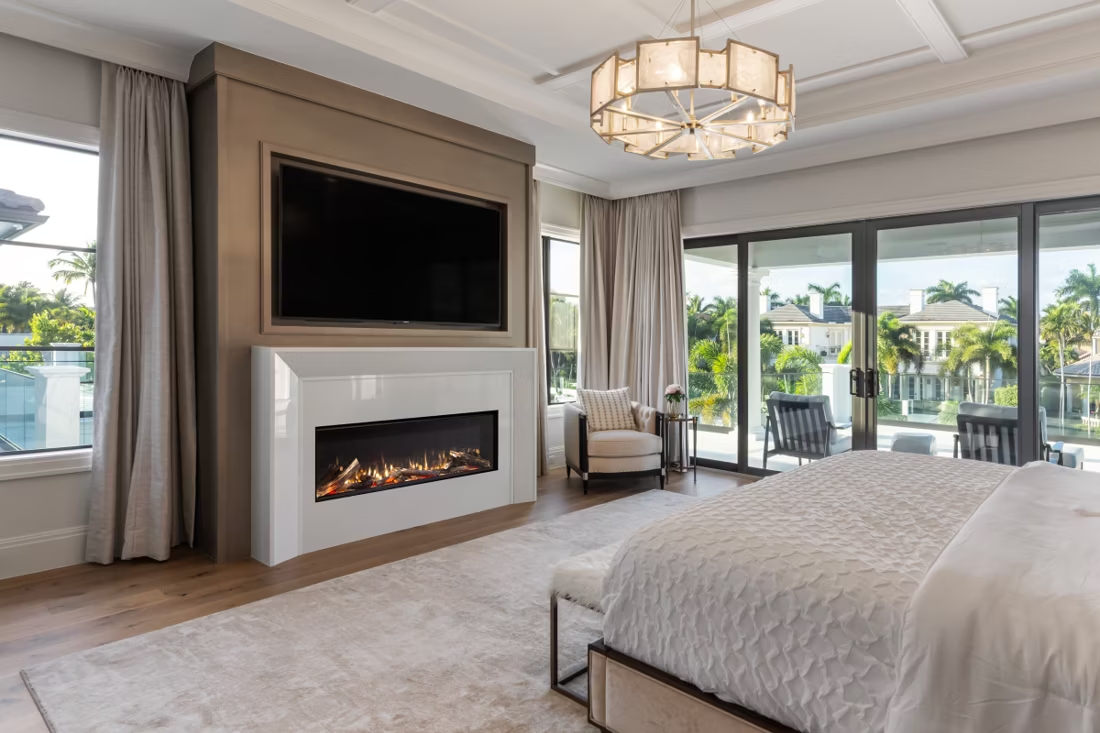
Yes—with an asterisk. Fireplaces are hot and TVs don't like heat. Either put a mantel between them to deflect rising warmth, or choose a fireplace with heat-management technology that creates a cool zone on the wall above—the wall stays around 125 degrees, barely warm, while the room still gets full heat. If you like clean lines and don't want a mantel, heat management is the answer.
Do electric fireplaces actually produce heat?
Yes—most put out around 4,800–5,000 BTUs from a standard outlet, which comfortably warms a bedroom, office, or den as a comfort-zone heater. What they won't do is carry a whole house the way wood, gas, or pellet can. Think of electric as ambiance-first with honest supplemental heat: flames on with no heat in July, flames plus warmth in January.
Electric Service in Puvirnituq
An electric fireplace's heater draws about 1,500 watts—pennies per hour at local rates.
Hydro-Québec
Get your free Project Guide & Parts List for a Puvirnituq electric fireplace.
Tell me about your home and I'll match you with a dealer who understands Nunavik freight timelines and Hydro-Québec hookups, then send a free Project Guide & Parts List with the exact parts your project needs.=
Find Your Fireplace →