
Clean heat riding James Bay's own hydro power.
Across a region where winter lows average -23.1°C and the nearest hearth shop might be hours away, electric fireplaces offer instant zone heat with no chimney, no fuel delivery, and no venting to plan around. I'll match you with a trusted local dealer who can size a unit correctly and get it to you across Nord-du-Québec's long supply lines.
Every Project Starts From One of These Five Situations
Powered by the same hydro grid that lights Montréal.
Nord-du-Québec covers an enormous stretch of the province, from mining towns like Chibougamau, Chapais, and Lebel-sur-Quévillon in the south up through Matagami, Radisson, and the Cree and Nunavik communities near James Bay and Hudson Bay. With just 32,838 people spread across that territory and a climate zone 7A subarctic winter that averages -23.1°C at its coldest, the heating season here runs long, closer in feel to Whitehorse or Fort McMurray than anywhere in southern Quebec. Wood remains the traditional backbone of home heating, cut from local sugar maple, yellow birch, American beech, and red oak under an MRNF permit, but electricity generated by the James Bay hydro complex right in this region is genuinely inexpensive relative to most of the country, which makes electric fireplaces a sensible and low-fuss addition to homes already wired for electric baseboard or forced-air heat.
Natural gas service barely reaches this far north—availability across Quebec is only partial to begin with, and mains gas essentially does not exist in Nord-du-Québec, so propane has to be trucked or barged in at a real premium. Electric fireplaces sidestep that supply chain entirely: no tank, no delivery schedule, no cutting and stacking cordwood. A typical installation runs $500 to $1,600 CAD, whether it's a plug-in unit dropped into an existing opening or a built-in model wired into its own circuit by a licensed electrician. For seasonal camps, apartments in Chibougamau or Matagami, or any home where a resident isn't set up to manage a wood stove, that simplicity is the whole appeal—real ambiance and supplemental warmth without adding another fuel system to maintain through a five-month winter.
Three steps. No salesperson until you're ready.
Tell us about your project
Your postal code, your situation, and the fuel you're leaning toward—or let the answers point you to one.
See what's actually available
The brands dealers within 100 miles genuinely carry—real options, never a catalog mirage.
Get your dealer & Project Guide
A trusted local dealer, plus the free Project Guide & Parts List that names every component of the job.
Frequently Asked Questions
How much does an electric fireplace installation cost in Nord-du-Québec?
Most installations across the region run $500 to $1,600 CAD. A freestanding or wall-mounted unit that plugs into a standard outlet sits at the lower end. A built-in electric fireplace or insert that needs a dedicated 15- or 20-amp circuit run by a licensed electrician costs more, especially in older housing stock in Chibougamau or Chapais where panel capacity sometimes needs upgrading first. Freight adds a real factor here too—units shipped into Matagami, Radisson, or Nunavik communities may carry a delivery surcharge that a local dealer can quote up front.
Can an electric fireplace actually heat a home through a Nord-du-Québec winter?
Honestly, on its own, no—a single electric fireplace is built for zone heat, not for carrying a whole house through nights averaging -23.1°C. Most homeowners here run one alongside existing electric baseboard heat or a forced-air system, using the fireplace to warm the room they actually live in while the rest of the house holds a lower background temperature. That said, in a well-insulated smaller space, a good 1,500-watt unit can meaningfully cut what the baseboards need to do on milder shoulder-season nights.
Do I need a permit to install an electric fireplace here?
A plug-in, freestanding electric fireplace generally doesn't require a permit—it's no different electrically than any other major appliance. A built-in unit that requires a new dedicated circuit or panel work does need to go through your municipal building department, and the electrical portion has to be done by a licensed electrician regardless of which community you're in. It's a much lighter permitting process than a wood or gas installation, which is part of why electric appeals to renters and seasonal camp owners across the region.
Why isn't gas more common as a fireplace option in Nord-du-Québec?
Natural gas is genuinely rare here. Quebec's mains gas network only reaches parts of the province farther south, and it doesn't extend into Nord-du-Québec at all, so any gas appliance would run on propane trucked in at a real cost premium over grid electricity. Between that and the hydro power already flowing through the James Bay system, most homeowners considering a gas fireplace in this region end up choosing electric instead once they see the delivered propane pricing and installed cost side by side—$6,000 to $15,000 CAD for a propane-fed gas fireplace versus $500 to $1,600 CAD for electric.
Wood stove or electric fireplace—which makes more sense for my home?
Wood is still the standard primary heat source across much of Nord-du-Québec, burned as sugar maple, yellow birch, American beech, or red oak cut under an MRNF permit for about $1.85 per cubic metre, up to 22.5 cubic metres a year. It keeps a home warm through a power outage, which matters given how remote parts of the grid up here can be. Electric fireplaces don't replace that role, but they're the better fit for apartments, seasonal camps, or any household that wants real supplemental heat and ambiance without a chimney, WETT inspection, or wood storage to manage. Plenty of homes here run both—wood as the workhorse, electric in a room where convenience matters more.
How does electric compare to pellet heat in this region?
Pellet stoves are a solid standard option here too, with Granules LG, Energex, and Trebio all distributed regionally at roughly $400 to $575 per ton, and they burn cleaner than an open wood fire. But pellets still mean a hopper to fill, an auger and blower to maintain, and bags to store and truck in—a real consideration in a community where deliveries can be seasonal or weather-dependent. Electric fireplaces have no fuel logistics at all, which is the trade-off: no delivery risk, but also no real primary-heat output the way a pellet stove has. For camps or homes where hauling fuel is the biggest hassle, electric wins on simplicity.
Does an electric fireplace need annual maintenance or inspection?
Very little. There's no WETT inspection requirement the way there is for wood-burning appliances under CSA B365, and no annual chimney sweep. Most electric units just need the interior dusted, the fan or blower checked periodically, and the heating element inspected if the unit is more than a few years old. That low-maintenance profile is a genuine advantage in a region where a service technician might have to travel a long distance to reach you.
What size electric fireplace do I need for my room?
Most electric fireplace inserts are rated around 4,600 to 5,000 BTU (roughly 1,500 watts), which comfortably heats a well-insulated room in the 300 to 400 square foot range. Older housing built during Chibougamau's or Chapais's mining-era construction boom sometimes has thinner insulation, so a dealer may recommend sizing up or adding a second unit for a larger open living area rather than relying on one fireplace to cover the whole main floor. A quick look at your room dimensions and window count during a consultation settles this fast.
Where can I actually buy and get help installing an electric fireplace in Nord-du-Québec?
Brick-and-mortar hearth retailers are thin on the ground across this much territory, which is exactly the gap Find My Fireplace fills. I don't sell or ship fireplaces myself—I match you with a manufacturer-authorized local dealer who knows how to get equipment freighted into Chibougamau, Matagami, or communities further north, and who can coordinate the electrical work with a licensed local electrician. That beats guessing at a big-box unit online and hoping it survives the trip.
How much does an electric fireplace cost to run?
With the heater on, a typical unit draws about 1,500 watts—at average electric rates that's roughly 20 cents an hour. Run the flame effect alone and it costs pennies; the flames are LED-driven and use about as much power as a light bulb. There's no pilot light, no fuel delivery, and essentially no maintenance.
What fireplace styles should I know before shopping?
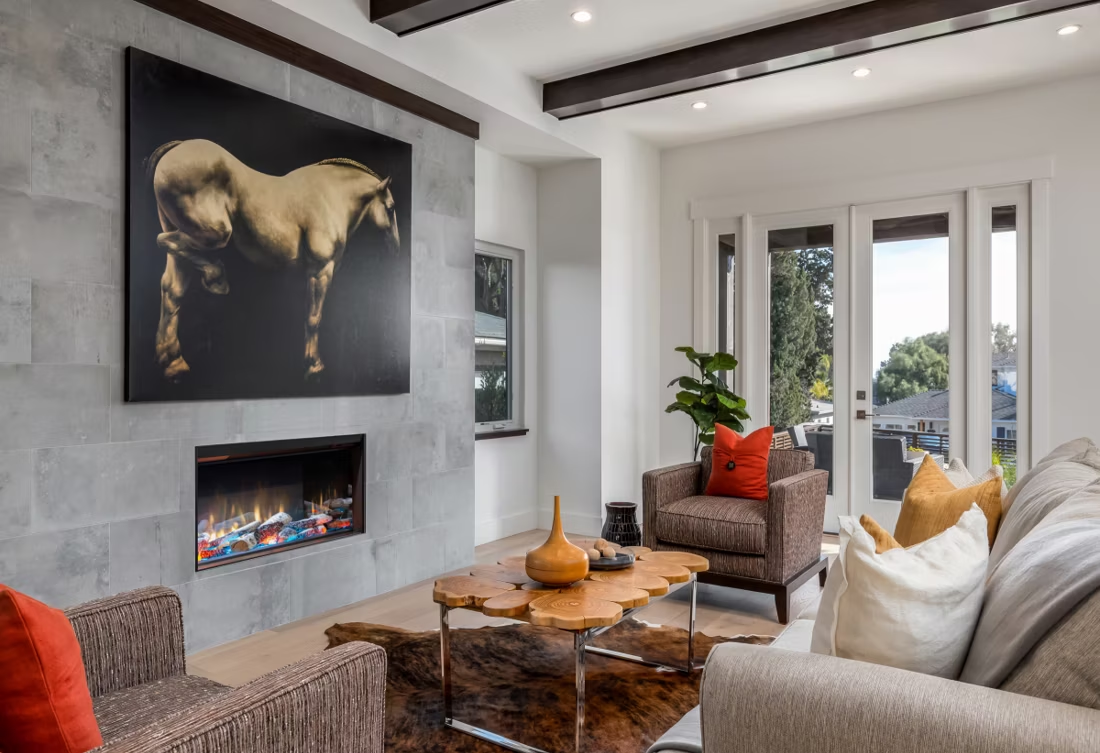
Four cover most of the market: screen-front traditional (mesh front, open feel, fits craftsman homes), traditional door set (the classic look you grew up with), modern linear (wide, low, the statement piece for entertaining), and clean face contemporary (no trim—your tile or stone runs right to the fire's edge). Walk in knowing those four terms and you're ahead of most buyers.
Does an electric fireplace need a vent or chimney?
No—that's its superpower. An electric fireplace needs a wall and an outlet, period. No vent pipe, no gas line, no clearances to design around, which is why it works in bedrooms, offices, apartments, and walls where venting a gas or wood unit would be impractical or impossible. Installation is typically the simplest and least expensive of any fireplace type.
Can I put a TV above my fireplace?
Yes—with an asterisk. Fireplaces are hot and TVs don't like heat. Either put a mantel between them to deflect rising warmth, or choose a fireplace with heat-management technology that creates a cool zone on the wall above—the wall stays around 125 degrees, barely warm, while the room still gets full heat. If you like clean lines and don't want a mantel, heat management is the answer.
Electric Service in Nord-du-Québec
An electric fireplace's heater draws about 1,500 watts—pennies per hour at local rates.
Hydro-Québec
Get your free Project Guide & Parts List for an electric fireplace in Nord-du-Québec.
Tell me about your home, its wiring, and how you plan to use the fireplace, and I'll match you with a trusted local dealer and send a free Project Guide & Parts List—the exact unit, wiring needs, and recommended dealer for your electric fireplace project, no big-box guesswork.
Find Your Fireplace →