
The fireplace option that skips Montréal's wood bylaw entirely.
No chimney, no gas line, no registration paperwork—just a unit that plugs into Hydro-Québec's grid at one of the lowest residential rates in the country. I'll match you with a trusted local dealer who can tell you exactly what fits your walk-up, plex, or condo.
Every Project Starts From One of These Five Situations
No chimney required, and Hydro-Québec keeps it cheap to run.
A huge share of Montréal's housing stock—Plateau and Mile End triplexes, Rosemont duplexes, downtown condo towers—was never built with a masonry chimney, and the island's bylaw now requires any wood-burning appliance to be registered and certified at no more than 2.5 grams of fine particles per hour. Retrofitting an old firebox to meet that standard is a real project. An electric fireplace sidesteps the whole question: no combustion, no venting, no registration, no WETT inspection for insurance.
Gas is a similar story here. Énergir's network reaches parts of greater Montréal and the south shore, but plenty of streets simply aren't on it, which is why gas fireplaces are the exception rather than the rule across the region. Electric has no such gap—Hydro-Québec serves every address—and at roughly $0.078 per kWh, running one is inexpensive by national standards, closer to what you'd pay in Winnipeg on Manitoba Hydro than the higher rates common in Ontario. Combined with a $500-$1,600 CAD install range against $6,000 and up for wood or gas, it's an easy add for a condo board or a landlord who can't run a flue through three storeys of a heritage building anyway.
Three steps. No salesperson until you're ready.
Tell us about your project
Your postal code, your situation, and the fuel you're leaning toward—or let the answers point you to one.
See what's actually available
The brands dealers within 100 miles genuinely carry—real options, never a catalog mirage.
Get your dealer & Project Guide
A trusted local dealer, plus the free Project Guide & Parts List that names every component of the job.
Frequently Asked Questions
How much does an electric fireplace installation cost in Montréal?
Most installs land between $500 and $1,600 CAD. A plug-in freestanding or mantel unit that just needs a standard outlet sits at the low end—common in rental apartments and condos where drilling into walls isn't an option. A built-in linear wall unit or an insert set into an old masonry firebox in a Rosemont or Villeray bungalow costs more if it needs a dedicated circuit, which means an electrician and sometimes a permit through your municipal building department for the wiring itself, not the fireplace.
Is electric a good fit for a Montréal triplex or condo without a chimney?
It's often the best fit. A lot of the city's classic triplexes and walk-ups in the Plateau, Villeray, and Rosemont were never built with a masonry flue, and many condo towers restrict combustion appliances outright in their bylaws. An electric insert or wall-mount needs nothing more than a nearby circuit—no CSA B365 wood installation code to satisfy, no WETT inspection for your home insurer, and no negotiating with a condo board about venting through a shared wall.
How does Montréal's wood-burning bylaw affect my choice of fireplace?
The island bylaw requires any wood-burning appliance to be registered with the municipality and certified at 2.5 grams per hour of fine particles or less, which rules out a lot of older, uncertified stoves and inserts still sitting in triplexes across town. That's a real cost and paperwork step for wood, one that a good local dealer handles routinely—but it simply doesn't apply to electric. There's no combustion, so there's nothing to register or certify, which is part of why electric has become the default answer for anyone who wants fireplace ambiance without a compliance project.
Should I look at a gas fireplace instead, given Énergir's network?
Only if your street is actually served. Énergir's natural gas distribution covers parts of greater Montréal, the south shore, and a few urban corridors, but coverage across the region is genuinely partial—gas fireplaces here are more the exception than the rule, and typical installs run $6,000-$15,000 CAD once you account for gas line work. Electric has no such dependency: Hydro-Québec serves every address on the island, so you're never checking a coverage map before you can move forward.
What will an electric fireplace actually cost me to run on Hydro-Québec rates?
At roughly $0.078 per kWh, Hydro-Québec's residential rate is among the lowest in the country—well below what a lot of Ontario households pay, and in the same range as Manitoba Hydro's rates in Winnipeg. A typical 1,500-watt electric insert run a few hours an evening costs somewhere around 30-40 cents a day. Over a long Montréal heating season that adds up to real but modest money, which is a big part of why electric works as a supplemental heat source rather than a splurge here.
Will an electric fireplace actually heat my home through a Montréal winter?
Not as your primary heat source. With winter lows averaging around -15.1°C, most Montréal homes rely on baseboards, a heat pump, or a furnace to carry the load, and an electric fireplace is best sized to supplement one room—typically 400 to 1,000 square feet depending on the model and your home's insulation. Think of it as zone heat and ambiance for the room you actually live in, not a whole-house solution.
What's the difference between an electric insert, a wall-mount, and a mantel package?
An insert drops into an existing masonry firebox—useful if you've got an old, unused wood fireplace in a Rosemont or Verdun bungalow and want the look back without the bylaw registration. A wall-mount linear unit is popular in newer downtown condo towers where there's no firebox at all, just a flat wall and an outlet. A mantel package is a freestanding furniture-style unit that needs nothing more than a plug, which makes it the easiest option for renters or condo units where you can't modify the wall.
Do I need a permit for an electric fireplace in Montréal?
Usually not for the appliance itself—most plug-in and even many wall-mounted electric units run on a standard circuit with no permit required. If your unit needs a new dedicated circuit or built-in wiring, that electrical work goes through your municipal building department and should be done by a licensed electrician. Either way, you're skipping the CSA B365 wood installation code and the WETT inspection that insurers typically want for a combustion appliance.
Electric vs. wood vs. pellet—which makes sense for a Montréal home?
Wood, typically sugar maple, yellow birch, or red oak cut under an MRNF permit, still has real appeal for anyone wanting a working chimney, but it means bylaw registration, a certified low-emission unit, and a $6,000-$12,000 CAD install. Pellet stoves from regional brands like Granules LG or Energex run $400-$575 a tonne and land around $6,000-$10,000 installed, but they're still combustion appliances needing venting. Electric, at $500-$1,600 with no venting at all, tends to win in condos, rentals, and any building where a shared chimney or a condo board's rules make the other two impractical.
How much does an electric fireplace cost to run?
With the heater on, a typical unit draws about 1,500 watts—at average electric rates that's roughly 20 cents an hour. Run the flame effect alone and it costs pennies; the flames are LED-driven and use about as much power as a light bulb. There's no pilot light, no fuel delivery, and essentially no maintenance.
What fireplace styles should I know before shopping?
Four cover most of the market: screen-front traditional (mesh front, open feel, fits craftsman homes), traditional door set (the classic look you grew up with), modern linear (wide, low, the statement piece for entertaining), and clean face contemporary (no trim—your tile or stone runs right to the fire's edge). Walk in knowing those four terms and you're ahead of most buyers.
Does an electric fireplace need a vent or chimney?
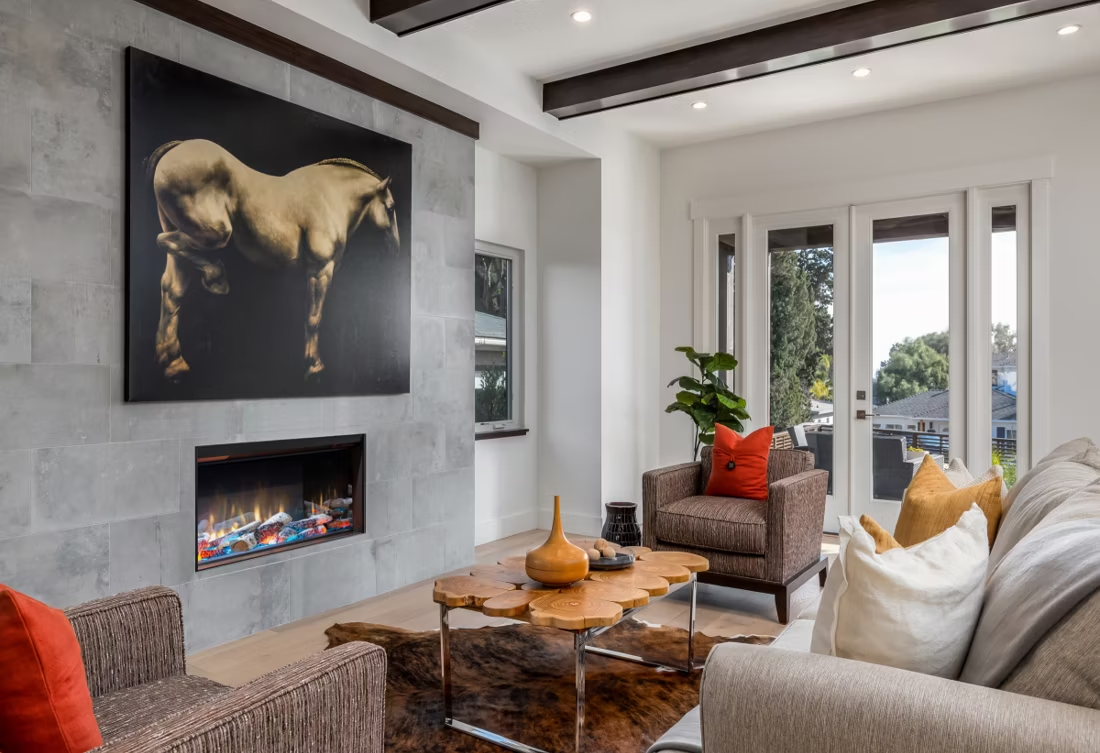
No—that's its superpower. An electric fireplace needs a wall and an outlet, period. No vent pipe, no gas line, no clearances to design around, which is why it works in bedrooms, offices, apartments, and walls where venting a gas or wood unit would be impractical or impossible. Installation is typically the simplest and least expensive of any fireplace type.
Can I put a TV above my fireplace?
Yes—with an asterisk. Fireplaces are hot and TVs don't like heat. Either put a mantel between them to deflect rising warmth, or choose a fireplace with heat-management technology that creates a cool zone on the wall above—the wall stays around 125 degrees, barely warm, while the room still gets full heat. If you like clean lines and don't want a mantel, heat management is the answer.
Nearby Dealers
Hearth shops serving Montréal and the surrounding area. Every listing shows whether it is a WhyFire partner, a dealer we have verified as authorized for the brands we recommend, or a local business carrying hearth products. No manufacturer pays for placement. How we verify dealers →
Confort Elite
Foyer Universel Montreal Inc. (A.m.f.)
Nergiflex
Noréa Foyers Montréal
Pro Du Foyer
Propane Plus Inc
Arta Boutik
Napert Signature
Décor Chaleur Châteauguay
Thermopompes N & R Sol
Finition Belle-Flammes
Alternatives
Noeea Foyers Rive-Nord
Les Foyer Mirabel A.m.f.
Electric Service in Montréal
An electric fireplace's heater draws about 1,500 watts—pennies per hour at local rates.
Hydro-Québec
Get your free Project Guide & Parts List for a Montréal electric fireplace.
Tell me about your home—triplex, condo, or heritage walk-up—and I'll match you with a trusted local dealer and send a free Project Guide & Parts List with the right unit, the circuit requirements, and no venting to plan around.
Find Your Fireplace →