
Automated heat built for -17°C nights on the St. Lawrence.
L'Islet-sur-Mer sits low along the river at just 7 metres of elevation, in a climate zone that runs five-plus months of real winter. I'll match you with a trusted local dealer who can size a pellet stove or insert to your home and send a free planning packet with the parts you need.
Every Project Starts From One of These Five Situations
A hands-off heat source for a village built on hard winters.
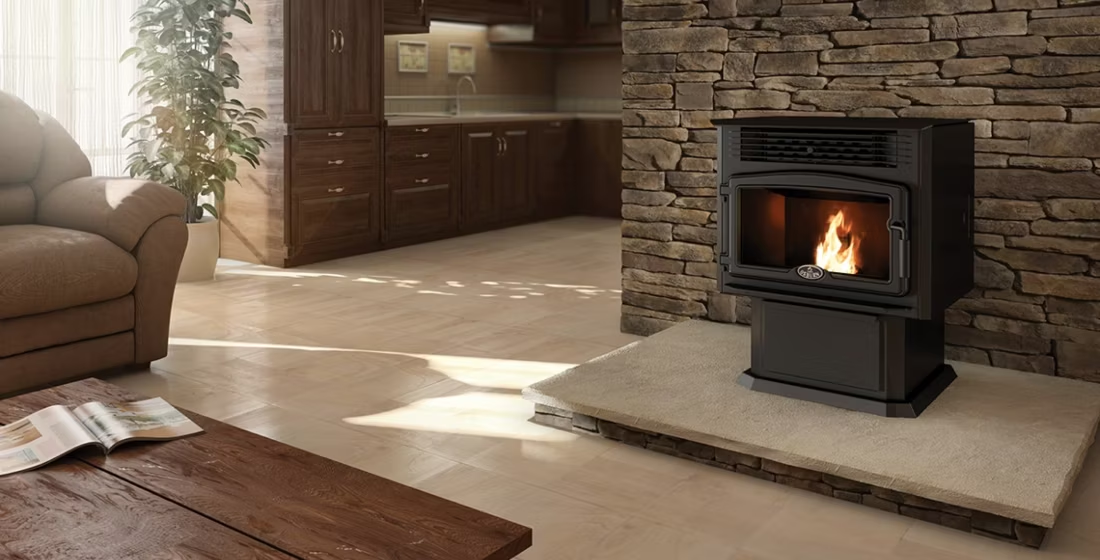
L'Islet-sur-Mer is a village of under 4,000 people set at just 7 metres above the St. Lawrence, and that low elevation doesn't spare it from a real winter: an average low of -17°C and a climate zone (7A) that keeps a heat source running daily for five-plus months. The river's humidity makes that cold feel deeper than the number suggests—closer in bite to a damp evening in Québec City than a dry prairie cold snap in Saskatoon. That's the case for pellet heat here: load the hopper, set the thermostat, and it holds a steady burn without the twice-daily reload a wood stove demands.
Sugar maple, yellow birch, American beech, and red oak dominate local wood lots, and plenty of households here still burn cordwood cut under an MRNF permit—about $1.85 per cubic metre up to a 22.5 m3 cap per season. Pellet appliances skip the splitting and seasoning work entirely, running instead on bagged product from Quebec producers like Granules LG, Energex, and Trebio, typically $400-$575 CAD a tonne. Installations still fall under CSA B365 and go through the municipal building department, and most insurers ask for a WETT inspection on solid-fuel appliances before writing a policy—a trusted local dealer handles that paperwork as a routine part of the job, not an afterthought.
Three steps. No salesperson until you're ready.
Tell us about your project
Your postal code, your situation, and the fuel you're leaning toward—or let the answers point you to one.
See what's actually available
The brands dealers within 100 miles genuinely carry—real options, never a catalog mirage.
Get your dealer & Project Guide
A trusted local dealer, plus the free Project Guide & Parts List that names every component of the job.
Frequently Asked Questions
How much does a pellet stove installation cost in L'Islet-sur-Mer?
Most installs run $6,000 to $10,000 CAD. A freestanding pellet stove venting through an existing wall near the hopper location sits toward the lower end, while a pellet insert going into an older masonry fireplace—common in the century homes along the Chemin des Pionniers—costs more once the liner, hopper placement, and hearth pad work are factored in. Your municipal building department permit and the CSA B365-compliant installation are typically folded into a dealer's quote rather than billed separately.
What size pellet stove do I need for a home here?
With winter lows averaging -17°C and the river's humidity making that cold linger indoors, most L'Islet-sur-Mer homes need a stove rated in the mid-range—roughly 40,000 to 60,000 BTU—to hold a main living area through a five-month heating season without running flat out constantly. Older homes along the river road with less insulation than newer builds further from the water often need to size up rather than down. A local dealer will size against your actual square footage and insulation rather than a rule of thumb.
Do I need a permit to install a pellet stove?
Yes. Installations go through the municipal building department and must follow CSA B365 installation code. Because pellet appliances burn cleaner than open wood-burning, they don't typically trigger the kind of fine-particle emissions review that stricter bylaws elsewhere in Quebec apply to wood stoves, but the permit and inspection step is still required, and most home insurers in the region ask for a WETT inspection before covering a new solid-fuel appliance. A dealer who installs pellet units regularly in Chaudière-Appalaches will already know the local inspector.
Where do I buy pellets in L'Islet-sur-Mer, and what do they cost?
Quebec producers Granules LG, Energex, and Trebio supply most of the bagged pellets sold through dealers in Chaudière-Appalaches, running roughly $400 to $575 CAD a tonne depending on the season and whether you buy early or mid-winter. A typical household burns 2 to 4 tonnes across a full heating season here, so buying and storing pellets in a dry space in fall, before demand and price climb, is worth planning around.
Pellet stove or wood stove—which makes more sense for my property?
If you already have access to a wood lot or can cut under an MRNF permit—about $1.85 per cubic metre up to 22.5 m3 a season—cordwood in sugar maple or yellow birch is hard to beat on fuel cost. Pellet stoves cost more per BTU on fuel but need none of the splitting, stacking, and seasoning time, and the auto-feed hopper holds a steady burn overnight without reloading. A lot of village and river-road households without their own woodlot access choose pellet for exactly that reason, while properties further out with standing timber tend to stay with wood.
Why isn't gas a bigger option here, and does pellet fill that gap?
Énergir's natural gas network reaches only parts of Quebec, and L'Islet-sur-Mer isn't on a served line, so a true gas fireplace here usually means a propane conversion rather than mains gas. That makes pellet the more practical middle ground for homeowners who want push-button convenience without the wood-splitting commitment—the auto-ignition and thermostatic control feel similar to gas day-to-day, without needing a propane tank set and delivery contract.
How much maintenance does a pellet stove need?
Plan on a full annual service, ideally in late summer before the fall reload, plus regular ash pan emptying and a burn-pot scrape every few days of heavy use. Because L'Islet-sur-Mer runs a genuinely long heating season, the auger, igniter, and exhaust fan all see more duty cycles than in a milder climate, so a dealer-serviced check before the first cold snap catches worn parts before they fail in January.
Will a pellet stove keep working if the power goes out?
Not without backup power. Pellet stoves rely on an electric auger and blower to feed fuel and move heat, so a Hydro-Québec outage shuts one down—worth remembering in a region that still remembers the 1998 ice storm's extended outages. Homeowners in L'Islet-sur-Mer who want heat that survives a multi-day outage often pair a pellet stove for daily convenience with a battery backup or keep a wood stove or fireplace elsewhere in the house as a fuel-independent fallback.
What pellet stove brands are actually available through local dealers?
Dealers serving Chaudière-Appalaches typically carry appliances built to run on the regional pellet supply—Granules LG, Energex, and Trebio all being widely stocked bag brands—alongside stove lines chosen for CSA B365 compliance and cold-climate performance. Rather than shopping a national catalogue, the more useful question is which units your nearest trusted dealer actually services and stocks parts for, since that determines how fast you get warranty support if something needs attention mid-winter.
Why do fireplace quotes vary so much?
Because a fireplace is an iceberg—there's more behind the wall than in front of it. A low quote often covers only the unit; the full scope includes vent pipe, gas line or electrical, framing, and the tile or stone that has to come off and go back on. Make every bidder price the whole job. If a dealer can't speak to the full scope with confidence, that's your signal to keep looking.
Is it worth replacing an old fireplace that still sort of works?
Ask three questions: Is it ugly? Is it drafty? Does it actually work? Most old fireplaces fail at least two. Beyond looks, an old unit leaks air around the damper year-round and—if it's gas with a standing pilot—quietly burns a couple hundred dollars a year. A modern replacement seals the wall, heats the room, and changes how the whole space gets used.
Why is a fireplace insert so efficient?
An insert does two things: it seals the chimney completely, so you stop losing air you already paid to heat, and it radiates warmth into the room through the firebox and glass. Most add a heat-exchange fan that pulls cool room air underneath, wraps it around the hot firebox, and pushes it back out warm. Your home is more efficient before you've even lit the first fire.
What should I look for in pellet stove design?
Three things separate the field: how easy the burn pot is to clean (trapdoor designs let the ash drop straight into the pan), how the auger moves pellets (top-mounted augers that pull instead of push jam less and wear slower), and diagnostics (self-diagnosing control boards tell you exactly which part needs attention instead of leaving you guessing). Heat output is table stakes—livability is in these details.
Nearby Dealers
Hearth shops serving L'Islet-sur-Mer and the surrounding area. Every listing shows whether it is a WhyFire partner, a dealer we have verified as authorized for the brands we recommend, or a local business carrying hearth products. No manufacturer pays for placement. How we verify dealers →
A. Tremblay Et Frères
Magasin H. Letourneau Inc.
Propane Multi-Service Inc
Maçonnex (Saint-Isidore)
Boutique Joli-Feu
Mission Ventilation K.g. Inc
Pellet Brands Stocked Around L'Islet-sur-Mer
Typical price runs $400-$575 per ton—buy early-season for the best rates. Manufacturers will point you to the nearest stocking dealer.
Granules Lg
Trebio
Get your free Project Guide & Parts List for a L'Islet-sur-Mer pellet project.
Tell me about your home and I'll match you with a trusted local dealer, then send a free Project Guide & Parts List sized for L'Islet-sur-Mer's long, damp winters, with the vent kit and parts specified.
Find Your Fireplace →