
Keep Your Family Warm and Safe—No Matter What
Cap-Chat sits on the exposed north shore of the Gaspé Peninsula, where average winter lows near -19.9°C meet some of the strongest coastal wind in Quebec. I'll match you with a trusted regional dealer who knows what actually holds up here, and send a free planning packet sized for your home.
Every Project Starts From One of These Five Situations
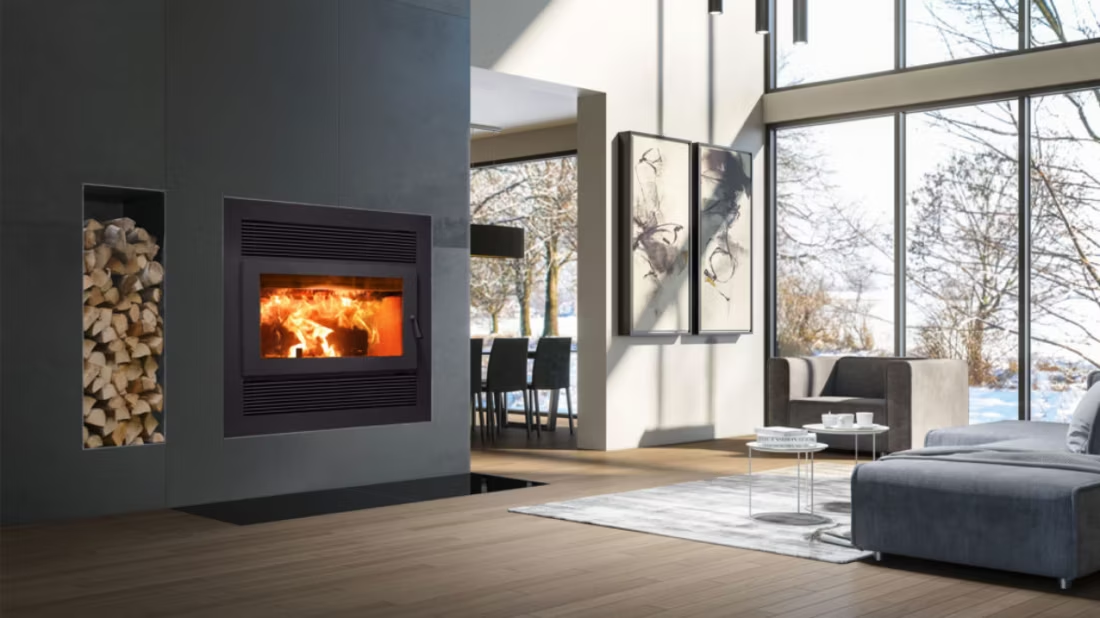
Wood is still the practical backbone of heat in Cap-Chat.
At climate zone 7A with winter lows averaging -19.9°C, Cap-Chat runs colder than most of Quebec ever sees, closer to what Thunder Bay or Québec City deal with than to Montréal's milder winters. The town's real distinguishing feature, though, is wind—it's home to some of the province's largest wind farms, including the towering Éole turbine, because the air off the St. Lawrence rarely lets up. That same wind punishes overhead power lines during winter storms, so a wood stove that runs with zero electricity is less a lifestyle choice here and more a practical hedge against the outages that come with living on this stretch of coast.
The Chic-Choc foothills behind town supply sugar maple, yellow birch, American beech, and red oak, all commonly split and stacked by local burners, and permits to cut on public land go through the Ministère des Ressources naturelles et des Forêts at roughly $1.85 per cubic metre plus taxes, up to a 22.5 cubic metre maximum, valid April 1 to March 31 with harvest windows that shift by region. Any new installation still needs a permit through the municipal building department and must meet the CSA B365 installation code, and most insurers here will ask for a WETT inspection before they'll cover the appliance. Cap-Chat doesn't fall under the stricter fine-particulate registration bylaw that applies on the island of Montréal, but a CSA-certified, low-emission stove is still the standard a good local dealer will steer you toward.
Firewood Cutting Permits Near Cap-Chat
Ministère Des Ressources Naturelles Et Des Forêts (Mrnf)
Three steps. No salesperson until you're ready.
Tell us about your project
Your postal code, your situation, and the fuel you're leaning toward—or let the answers point you to one.
See what's actually available
The brands dealers within 100 miles genuinely carry—real options, never a catalog mirage.
Get your dealer & Project Guide
A trusted local dealer, plus the free Project Guide & Parts List that names every component of the job.
Frequently Asked Questions
How much does a wood stove installation cost in Cap-Chat?
Most installs run $6,000 to $12,000 CAD. An insert dropping into an existing masonry chimney lands toward the low end, while a full Class A chimney system in a home without one already pushes toward the top. One local wrinkle: because Cap-Chat is a small community on the outer Gaspé coast, most certified installers travel in from Sainte-Anne-des-Monts or Matane, so factor that into scheduling and, sometimes, the quote itself.
What size wood stove works best for a Cap-Chat home?
With average winter lows of -19.9°C and near-constant wind off the St. Lawrence driving extra heat loss through older walls and windows, undersizing is the mistake to avoid. Homes along the shore road, many built decades before current insulation standards, generally do better with a medium to large stove capable of a long, steady overnight burn rather than a small unit that has to cycle constantly to keep up with the wind chill.
Do I need a permit to install a wood stove in Cap-Chat?
Yes. New installations require a permit through the municipal building department and must meet the CSA B365 installation code. Most home insurers in the region also require a WETT inspection before they'll add coverage for a wood-burning appliance, so it's worth booking that at the same time as your install rather than treating it as a separate step later.
Which wood species are common around Cap-Chat, and how do they burn?
Sugar maple and yellow birch are the two most commonly split and stacked woods in the area, both dense and long-burning once properly seasoned, which suits the long Gaspé heating season. American beech burns similarly hot but seasons a bit slower due to its density, and red oak, while less common, is prized by those who can get it for its steady, coal-producing burn overnight—useful on the coldest nights when you want a stove still holding heat by morning.
How do I get a permit to cut firewood on public land near Cap-Chat?
Permits go through the Ministère des Ressources naturelles et des Forêts (MRNF), running about $1.85 per cubic metre plus taxes with a maximum of 22.5 cubic metres per permit. The season runs April 1 to March 31, though the exact harvest window depends on the regional forest unit, so it's worth confirming current dates with the MRNF office covering the Gaspésie–Îles-de-la-Madeleine region before you plan a cutting trip.
What's the best wood stove for an area that loses power to coastal wind?
Cap-Chat's wind is strong enough to host major wind farms, and that same wind regularly stresses overhead lines during winter storms. A catalytic stove from a brand like Blaze King, capable of a long, controlled overnight burn without any electrical components, is popular locally for exactly that reason—it keeps working when the power doesn't. Non-catalytic stoves from Pacific Energy are a lower-maintenance option for households treating wood as backup rather than a daily primary heat source.
How often should my chimney be swept in Cap-Chat?
An annual inspection before burning season, ideally in September ahead of the first real cold snap, is the standard recommendation, and it holds here given how many homes run a wood stove through a long, cold season. A WETT-certified sweep does double duty—it keeps the chimney safe and satisfies the inspection most insurers already require for coverage on the appliance.
Wood vs. pellet vs. electric—what makes sense in Cap-Chat?
Hydro-Québec's residential rate of roughly $0.078 per kWh is among the cheapest power in the country, so a lot of Cap-Chat homes lean on electric baseboard as their base heat and add a wood stove specifically for the outage resilience the wind here makes necessary. Pellet stoves using regional brands like Granules LG, Energex, or Trebio, running $400-$575 CAD a tonne, are a middle path for households that want cleaner, more hands-off heat but still need to check for backup during storms, since pellet stoves require electricity to run the auger and blower.
Is natural gas an option for a fireplace in Cap-Chat?
Realistically, no. Énergir's natural gas network covers only parts of the province, concentrated around greater Montréal, the south shore, and a handful of urban corridors, and Cap-Chat, out on the Gaspé Peninsula, isn't on it. A "gas fireplace" here almost always means a propane system with its own tank rather than a piped natural gas connection, so it's worth confirming fuel type with a local dealer before you commit to a gas option over wood or pellet.
Why do fireplace quotes vary so much?
Because a fireplace is an iceberg—there's more behind the wall than in front of it. A low quote often covers only the unit; the full scope includes vent pipe, gas line or electrical, framing, and the tile or stone that has to come off and go back on. Make every bidder price the whole job. If a dealer can't speak to the full scope with confidence, that's your signal to keep looking.
Louvered or clean face—which fireplace front is better?
Louvered fronts have grill work above and below the glass for airflow, move heat a little better with a fan, and suit traditional mantels. Clean face designs drop the louvers entirely so finish work runs to the fire's edge—they fit both modern and traditional rooms. When we did our own home we chose clean face: a big viewing area beat a little extra airflow. It depends on your room, not on a rulebook.
Do I have to leave the stove door cracked open to start a fire?
On many stoves, yes—a new fire needs extra air, and cracking the door a couple inches is how most stoves get it. But some modern stoves offer an automatic startup air system: engage it when you light, and timed air jets feed the fire for the first 20 minutes with the door fully shut, then close automatically. It's mechanical—like an egg timer, no electricity—and it means you can load it, light it, and walk away.
Why is my open fireplace making my house colder?
Open fireplaces suck—literally. As the fire burns, it consumes air your furnace already paid to heat and pulls it out through the chimney, so the house is actually colder after the fire goes out than before you lit it. An insert fixes this: it seals the chimney, puts fixed glass across the front, and turns that hole in your house into a real heat source.
Nearby Dealers
Hearth shops serving Cap-Chat and the surrounding area. Every listing shows whether it is a WhyFire partner, a dealer we have verified as authorized for the brands we recommend, or a local business carrying hearth products. No manufacturer pays for placement. How we verify dealers →
Plomberie G.d. Gauthier - Chauffage C.g.
Lamarre Gaz Industriel Inc
Propane Lavoie Inc
Propane Nord Cotier
Propane M.c.a Inc
Get your free Project Guide & Parts List for a Cap-Chat wood heat project.
Tell me about your home and I'll match you with a trusted regional dealer who covers the Gaspésie–Îles-de-la-Madeleine region, then send a free Project Guide & Parts List sized for -19.9°C nights and coastal wind, with the vent kit and parts specified.
Find Your Fireplace →