
Keep Your Family Warm and Safe—No Matter What
Gas heat runs the show in this Mon Valley borough, and Allegheny County's air quality rules make new wood installs the exception. For the right home, though, a certified stove or insert still works—and we'll connect you with a dealer who handles the paperwork.
Every Project Starts From One of These Five Situations
Wood heat exists here—but it's the exception, not the rule.
West Mifflin sits in the Monongahela Valley just south of Pittsburgh, at a modest 1,091 feet with winters that dip to an average low of 22°F and around 5,400 heating degree days—cold enough for real heating demand, but nowhere close to the wood-heavy climates of places like Buffalo, NY or Duluth, MN where rural acreage and easy firewood access keep wood stoves mainstream. West Mifflin's housing stock is dense, mid-20th-century suburban development, and the borough falls inside Allegheny County's EPA non-attainment area for fine particulate matter—a designation that puts real weight behind why solid-fuel appliances never became the default here the way natural gas did.
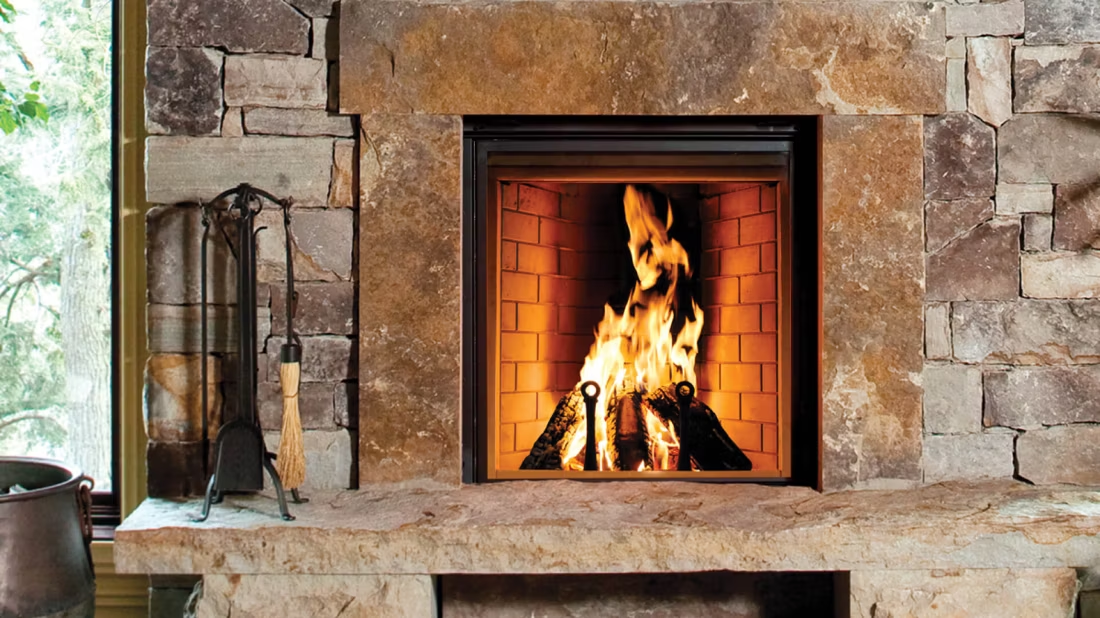
That doesn't mean wood is off-limits. Older West Mifflin homes built during the Mon Valley's postwar boom often have original masonry fireplaces, and some homeowners still convert them to inserts for backup heat or ambiance. Local hardwood—oak, hickory, maple, and cherry—is readily available through regional firewood suppliers rather than public-land permits, since there isn't much cuttable forest inside the borough itself. If you're one of the homeowners for whom wood still makes sense—an existing chimney, a desire for off-grid backup heat, or simply a preference for a real fire—a certified installer can make it work within the county's air quality rules.
Three steps. No salesperson until you're ready.
Tell us about your project
Your zip code, your situation, and the fuel you're leaning toward—or let the answers point you to one.
See what's actually available
The brands dealers within 100 miles genuinely carry—real options, never a catalog mirage.
Get your dealer & Project Guide
A trusted local dealer, plus the free Project Guide & Parts List that names every component of the job.
Frequently Asked Questions
How much does it cost to install a wood stove in West Mifflin?
Because wood-burning installs are uncommon in this part of Allegheny County, pricing runs a bit higher than in rural wood-heavy markets—expect roughly $3,500 to $7,500 for a freestanding EPA-certified stove with new Class A chimney pipe, and $4,000 to $8,000 for an insert that reuses an existing masonry chimney with a new stainless liner. Homes without any existing chimney infrastructure sit at the top of that range. Because so few installers in the immediate South Hills/Mon Valley area regularly handle solid-fuel work, it's worth getting quotes from a couple of Pittsburgh-area hearth dealers rather than assuming your first estimate is the going rate.
Is wood burning restricted in West Mifflin because of air quality rules?
Allegheny County—including West Mifflin—is designated a non-attainment area for fine particulate matter, which puts it under closer scrutiny from the Allegheny County Health Department's Bureau of Air Quality. That doesn't ban wood stoves outright, but any new installation must use an EPA 2020 NSPS-certified appliance, and the county can issue burn advisories during high-pollution days that ask residents to avoid unnecessary wood burning. It's one of the practical reasons wood heat never became common here the way it did in less-developed parts of western Pennsylvania.
Why don't more homes in West Mifflin have wood stoves?
It comes down to geography and infrastructure more than climate. West Mifflin's winters are real but moderate compared to places like Buffalo, NY, where colder temperatures and rural acreage keep wood heat mainstream. West Mifflin is dense, built-up Mon Valley suburb with small lots and row-style housing from the 1940s through 1960s, and natural gas service arrived early enough that it became the default heating fuel for most of the borough. Add Allegheny County's non-attainment status, and the combination of limited lot space, no local public land for cutting permits, and stricter emissions oversight has kept wood stoves a minority choice rather than the norm.
Can I convert my existing masonry fireplace to a wood-burning insert?
Yes, and it's usually the most practical path to wood heat in West Mifflin. A lot of the borough's older housing stock still has the original masonry fireplace, and converting it to an EPA-certified insert with a stainless steel liner typically runs $4,000 to $8,000 depending on the chimney's condition and whether the liner needs a full relining versus a simple insert connector. Since you're using a chimney that's already there, this route avoids the cost of new exterior venting that a freestanding stove install in a home without a chimney would require.
Does my wood stove need to be EPA certified to install it in West Mifflin?
Yes. Any new wood-burning stove or insert installed in West Mifflin needs to meet current EPA 2020 NSPS emissions standards—this matters more here than in many parts of the state given Allegheny County's non-attainment designation. Older, uncertified stoves already in place aren't automatically required to be removed, but if you're buying a home with one, or replacing an aging unit, plan on installing a certified model. A local hearth dealer can confirm certification status on any stove you're considering.
What firewood is available locally, and where does it come from?
Common species in the region—oak, hickory, maple, and cherry—are widely available through Appalachian hardwood suppliers and regional firewood dealers, typically running $220 to $300 per cord seasoned and split. Unlike more rural parts of western Pennsylvania, West Mifflin doesn't have meaningful public forest land inside the borough for self-cut permits, so almost all firewood here is purchased rather than harvested. If you're planning to burn through a full winter, order early—seasoned hardwood needs six months to a year of drying time, and demand tightens as fall approaches.
How often should my chimney be inspected if I do have a wood stove?
The Chimney Safety Institute of America recommends an annual inspection for any wood-burning appliance, and that guidance applies just as much to the small number of wood stoves in West Mifflin as anywhere else. A Level 1 inspection and sweep typically runs $150 to $250 locally. Given how few chimneys in the borough see regular wood-burning use, it's worth confirming your sweep has specific experience with solid-fuel appliances rather than just masonry inspection—the creosote and draft issues are different from a purely decorative fireplace.
Does a wood stove make sense as backup heat during a power outage?
It's one of the stronger arguments for keeping wood heat in West Mifflin despite its rarity. Duquesne Light serves most of the borough, and at the current residential rate of roughly $0.195 per kWh, electric-resistance backup heat gets expensive fast during extended outages—and doesn't work at all if the grid itself is down. A wood stove or insert keeps producing heat with zero electrical dependence, which is a real advantage during ice storms or high-wind outages common to the Mon Valley in winter, even for homeowners who otherwise heat with gas.
Wood vs. gas—which is right for my West Mifflin home?
For most West Mifflin homes, gas wins on convenience: it's the established default fuel in the borough, offers instant on-off heat, and doesn't require firewood storage or ash cleanup. Wood makes sense in narrower cases—homes with an existing masonry fireplace worth reactivating, owners who specifically want off-grid backup heat, or anyone drawn to the ambiance of a real fire who's willing to work within Allegheny County's certification and air-quality rules. If you're weighing both, a local dealer can walk through whether your chimney, lot, and budget make wood a realistic option before you commit to it over a gas insert.
Why is a fireplace insert so efficient?
An insert does two things: it seals the chimney completely, so you stop losing air you already paid to heat, and it radiates warmth into the room through the firebox and glass. Most add a heat-exchange fan that pulls cool room air underneath, wraps it around the hot firebox, and pushes it back out warm. Your home is more efficient before you've even lit the first fire.
Why is my open fireplace making my house colder?
Open fireplaces suck—literally. As the fire burns, it consumes air your furnace already paid to heat and pulls it out through the chimney, so the house is actually colder after the fire goes out than before you lit it. An insert fixes this: it seals the chimney, puts fixed glass across the front, and turns that hole in your house into a real heat source.
How much should I budget for a fireplace?
For an average home—covering the fireplace, the vent pipe, and basic installation—a budget between $3,900 and $5,500 gives you a lot of options across wood, gas, and pellet. By the time you add finish work, gas line, and electrical, the average complete installation lands between $5,000 and $12,000 all-in. In a remodel or new build, a good rule is to put about 2.5% of the total project cost toward the fireplace.
Can I install a fireplace myself?
If you're putting a fire in your house on purpose, it's best to work with an expert. Unless you're genuinely experienced in framing, gas line, vent pipe, and the national code on clearances to combustibles, have a professional do it—and ideally the same company that sells you the fireplace, so warranty, service, and liability all live under one roof.
Nearby Dealers
Hearth shops serving West Mifflin and the surrounding area. Every listing shows whether it is a WhyFire partner, a dealer we have verified as authorized for the brands we recommend, or a local business carrying hearth products. No manufacturer pays for placement. How we verify dealers →
All Seasons Fireplace & Home
Fireplace & Patioplace
Howell Craft Inc.
A Capital Roofing
Tri-State Stoves
Fireplace And Patio Place
Clear Water Pools LLC
Tomayko Construction & Alternative Heating Llc.
Samson Glass And Mirror
The Stove Place
Halls Pools & Fireplaces
Northern Woodworking
Scenery Hill Hardware
Find your wood fireplace fit in West Mifflin.
Tell us about your home and we'll be straight with you about whether wood makes sense in West Mifflin—and if it does, match you with a trusted local dealer and a free Project Guide & Parts List covering the exact parts, venting, and install plan for your project.
Find Your Fireplace →