
Warm up your Juniata County home—no chimney required.
Zone-heat a living room, sunroom, or addition anywhere in Juniata County without running a flue or cutting a hole in the roof. Find the right unit and get matched with a trusted local dealer.
Every Project Starts From One of These Five Situations
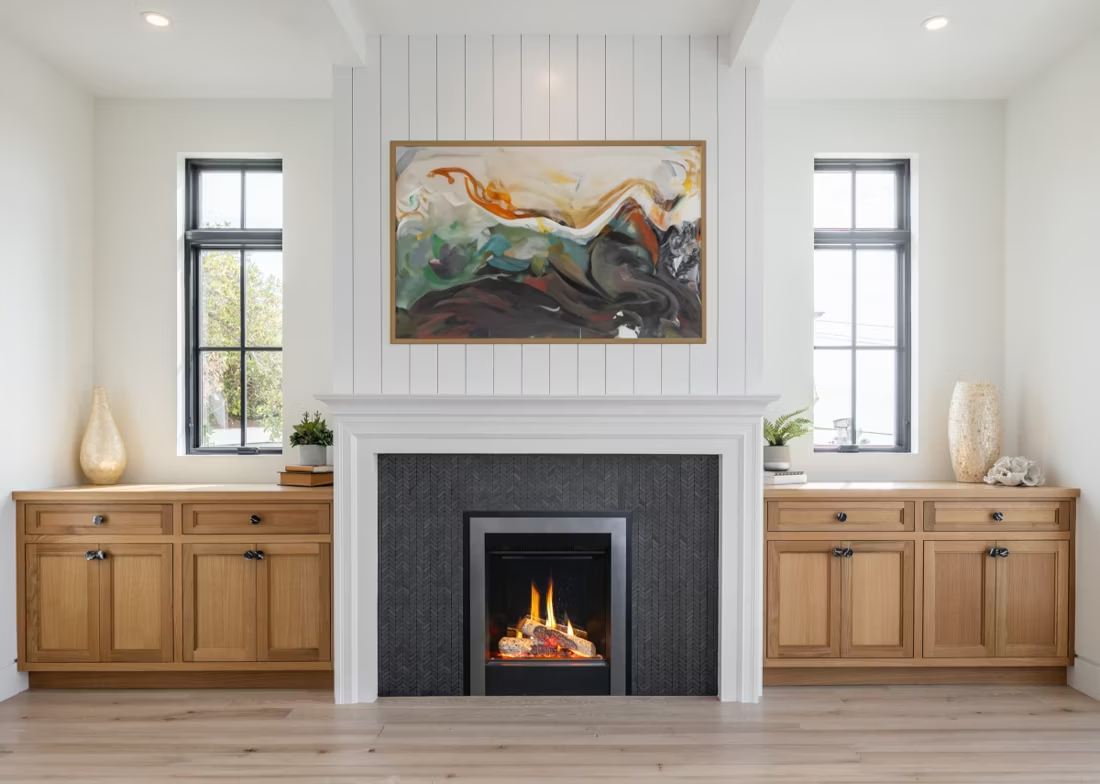
Real fire look, plug-in simplicity, no venting.
Juniata County sits in the Ridge-and-Valley region of central Pennsylvania—a Climate Zone 5A county of small boroughs and townships like Mifflintown, Port Royal, Thompsontown, and McAlisterville, with a population under 5,000 spread across mostly rural land. Winters here are genuinely cold, and a lot of county homes still lean on wood, oil, or propane as their primary heat source, often burning oak, hickory, maple, or cherry cut from the surrounding ridges. Electric fireplaces fill a different role in this county: supplemental warmth and real-fire ambiance in a room where running a chimney or gas line isn't practical—a finished basement, a sunroom addition, a bedroom, or a rental unit.
The appeal of electric is the install simplicity. Most freestanding and mantel units plug into a standard outlet, and built-in models typically just need a dedicated 240V circuit run by a licensed electrician—no masonry, no venting, no combustion byproducts to manage. Under Pennsylvania's Uniform Construction Code, permit authority in Juniata County rests with individual townships and boroughs rather than one county office, so what triggers a permit (usually just the new circuit, not the fireplace itself) can vary slightly depending on whether you're in Mifflintown Borough, Fermanagh Township, or elsewhere. A local dealer who's pulled permits across the county already knows which office to call.
Three steps. No salesperson until you're ready.
Tell us about your project
Your zip code, your situation, and the fuel you're leaning toward—or let the answers point you to one.
See what's actually available
The brands dealers within 100 miles genuinely carry—real options, never a catalog mirage.
Get your dealer & Project Guide
A trusted local dealer, plus the free Project Guide & Parts List that names every component of the job.
Frequently Asked Questions
How much does an electric fireplace installation cost in Juniata County?
A basic plug-in insert or mantel package that just needs a standard 120V outlet can run as little as $400 to $800 installed. A built-in wall unit or a larger insert that requires a dedicated 240V circuit typically lands between $1,200 and $2,500 once electrician labor is included. Older Juniata County farmhouses and older housing stock in the boroughs sometimes still run 100-amp electrical panels, and adding a dedicated circuit for a larger unit can mean a panel evaluation first—your installer or electrician will check this before quoting a firm number.
Do I need a permit to install an electric fireplace in Juniata County?
Usually not for the fireplace itself, but the electrical work often does. Pennsylvania's Uniform Construction Code puts permitting authority with the local township or borough rather than a single county building department, so Mifflintown Borough and a rural township like Fermanagh or Milford handle it a little differently. A simple plug-in unit on an existing circuit generally needs nothing. A built-in that requires a new dedicated circuit typically needs an electrical permit, which most electricians or full-service hearth dealers pull as part of the job.
Can an electric fireplace heat my whole house in Juniata County's climate?
Not realistically. Juniata County sits in Climate Zone 5A with genuinely cold winters, and most electric fireplaces are rated around 1,500 watts—roughly 5,000 BTU of supplemental heat, enough to take the chill off a single room, not carry a whole house through a January cold snap. That's why most county homeowners pair one with an existing primary system—a wood stove, oil furnace, or propane heat—and use the electric unit for zone heat in a specific room or for the fire look without the upkeep of tending a real one.
What's the difference between an electric fireplace, insert, and mantel package?
An electric insert is built to slide into an existing masonry fireplace opening, letting you keep the surround and mantel you already have while swapping wood-burning for a flame-effect heater. A mantel package pairs an electric firebox with a matching cabinet or surround for rooms with no existing fireplace—common in additions and finished basements around the county. A wall-mounted or built-in unit recesses into a framed wall, often used in newer construction or remodels. For most Juniata County homes with an old masonry fireplace that's no longer used for wood, an insert is the straightforward fit.
Will my electric fireplace work during a power outage?
No—and this matters more in a rural county like Juniata than it might elsewhere. Electric fireplaces run entirely off grid power, so an ice storm or downed line takes them out along with everything else. If you're relying on your fireplace for real backup heat during winter outages, a wood stove or a gas unit with battery-backed ignition is a better fit for that role. Many county homeowners treat the electric fireplace as the everyday convenience option and keep wood heat as the outage backup—a common combination out here.
How much does it cost to run an electric fireplace?
Most units draw around 1,500 watts on the heater setting, roughly the same as a space heater. Running one for a few hours an evening adds a modest amount to a monthly bill—a rough estimate is $0.15 to $0.25 per hour of heater use at typical Pennsylvania residential electric rates, less if you run the flame effect without the heater. Compared to heating an entire room with a whole-home system, it's a cheap way to warm the one space you're actually sitting in.
What's a good electric fireplace for an older Juniata County home?
For farmhouses and older borough homes with an existing masonry fireplace that's been sealed off or isn't burning wood anymore, an insert sized to the opening is the cleanest option—it fills the existing hole, keeps the mantel and surround, and just needs power. For rooms with no fireplace at all—additions, converted porches, finished basements common in the county's older housing stock—a mantel package or a linear wall-mount unit works better. A local dealer will measure your existing opening and check your panel before recommending a specific model and wattage.
Electric vs. wood—which is right for my Juniata County home?
Wood is still the backbone of home heating for a lot of Juniata County households, and with oak, hickory, maple, and cherry all common on local woodlots, self-cut firewood keeps fuel costs low and gives you heat that works with the power out. Electric can't compete on raw BTU output or storm-day reliability, but it wins on convenience—no ash, no chimney maintenance, no hauling wood, and instant on-off with a remote. A lot of county homes run both: a wood stove or fireplace for the bulk of the heating season, and an electric unit in a second room where running a flue doesn't make sense.
Electric vs. pellet stove—which makes more sense?
Both need electricity to operate, so neither is a true outage backup—a pellet stove's auger and blower stop the moment the power drops just like an electric fireplace's heater does. Where they differ is heat output and fuel: a pellet stove burning bags from a regional supplier like Energex, Hamer Pellet Fuel, or Greene Team Pellet Fuel can genuinely heat a living area through a Juniata County winter, while an electric fireplace is realistically a supplemental or ambiance unit. If you want real whole-room heat and don't mind loading a hopper, pellet is the stronger choice. If you want the fire look in a room with no venting path and don't need it to carry the heating load, electric is simpler.
Can I put a TV above my fireplace?
Yes—with an asterisk. Fireplaces are hot and TVs don't like heat. Either put a mantel between them to deflect rising warmth, or choose a fireplace with heat-management technology that creates a cool zone on the wall above—the wall stays around 125 degrees, barely warm, while the room still gets full heat. If you like clean lines and don't want a mantel, heat management is the answer.
Does an electric fireplace need a vent or chimney?
No—that's its superpower. An electric fireplace needs a wall and an outlet, period. No vent pipe, no gas line, no clearances to design around, which is why it works in bedrooms, offices, apartments, and walls where venting a gas or wood unit would be impractical or impossible. Installation is typically the simplest and least expensive of any fireplace type.
Can I install a fireplace myself?
If you're putting a fire in your house on purpose, it's best to work with an expert. Unless you're genuinely experienced in framing, gas line, vent pipe, and the national code on clearances to combustibles, have a professional do it—and ideally the same company that sells you the fireplace, so warranty, service, and liability all live under one roof.
Can a fireplace actually lower my heating bill?
Yes—by creating a comfort zone. A furnace heats every square foot of the house just to warm the one room you're in; a gas fireplace on low burns roughly a sixth of the gas a typical furnace does. Set the furnace around 55–60 degrees as a baseline, then heat the rooms your family actually uses. Families who heat this way commonly save $20–$60 a month.
Find your electric fireplace in Juniata County.
Tell us a bit about your home and we'll put together a free Project Guide & Parts List for your electric fireplace project—sized right, matched to your panel, and paired with a trusted local dealer in Juniata County.
Find Your Fireplace →