
Warm up your Grant County home—no gas line, no chimney, no fuss.
From Medford to Pond Creek to Wakita, electric fireplaces bring real warmth and ambiance to Grant County's farmhouses and in-town homes alike—without a flue, a fuel tank, or a permit fight. Find the right unit and connect with a trusted local dealer.
Every Project Starts From One of These Five Situations
Simple, safe heat for Grant County's wheat country farmhouses.
Grant County sits in the wheat and cattle country of north-central Oklahoma, just south of the Kansas line, with a population under 3,000 spread across Medford, Pond Creek, Wakita, Nash, and the farmland between them. The climate here (Zone 3A, mixed-humid) is nowhere near the brutal winters of a place like Bismarck, ND—most winters bring cold mornings in the 20s and 30s rather than weeks of sub-zero cold—but Grant County still sees the occasional Arctic front and ice storm blow through on the wind off the plains, and older farmhouses with drafty windows and high ceilings often need more than a central furnace can comfortably deliver to a single room.
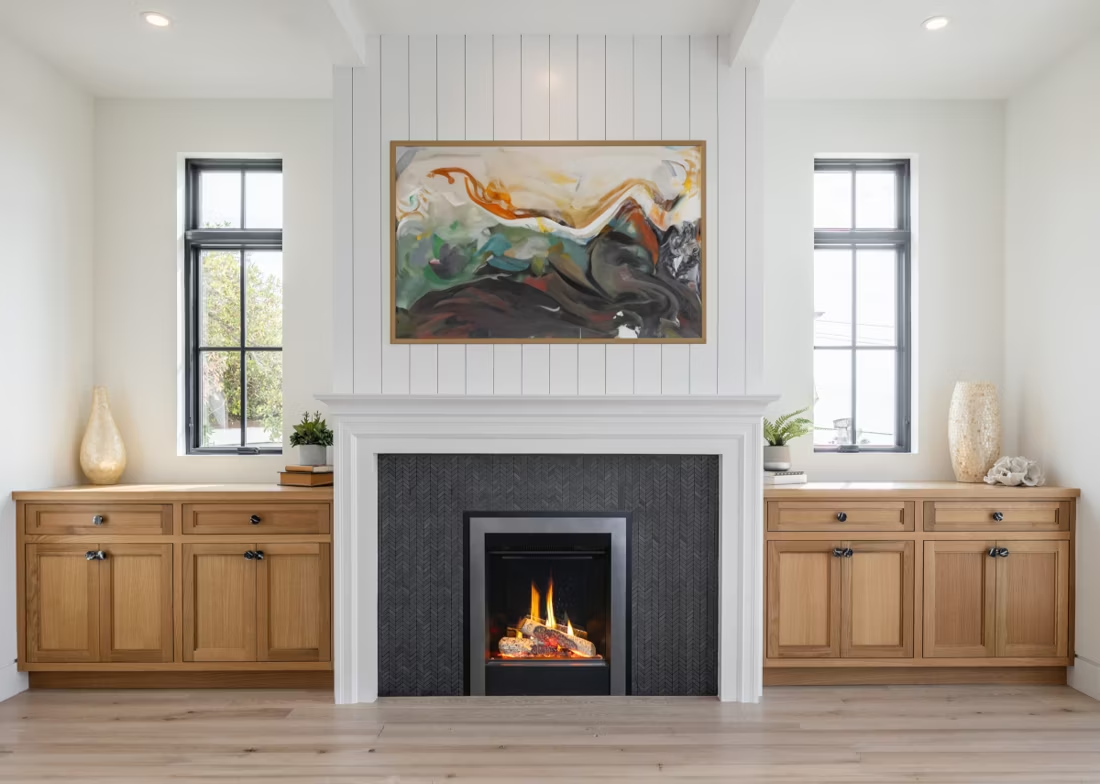
That's where electric fireplaces do their best work. No chimney, no gas line, no combustion byproducts to vent—just plug-in or hardwired zone heat that a homeowner can add to a bedroom, sunroom, or living room without touching the roofline or running new gas piping. For rental properties around Medford and Pond Creek, for older homes on rural acreages served by Alfalfa Electric Cooperative, or for anyone who wants the look of a fire without the upkeep of cordwood or a propane tank, electric is often the lowest-friction way to add real, usable heat to a Grant County home.
Three steps. No salesperson until you're ready.
Tell us about your project
Your zip code, your situation, and the fuel you're leaning toward—or let the answers point you to one.
See what's actually available
The brands dealers within 100 miles genuinely carry—real options, never a catalog mirage.
Get your dealer & Project Guide
A trusted local dealer, plus the free Project Guide & Parts List that names every component of the job.
Frequently Asked Questions
How much does an electric fireplace installation cost in Grant County?
Most electric fireplace projects in Grant County fall between $300 and $2,000 total. A simple plug-in insert or freestanding unit that fits into an existing masonry opening is on the low end—it needs no new wiring, just an existing outlet. A built-in wall unit or a linear electric fireplace set into new framing costs more, mainly because it usually calls for a dedicated 120V or 240V circuit run by a licensed electrician, plus any drywall or trim carpentry around the unit. Homes on rural acreage outside Medford or Pond Creek sometimes see a modest travel charge added by the installer, since dealers covering Grant County are often based in Enid or Ponca City.
What size electric fireplace do I need for my home?
Electric fireplaces are rated by room heating capacity, not whole-home BTU output—most units comfortably heat 400 to 1,000 square feet of open space, which covers a single living room or bedroom in the majority of Grant County homes. Older farmhouses around Wakita and Nash with high ceilings and older single-pane windows lose heat faster, so it's worth sizing up or choosing a model with a higher-wattage heater core rather than relying on the unit's visual size alone. For homes seeking whole-house electric heat rather than a single accent room, a local dealer can talk through electric wall furnaces or a larger built-in unit sized to the space.
Do I need an electrician to install an electric fireplace?
Plug-in electric fireplace inserts and freestanding units typically just need a standard grounded outlet, so no electrician is required for those. Built-in and wall-mounted models, especially larger linear units, usually draw enough current to need a dedicated circuit—that work should be done by a licensed electrician, both for safety and because Alfalfa Electric Cooperative's service equipment is sized for typical household loads, not an unplanned new high-draw appliance. A trusted local dealer will tell you upfront whether your chosen unit needs new circuit work before you buy it.
What's the difference between an electric fireplace insert, a built-in unit, and a freestanding electric stove?
An electric insert is built to slide into an existing masonry fireplace opening, giving an old wood-burning fireplace new life without any chimney work. A built-in unit is designed to be framed into a wall—common in new construction or remodels around Medford and Pond Creek—and creates a true focal-point fireplace look. A freestanding electric stove sits on the floor like a wood stove and can go anywhere near an outlet, which makes it a popular choice for a sunroom, garage apartment, or outbuilding on a rural property. All three produce the same style of heat; the choice mostly comes down to what opening or wall space you're working with.
Do I need a permit for an electric fireplace in Grant County?
In most cases, no—a plug-in electric fireplace that uses an existing outlet doesn't require a permit anywhere in Grant County. If your project involves new electrical wiring, such as a dedicated circuit for a built-in unit, incorporated towns like Medford, Pond Creek, and Wakita typically require an electrical permit for that wiring work, even though the county doesn't maintain a general building code for unincorporated rural properties. A licensed electrician pulling the permit as part of the installation is the simplest way to stay compliant without doing the paperwork yourself.
What's the best electric fireplace for Grant County's climate?
Since Grant County's winters are milder than the deep-freeze conditions of places like Fargo, ND or Duluth, MN, most homeowners here are choosing an electric fireplace for supplemental zone heat and ambiance rather than to fight off extreme cold. A mid-range insert or linear unit with a strong infrared or fan-forced heater core (roughly 4,600–5,200 BTU) will comfortably take the edge off a chilly morning in a living room or bedroom. For sunrooms or additions with more glass and less insulation—common on some of the newer builds around Medford—a slightly higher-wattage unit or a model with a built-in thermostat helps keep the room from swinging in temperature.
How much maintenance does an electric fireplace need?
Very little compared to wood or gas. There's no chimney to sweep and no burner or pilot to service. Most upkeep is limited to periodically dusting the heater vents and cleaning the glass front, plus checking that the fan or blower runs quietly—a rattling or overheating fan is usually the first sign a unit needs a technician. Because there's no combustion, there's also nothing to inspect for carbon monoxide or venting concerns, which is one reason electric fireplaces are popular in rental properties around Pond Creek and Wakita where low-maintenance matters to landlords.
Will my electric fireplace work during a power outage?
No—and this is worth planning around in Grant County, where ice storms occasionally knock out power to rural Alfalfa Electric Cooperative lines for hours or, in bad years, days. An electric fireplace is entirely dependent on grid power (or a generator), so it won't provide heat during an outage the way a wood stove or a battery-backed gas unit can. If backup heat during outages matters to your household, it's worth asking a local dealer about pairing electric heat in your main living space with a wood-burning option elsewhere in the house, or planning for a generator that can carry the fireplace's circuit.
Electric vs. wood or pellet—which is right for my Grant County home?
Electric fireplaces win on convenience: no fuel to store, no ash, no chimney, and a fire that switches on and off instantly. Wood is still the traditional choice in this part of Oklahoma—oak, hickory, and mesquite are all common locally and burn well—and it keeps working even when the power's out, which matters given the area's occasional ice storms. Pellet stoves, using regional brands like Lignetics or Indeck Energy Services, split the difference: cleaner and easier to load than cordwood, but like electric, they need power to run the auger and blower. For a primary living room where looks and low-maintenance matter most, electric is usually the easiest fit. For a home that wants backup heat capability during a Grant County winter storm, wood remains hard to beat.
Can I put a TV above my fireplace?
Yes—with an asterisk. Fireplaces are hot and TVs don't like heat. Either put a mantel between them to deflect rising warmth, or choose a fireplace with heat-management technology that creates a cool zone on the wall above—the wall stays around 125 degrees, barely warm, while the room still gets full heat. If you like clean lines and don't want a mantel, heat management is the answer.
Do electric fireplaces actually produce heat?
Yes—most put out around 4,800–5,000 BTUs from a standard outlet, which comfortably warms a bedroom, office, or den as a comfort-zone heater. What they won't do is carry a whole house the way wood, gas, or pellet can. Think of electric as ambiance-first with honest supplemental heat: flames on with no heat in July, flames plus warmth in January.
How much should I budget for a fireplace?
For an average home—covering the fireplace, the vent pipe, and basic installation—a budget between $3,900 and $5,500 gives you a lot of options across wood, gas, and pellet. By the time you add finish work, gas line, and electrical, the average complete installation lands between $5,000 and $12,000 all-in. In a remodel or new build, a good rule is to put about 2.5% of the total project cost toward the fireplace.
What is an in-home preview and do I need one?
It's a visit where a hearth professional measures your space, confirms the model you picked actually works in your home, and walks the specs—framing, gas line, venting, finish work—before anything is ordered. Some details you just can't know until you see the house. Never make a down payment without one; it's the single most-skipped step that burns buyers.
Find your electric fireplace in Grant County.
Tell us a bit about your home and we'll match you with a trusted local dealer serving Grant County, plus a free Project Guide & Parts List—the exact parts, including any circuit or venting needs, for your electric fireplace project.
Find Your Fireplace →