
Electric warmth for Griggs County's zone 7 winters.
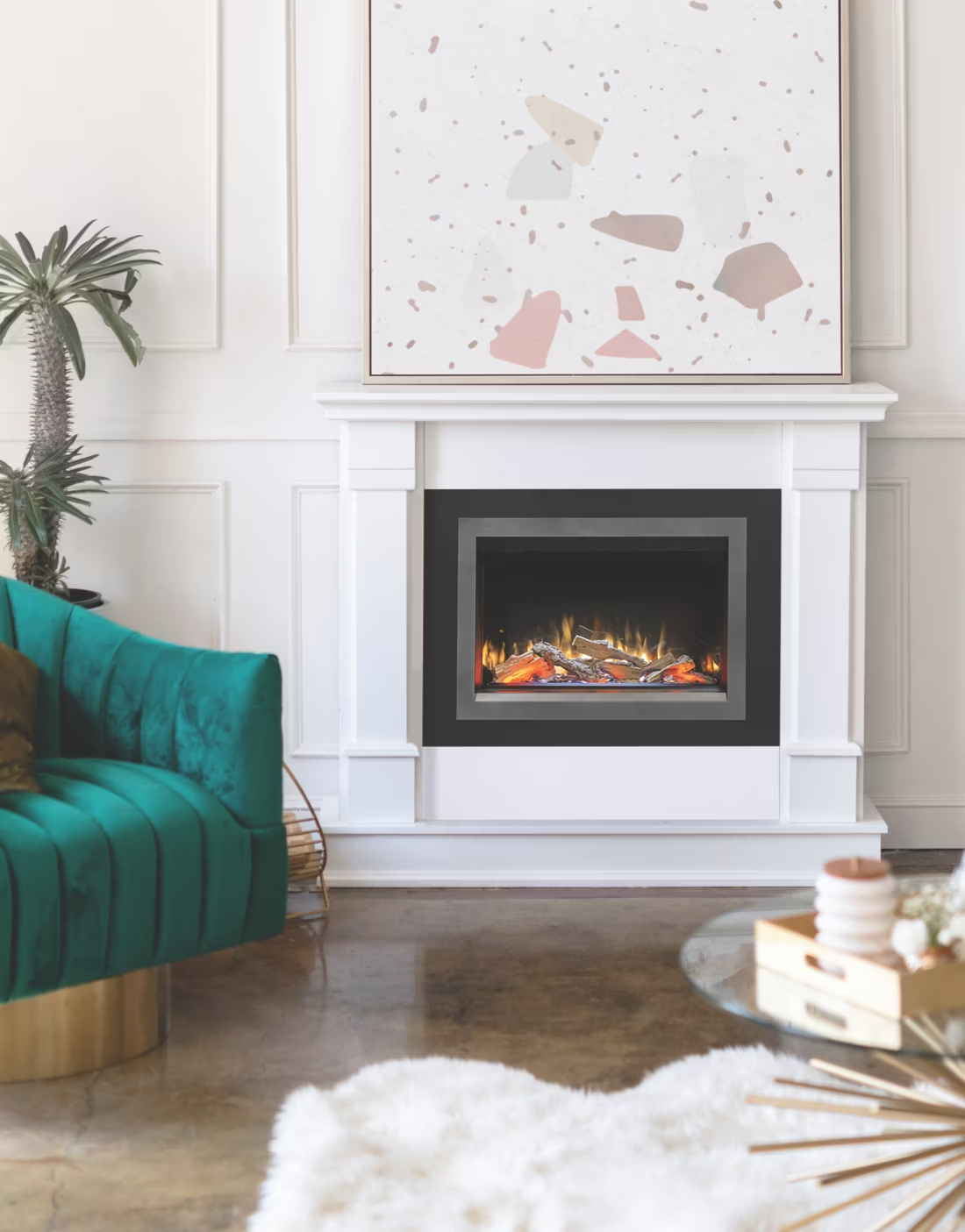
From Cooperstown to Hannaford, Binford, Sutton, and Jessie, Griggs County sees some of the coldest, longest winters in the Lower 48. An electric fireplace won't replace your furnace here, but it adds real supplemental warmth and glow to the rooms you actually live in. Find the right unit and get matched with a trusted local dealer.
Every Project Starts From One of These Five Situations
Supplemental heat and ambiance for a genuinely brutal climate.
Griggs County sits in ASHRAE climate zone 7—one of the coldest zones on the map, alongside places like Fargo and International Falls, Minnesota. With only about 1,161 residents spread across Cooperstown, Hannaford, Binford, Sutton, and the surrounding farmland, this is prairie country with limited timber; the oak, cottonwood, and ash that do grow here are mostly found along river bottoms, not in the kind of forest acreage that supports a wood-heat culture. That's a big part of why wood and pellet stoves see little use countywide, while propane, natural gas, and electric heat carry the load instead.
Electricity in Griggs County runs through Griggs-Steele Rural Electric Cooperative, which serves the farms and small towns spread across this stretch of the county. An electric fireplace or insert doesn't ask anything extra of that system beyond a standard 120V or 240V circuit, and it delivers instant, thermostat-controlled heat to a single room—a bedroom, a den, a finished basement—without touching your existing furnace or propane setup. For a county this sparsely populated, where the nearest big-box hearth showroom is often an hour or more away in Valley City or Fargo, that simplicity matters: a local electrician or hearth dealer can usually get a unit installed in a day, no gas line and no chimney required.
Three steps. No salesperson until you're ready.
Tell us about your project
Your zip code, your situation, and the fuel you're leaning toward—or let the answers point you to one.
See what's actually available
The brands dealers within 100 miles genuinely carry—real options, never a catalog mirage.
Get your dealer & Project Guide
A trusted local dealer, plus the free Project Guide & Parts List that names every component of the job.
Frequently Asked Questions
How much does an electric fireplace installation cost in Griggs County?
A plug-in electric fireplace or freestanding stove that just needs a standard outlet can run as little as $300 to $800 including the unit. A built-in electric insert or wall-mounted unit that requires a dedicated 240V circuit, new framing, or a mantel surround typically lands between $1,000 and $2,500 once electrical work is included. Because Griggs County is served by Griggs-Steele Rural Electric Cooperative rather than a municipal utility with its own inspection staff, most rural installs are handled by a licensed electrician working alongside your hearth dealer, which keeps the process straightforward even outside city limits.
Can an electric fireplace heat my whole home in a Zone 7 climate?
No, and it's worth being honest about that up front. Zone 7 winters in Griggs County routinely bring stretches well below zero, and electric resistance heat simply doesn't produce the BTU output per dollar that a propane furnace or boiler does at that scale. Electric fireplaces are best used the way most Griggs County households already use them: as zone heat for a specific room, paired with your home's primary propane or natural gas heating system. Think of it as taking the load off your furnace in the room you spend the most time in, not replacing the furnace itself.
Will my electric fireplace work during a power outage?
No—electric fireplaces need grid power to run, and that's an important consideration in a county where winter storms and rural electric co-op outages can occasionally stretch for hours. If backup heat during outages matters to your household, plan on a propane space heater or generator as your fallback, and treat the electric fireplace as everyday supplemental comfort rather than emergency heat. This is one area where a propane or wood-burning option has a real advantage over electric for rural Griggs County homes.
Do I need a permit to install an electric fireplace in Griggs County?
Most plug-in electric fireplaces don't require a permit since they use an existing outlet. If your installation needs a new dedicated circuit—common for larger built-in inserts—that electrical work should be done by a licensed electrician and typically requires an electrical permit and inspection under North Dakota state electrical code, regardless of whether you're inside Cooperstown or out in unincorporated Griggs County. Your installer or dealer can tell you upfront whether your specific unit triggers that requirement.
What's the difference between a plug-in electric fireplace and a built-in insert?
A plug-in electric fireplace or stove is freestanding, uses a standard outlet, and can be moved or taken with you if you relocate—a practical option for renters and the many farm and acreage properties around Griggs County where ownership changes hands with the land. A built-in electric insert is installed into a wall cavity or existing fireplace opening, often wired to a dedicated circuit, and becomes a permanent architectural feature. For a remodel of an old masonry fireplace that's rarely used, an insert is usually the better long-term choice; for a rental or a room where flexibility matters, plug-in units make more sense.
Are electric fireplaces a good fit for manufactured or mobile homes common in rural Griggs County?
Yes, and it's actually one of the more common applications in a county like this, where manufactured and modular homes make up a meaningful share of the rural housing stock. Electric units add zero combustion risk, need no chimney or venting penetration through a manufactured home's roof or wall assembly, and many models are UL-listed for use in manufactured housing specifically. Check the unit's listing before buying—not every electric fireplace on the market carries that certification—and a local dealer can steer you to models that do.
What electric fireplace brands are recommended for cold climates like Griggs County?
Dimplex, Napoleon, and Amantii all make electric inserts and built-ins with strong heater performance rated for supplemental use in cold-climate homes, and their electric heating elements top out in the 4,000–5,000 BTU range—enough to noticeably warm a bedroom or den even when it's well below zero outside. Since electric fireplaces in Griggs County are almost always paired with propane or natural gas as the primary heat source, brand choice matters less for raw heat output and more for fit, finish, and reliability of the electronics over years of use. A local dealer can walk you through which models perform best as a genuine secondary heat source versus purely decorative units.
Electric vs. gas—which is right for my Griggs County home?
Gas fireplaces—running on propane, since natural gas service is limited in this part of North Dakota—produce far more usable heat and can serve as real backup heat during a power outage, which matters given Griggs County's Zone 7 winters and occasional rural outages. Electric fireplaces cost less to install, require no venting or gas line, and work well for ambiance or light supplemental warmth in a bedroom or living room. Many Griggs County households end up with both: propane for serious backup heating capacity, electric for the rooms where a simple plug-and-go glow is all that's needed.
Where can I find a local dealer for electric fireplace installation near Griggs County?
With a county population of just 1,161 spread across Cooperstown, Hannaford, Binford, Sutton, and Jessie, there isn't a hearth showroom in every town—most Griggs County residents end up working with a dealer based in Valley City or the Fargo area who serves the surrounding rural counties. That's exactly the gap Find My Fireplace is built to close: we match you with a trusted dealer who actually services Griggs County, rather than leaving you to guess which retailer will make the drive.
Can I put a TV above my fireplace?
Yes—with an asterisk. Fireplaces are hot and TVs don't like heat. Either put a mantel between them to deflect rising warmth, or choose a fireplace with heat-management technology that creates a cool zone on the wall above—the wall stays around 125 degrees, barely warm, while the room still gets full heat. If you like clean lines and don't want a mantel, heat management is the answer.
Do electric fireplaces actually produce heat?
Yes—most put out around 4,800–5,000 BTUs from a standard outlet, which comfortably warms a bedroom, office, or den as a comfort-zone heater. What they won't do is carry a whole house the way wood, gas, or pellet can. Think of electric as ambiance-first with honest supplemental heat: flames on with no heat in July, flames plus warmth in January.
How much should I budget for a fireplace?
For an average home—covering the fireplace, the vent pipe, and basic installation—a budget between $3,900 and $5,500 gives you a lot of options across wood, gas, and pellet. By the time you add finish work, gas line, and electrical, the average complete installation lands between $5,000 and $12,000 all-in. In a remodel or new build, a good rule is to put about 2.5% of the total project cost toward the fireplace.
Can I install a fireplace myself?
If you're putting a fire in your house on purpose, it's best to work with an expert. Unless you're genuinely experienced in framing, gas line, vent pipe, and the national code on clearances to combustibles, have a professional do it—and ideally the same company that sells you the fireplace, so warranty, service, and liability all live under one roof.
Find your electric fireplace in Griggs County.
Tell us a bit about your home and we'll put together a free Project Guide & Parts List—the right electric fireplace or insert for your space, the exact parts you'll need, and a trusted local dealer who actually serves Griggs County.
Find Your Fireplace →