
Warm, Reliable Heat for Life on the Outer Banks.
Instant propane heat for beach cottages, rentals, and full-time Outer Banks homes—heat that still works when a nor'easter or hurricane knocks the power out. Find the right unit and connect with a trusted local dealer.
Every Project Starts From One of These Five Situations
Propane heat built for barrier-island living.
Kill Devil Hills sits just 7 feet above sea level on the Outer Banks barrier island, where winters are mild by national standards—average lows around 36°F and a heating season that's just a fraction as demanding as what a place like Burlington, VT or Duluth, MN sees. Nobody here is fighting single-digit cold, but there's no natural gas main serving the barrier islands at all, so propane is the standard fuel behind almost every gas fireplace, insert, or stove installed from Colington to South Nags Head.
A large share of the housing stock along the beach road and the bypass is vacation rentals and second homes, and owners want ambiance and instant heat without storing firewood in a flood-prone crawlspace or on pilings. Hurricane season also brings multi-day outages from Dominion Energy (Virginia Electric & Power Co.) and Tideland EMC lines, so a gas fireplace with battery-backup or self-powering ignition isn't a luxury here—it's a real contingency for storm season.
Three steps. No salesperson until you're ready.
Tell us about your project
Your zip code, your situation, and the fuel you're leaning toward—or let the answers point you to one.
See what's actually available
The brands dealers within 100 miles genuinely carry—real options, never a catalog mirage.
Get your dealer & Project Guide
A trusted local dealer, plus the free Project Guide & Parts List that names every component of the job.
Frequently Asked Questions
How much does a gas fireplace installation cost in Kill Devil Hills?
Most propane fireplace and insert installations on the Outer Banks run roughly $4,500 to $10,000, depending on the unit, the venting run, and whether a new propane tank is needed. A direct-vent insert into an existing masonry fireplace with propane already piped to the house sits toward the lower end. New construction or a beach home on pilings—where the gas line and vent have to route up through an elevated structure—tends to run higher. If you don't already have a propane tank, budget an additional $1,500 to $3,000 for a tank and setup with a local propane supplier.
Can I convert my existing wood-burning fireplace to gas?
Yes, and it's a common upgrade for older cottages and beach houses around Kill Devil Hills that still have an open masonry fireplace. A propane insert is fitted into the existing firebox with a stainless liner run up the chimney, giving you push-button heat without the wood storage headaches that come with a home in a flood zone. Since there's no natural gas line to tap into on the barrier island, the conversion is paired with either a new propane tank or a tie-in to an existing one, which your installer will size based on the insert's BTU rating.
Is gas heat here natural gas or propane?
Propane, in nearly every case. There's no natural gas distribution system serving Kill Devil Hills or the rest of Dare County's barrier islands, so any "gas" fireplace installed here runs on propane supplied by a local delivery company. One local wrinkle worth knowing: the high water table this close to the sound and ocean means propane tanks are usually set above ground rather than buried, and your installer or propane supplier will help you find a spot that keeps the tank clear of flood elevation requirements and hurricane storm surge exposure.
Will my gas fireplace work if the power goes out during a hurricane?
Most modern propane fireplaces are built to work through outages, which matters here given how often storms take down Dominion or Tideland EMC service for days at a time. Units with IPI (intermittent pilot ignition) run on internal AA batteries that kick in automatically when the power drops—just remember to swap the batteries before storm season, not after. Valor fireplaces take it a step further: their pilot assembly generates its own electricity through a thermocouple, so the unit never depends on batteries at all. For a beach house that might sit through a multi-day outage after a nor'easter, that's a meaningful advantage worth asking your local dealer about.
What's the difference between a gas fireplace, gas insert, and gas stove?
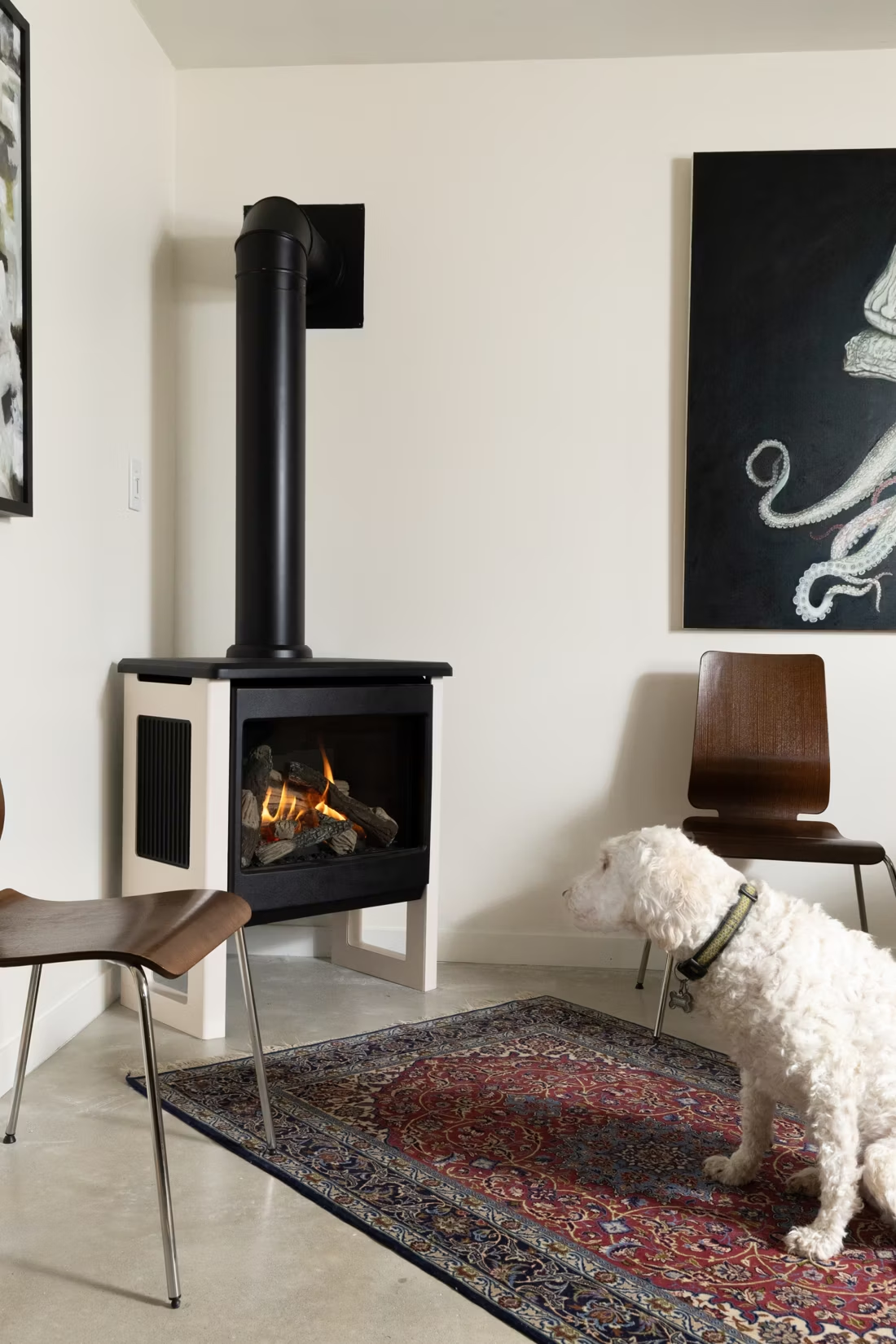
A gas fireplace is a fully built-in unit framed into a wall—the standard choice for new construction or a full remodel. A gas insert slides into an existing masonry firebox and uses the existing chimney (relined) as its vent path, which is the common route for older Kill Devil Hills cottages being updated. A gas stove is a freestanding cabinet unit, popular in smaller beach houses or additions where there's no existing fireplace to build around and floor space is tight. Your local dealer can walk the space with you and tell you which of the three actually fits.
Do I need a permit to install a gas fireplace in Kill Devil Hills?
Yes—a building permit and gas/mechanical permit are required through the Town of Kill Devil Hills, and since much of the housing stock sits on pilings to meet coastal flood elevation rules, inspectors also check that venting and gas line runs are properly supported and clear of required flood vents. A licensed gas contractor has to handle the propane line and appliance connection either way. Reputable local installers pull these permits as part of the job, which is one more reason to avoid a big-box install on an elevated coastal home where the plumbing and structural details aren't always straightforward.
Should I worry about salt air affecting a gas fireplace on the Outer Banks?
It's worth asking about. Salt-laden coastal air accelerates corrosion on exterior venting caps, connectors, and any exposed metal components faster here than it would inland—a real consideration a few blocks from the beach road. Stainless steel venting components hold up considerably better than standard galvanized options over the long run, and it's worth confirming with your dealer that the termination cap and any exposed hardware are rated for coastal exposure. Vent-free propane units are legal in North Carolina but add indoor humidity in an already humid climate, so most local installers steer beachfront homes toward standard direct-vent, sealed-combustion units instead.
How often should a gas fireplace be serviced in Kill Devil Hills?
Plan on an annual inspection, same as anywhere, but don't skip the exterior vent termination check given the salt air—a technician should look at the cap, connectors, and gasket for corrosion or salt buildup in addition to the usual burner, pilot, and glass service. This runs about $150 to $250 with most regional hearth service companies. Homes that sit empty for stretches as rentals or seasonal properties should also have the unit checked before the first cold snap of the season and again before hurricane season, since it may be the only heat source running during an outage.
Should I consider a wood stove instead of gas?
Probably not as a primary option here. Wood heat is genuinely uncommon on the immediate Outer Banks—the barrier island's mild winters (avg low 36°F) don't demand it, firewood storage is awkward on a flood-zone lot or under a piling-supported home, and there's no nearby national forest land offering cutting permits the way there is on the mainland. A handful of homeowners with larger inland Dare County lots or camp-style properties still keep a wood stove for ambiance, but for the vast majority of Kill Devil Hills homes and rentals, a propane fireplace or insert is the practical choice—instant heat, no ash, and it keeps working when the power doesn't.
Why is my open fireplace making my house colder?
Open fireplaces suck—literally. As the fire burns, it consumes air your furnace already paid to heat and pulls it out through the chimney, so the house is actually colder after the fire goes out than before you lit it. An insert fixes this: it seals the chimney, puts fixed glass across the front, and turns that hole in your house into a real heat source.
Is my gas fireplace wasting gas?
If it was installed more than 15 years ago, probably. Older gas fireplaces keep a standing pilot light burning all the time, and that little flame can cost a couple hundred dollars a year. Newer models use pilot-on-demand ignition—the pilot lights only when you use the fireplace and goes out when you turn it off.
Can a fireplace actually lower my heating bill?
Yes—by creating a comfort zone. A furnace heats every square foot of the house just to warm the one room you're in; a gas fireplace on low burns roughly a sixth of the gas a typical furnace does. Set the furnace around 55–60 degrees as a baseline, then heat the rooms your family actually uses. Families who heat this way commonly save $20–$60 a month.
What is an in-home preview and do I need one?
It's a visit where a hearth professional measures your space, confirms the model you picked actually works in your home, and walks the specs—framing, gas line, venting, finish work—before anything is ordered. Some details you just can't know until you see the house. Never make a down payment without one; it's the single most-skipped step that burns buyers.
Nearby Dealers
Hearth shops serving Kill Devil Hills and the surrounding area. Every listing shows whether it is a WhyFire partner, a dealer we have verified as authorized for the brands we recommend, or a local business carrying hearth products. No manufacturer pays for placement. How we verify dealers →
We’ve paused dealer listings for this connection today. Enter your zip or postal code above to find dealers near you, or come back tomorrow.
Popular Gas Brands
Where each brand came from, what's inside it today, and every current model. No brand pays to be here. Not every dealer carries every brand, so enter your zip code to see what's sold near Kill Devil Hills.
Kozy Heat
Kozy Heat was founded in 1976 by Dudley Hussong in Lakefield, Minnesota, and incorporated as Hussong Manufacturing Co., Inc. in 1978.
28 gas models →Fireplace Xtrordinair
Fireplace Xtrordinair, now often called FireplaceX, is the fireplace brand of Travis Industries, Inc., of Mukilteo, Washington.
25 gas models →Town & Country
Town & Country Fireplaces is the luxury gas fireplace brand of Pacific Energy Fireplace Products Ltd., of Duncan, British Columbia.
14 gas models →Lopi
Lopi is a wood, pellet, and gas stove brand founded by Kurt Rumens in Bellevue, Washington, in 1979.
7 gas models →Forge & Flame
Forge & Flame is the stove brand Hearth & Home Technologies introduced in August 2023 to bring Vermont Castings, Harman, and Quadra-Fire under one name.
6 gas models →Vermont Castings
Vermont Castings was founded in 1975 by Duncan Syme, the designer, and his brother-in-law Murray Howell, the business partner, in Randolph, Vermont.
6 gas models →Find your gas fireplace in Kill Devil Hills.
Tell us about your home or rental property and we'll help you find a trusted local dealer and send over a free Project Guide & Parts List—the exact parts, including the vent kit, for your Kill Devil Hills gas fireplace project.
Find Your Fireplace →