
Steady heat for Jackson County's mountain winters.
From Sylva to Cashiers, pellet stoves give Jackson County homeowners thermostat-level heat without cutting, splitting, or stacking a woodpile. Tell us about your home and we'll match you with a trusted local dealer who knows what actually installs well at your elevation.
Every Project Starts From One of These Five Situations
A hopper-fed alternative to splitting oak and hickory.
Jackson County sits on the Blue Ridge escarpment, with Sylva down around 2,000 feet and Cashiers up near 3,500—a real elevation swing that shows up in the county's heating season. At 4,130 heating degree days and an average winter low of 26°F, this is climate zone 4A: cold enough for a legitimate heating appliance, but not the kind of brutal, sustained deep-freeze you'd see in Duluth or Fargo. Unlike some western North Carolina counties, Jackson has no air quality non-attainment issues or winter inversion concerns on record, which means no seasonal burn curtailment periods to plan around—pellet or otherwise.
That combination of moderate cold and unrestricted burning makes pellet stoves a genuinely practical fit here, particularly for second-home owners in Cashiers, retirees in Sylva who don't want to manage a woodpile, and renters or homeowners near Western Carolina University in Cullowhee who want set-it-and-forget-it heat. Compare that to cutting your own firewood: a Nantahala-Pisgah National Forest permit runs about $20 per cord and the cutting season closes for the year after October, so if you miss the window on this year's oak or hickory, you're buying wood or waiting. Regional pellet brands like Lignetics, Hamer Pellet Fuel, and Greenway Renewable Energy are stocked by dealers throughout the region, so fuel supply isn't the seasonal scramble that firewood can become.
Three steps. No salesperson until you're ready.
Tell us about your project
Your zip code, your situation, and the fuel you're leaning toward—or let the answers point you to one.
See what's actually available
The brands dealers within 100 miles genuinely carry—real options, never a catalog mirage.
Get your dealer & Project Guide
A trusted local dealer, plus the free Project Guide & Parts List that names every component of the job.
Frequently Asked Questions
How much does a pellet stove installation cost in Jackson County?
Most pellet stove and insert installations run in the neighborhood of $3,000 to $6,500 in this part of western North Carolina, with the final number driven by whether the unit is a freestanding stove or an insert going into an existing masonry fireplace—common in older Sylva and Dillsboro homes—and whether new venting has to be run through an exterior wall. Newer construction in the Cashiers area, where fireplaces are often built with venting already roughed in, tends to land toward the lower end. A local dealer will give you a firm number after seeing the space in person, but this range is a realistic starting point for budgeting.
What size pellet stove do I need for my Jackson County home?
Sizing depends on square footage, ceiling height, and how well the home is insulated, but elevation matters here too. A cabin in Cashiers at 3,500 feet loses heat faster in a January wind than a similarly sized house down in Sylva, so dealers typically size up slightly for higher-elevation homes even at the same footprint. As a rough guide: smaller hopper-fed stoves suit a single great room or cabin under 1,000 square feet, mid-size units cover most main living areas up to around 2,000 square feet, and larger stoves are needed for whole-home heating in bigger or leakier older homes. A local dealer can size this properly during an in-home visit rather than guessing off square footage alone.
Where can I find certified pellet stove installers near me?
Look for installers with NFI (National Fireplace Institute) certification, which covers proper venting, clearance-to-combustible rules, and hopper/auger setup specific to pellet appliances. Because Jackson County is rural—just over 11,000 residents spread across Sylva, Cullowhee, Cashiers, and the surrounding areas—dealer coverage is thinner than in a metro area, so it's worth confirming a retailer actually services your specific address, especially out toward Cashiers or the more remote parts of the county, before assuming installation and any follow-up service calls will be quick.
What's the difference between a pellet stove and a pellet insert?
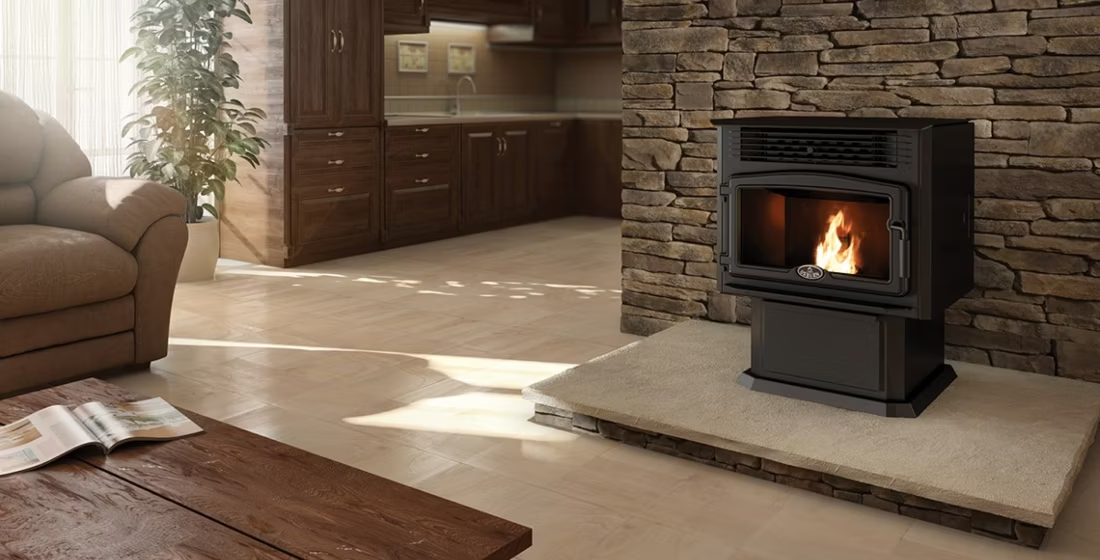
A pellet stove is a freestanding, self-contained unit that vents through a wall or existing chimney and can go almost anywhere with the right clearances. A pellet insert is built to slide into an existing masonry fireplace opening, which makes it a strong option for the older homes around Sylva and Dillsboro that already have a fireplace but want better efficiency and thermostat control than an open hearth provides. If you don't have an existing fireplace opening—which is common in newer Cashiers builds—a freestanding stove is usually the simpler path.
Do I need a permit to install a pellet stove in Jackson County?
Yes—a new pellet stove or insert installation typically requires a building permit through Jackson County's building inspections office, covering the appliance placement, clearances, and venting termination. Most established local dealers handle this paperwork as part of the installation, so you generally don't have to file it yourself. Because there are no air quality non-attainment restrictions in Jackson County, you won't run into the seasonal burn curtailment rules that affect some other North Carolina counties—pellet stoves here operate year-round without that added layer of regulation.
What's the best pellet stove for Jackson County's climate?
At 4,130 heating degree days and an average winter low around 26°F, Jackson County doesn't demand the extreme-cold, maximum-hopper-capacity units built for places like Bozeman or International Falls—a mid-efficiency pellet stove with a standard 40-to-60-pound hopper handles most homes here comfortably, refilling roughly once a day during heavy use. Homes at higher elevation around Cashiers, where wind and snow load are more of a factor, may benefit from a slightly larger hopper to reduce refill frequency during multi-day cold stretches. Local dealers stocking Lignetics, Hamer Pellet Fuel, and Greenway Renewable Energy pellets can also point you toward stove models tuned to burn those specific pellet formulations cleanly.
How often does a pellet stove need to be cleaned and serviced?
Pellet stoves need more frequent attention than people expect—the burn pot and ash pan should be cleaned weekly during regular winter use, and the exhaust venting and hopper mechanism should get a full professional inspection and cleaning annually, ideally before the heating season starts in the fall. This is less involved than a wood chimney sweep but still matters: a dirty burn pot is the most common cause of poor ignition and reduced heat output. Local dealers who sell pellet stoves in the area typically offer this service directly.
Where can I buy pellet fuel in Jackson County?
Regional brands including Lignetics, Hamer Pellet Fuel, and Greenway Renewable Energy are carried by hearth dealers and farm/home supply stores throughout western North Carolina, and pellet fuel in this region typically runs somewhere in the $250 to $300 per ton range, though pricing shifts with demand during cold stretches. Buying a season's supply early—rather than waiting for the first hard freeze—tends to get better selection, since rural dealer stock in a county this size can run thin once winter demand picks up.
Pellet stove vs. wood stove—which is right for my Jackson County home?
Wood stoves burn locally available oak, hickory, maple, and pine, run without electricity, and are the better choice if you want backup heat during a winter power outage—which does happen in the mountains around Cashiers and Sylva during ice storms. Pellet stoves need electricity to run the auger and blower, so they go dark in an outage unless paired with a battery backup, but they offer thermostat-controlled, consistent heat with far less physical labor than cutting and splitting cordwood, and no need to hold a Nantahala-Pisgah cutting permit or fight the May-through-October cutting season deadline. For a primary living space where convenience matters most, pellet often wins; for backup or off-grid resilience, wood still has the edge.
Why is my open fireplace making my house colder?
Open fireplaces suck—literally. As the fire burns, it consumes air your furnace already paid to heat and pulls it out through the chimney, so the house is actually colder after the fire goes out than before you lit it. An insert fixes this: it seals the chimney, puts fixed glass across the front, and turns that hole in your house into a real heat source.
What's the difference between an insert and a zero-clearance fireplace?
An insert is a fireplace that slides into a pre-existing wood-burning fireplace—if you don't have one, there's nothing to insert it into. A zero-clearance fireplace is built into a framed wall, which makes it the answer for remodels and new construction. Simple test: existing masonry fireplace means insert; blank or framed wall means zero-clearance.
How much should I budget for a fireplace?
For an average home—covering the fireplace, the vent pipe, and basic installation—a budget between $3,900 and $5,500 gives you a lot of options across wood, gas, and pellet. By the time you add finish work, gas line, and electrical, the average complete installation lands between $5,000 and $12,000 all-in. In a remodel or new build, a good rule is to put about 2.5% of the total project cost toward the fireplace.
Can I install a fireplace myself?
If you're putting a fire in your house on purpose, it's best to work with an expert. Unless you're genuinely experienced in framing, gas line, vent pipe, and the national code on clearances to combustibles, have a professional do it—and ideally the same company that sells you the fireplace, so warranty, service, and liability all live under one roof.
Stove and Fireplace Dealers in Jackson County
Pellet Brands Stocked Around Jackson County
Manufacturers will point you to the nearest stocking dealer.
Find your pellet stove in Jackson County.
Tell us about your home and heating goals, and we'll match you with a trusted local dealer plus a free Project Guide & Parts List—a plan for your pellet stove or insert project in Jackson County, with the exact parts, including the vent kit, and our recommended local installer.
Find Your Fireplace →