
Reliable heat for Sandhills winters that rarely dip far below freezing.
With a winter low averaging 30°F and just 3,280 heating degree days a year, Hoke County doesn't need a wood-splitting operation to stay warm—it needs a fireplace that lights instantly on the handful of genuinely cold nights each winter. I'll match you with a trusted local dealer near Raeford who knows whether your street runs natural gas or propane before a single part gets ordered.
Every Project Starts From One of These Five Situations
Instant heat for a short, mild heating season.
Hoke County sits in North Carolina's Sandhills region, anchored by Raeford as the county seat and shaped in large part by its proximity to Fort Liberty, which has driven steady population growth even as the county stays largely rural at just over 10,500 residents outside its towns. Climate zone 3A means hot, humid summers and short, mild winters—3,280 heating degree days is less than half of what a colder climate like Minneapolis, MN sees in a typical year, and well under half of Fargo, ND. That's not a climate that demands a wood-burning operation running six months straight; it's one where homeowners want a fireplace that works instantly on the coldest nights of January and sits quiet the rest of the year.
Natural gas service isn't universal across Hoke County—it tends to run along the more built-up corridors near Raeford, while the county's rural stretches typically rely on propane delivered and stored on-site, which works just as well for a direct-vent gas fireplace once the tank and line are sized correctly. Hoke County has no listed air quality non-attainment concerns, so there's no curtailment season or inversion advisory limiting when or how a gas appliance can run—it operates the same way in December as it does in a cold snap in March. For homes with an older masonry fireplace built around locally common oak or hickory, a direct-vent gas insert is often the simplest upgrade: keep the existing chimney chase, gain a fireplace that heats on demand without ash, smoke, or a wood supply to manage.
Three steps. No salesperson until you're ready.
Tell us about your project
Your zip code, your situation, and the fuel you're leaning toward—or let the answers point you to one.
See what's actually available
The brands dealers within 100 miles genuinely carry—real options, never a catalog mirage.
Get your dealer & Project Guide
A trusted local dealer, plus the free Project Guide & Parts List that names every component of the job.
Frequently Asked Questions
How much does a gas fireplace installation cost in Hoke County?
Most gas fireplace installations in Hoke County run somewhere between $3,500 and $9,000. A direct-vent insert going into an existing masonry firebox in an established Raeford neighborhood, with a gas or propane line already reasonably close, sits toward the lower end. A new direct-vent fireplace for a remodel or new build—with fresh framing, venting, and either a new gas line or a propane tank set—lands higher. Homes farther out in the county's rural stretches, where a propane company has to run a new line to a tank, should budget for that added cost on top of the appliance and labor. A local dealer will give you a firm number after seeing the space and confirming what fuel source is actually available at your address.
Can I convert my existing wood fireplace to gas?
Yes, and it's a common project for the older masonry fireplaces found in and around Raeford, many of which were originally built to burn oak, hickory, or pine cut locally. A gas insert drops into the existing firebox and vents through a stainless liner run up the current chimney, so the fireplace keeps its look while gaining instant, controllable heat. Whether you end up on natural gas or propane determines part of the cost, since a propane conversion may require a new tank set if one isn't already on the property—your local dealer can walk you through both options during a site visit.
Is my home on natural gas, or will I need propane?
It depends on where in Hoke County you're located. Natural gas lines tend to follow the more developed areas near Raeford, while homes farther out in the county—which describes a large share of Hoke's rural land—generally run on propane delivered and stored in an on-site tank. Both fuels work fine in a modern direct-vent gas fireplace once the unit is set up with the correct orifice and regulator for that fuel type. A local hearth dealer can confirm what's actually running to your street before recommending a specific model, rather than assuming natural gas is available everywhere in the county.
Will my gas fireplace still work if the power goes out?
Most modern gas fireplaces are built to keep running through a power outage. Units with intermittent pilot ignition (IPI) carry a battery backup that kicks in automatically when utility power drops, so the fireplace still lights and heats on demand. Valor fireplaces take it a step further, generating their own electricity through the pilot assembly's thermocouple so there's no battery to think about at all. That matters in Hoke County during the occasional severe thunderstorm or ice event that knocks out power along rural feeder lines—ask your local dealer which ignition system a model uses before you buy.
What's the difference between a gas fireplace, gas insert, and gas stove?
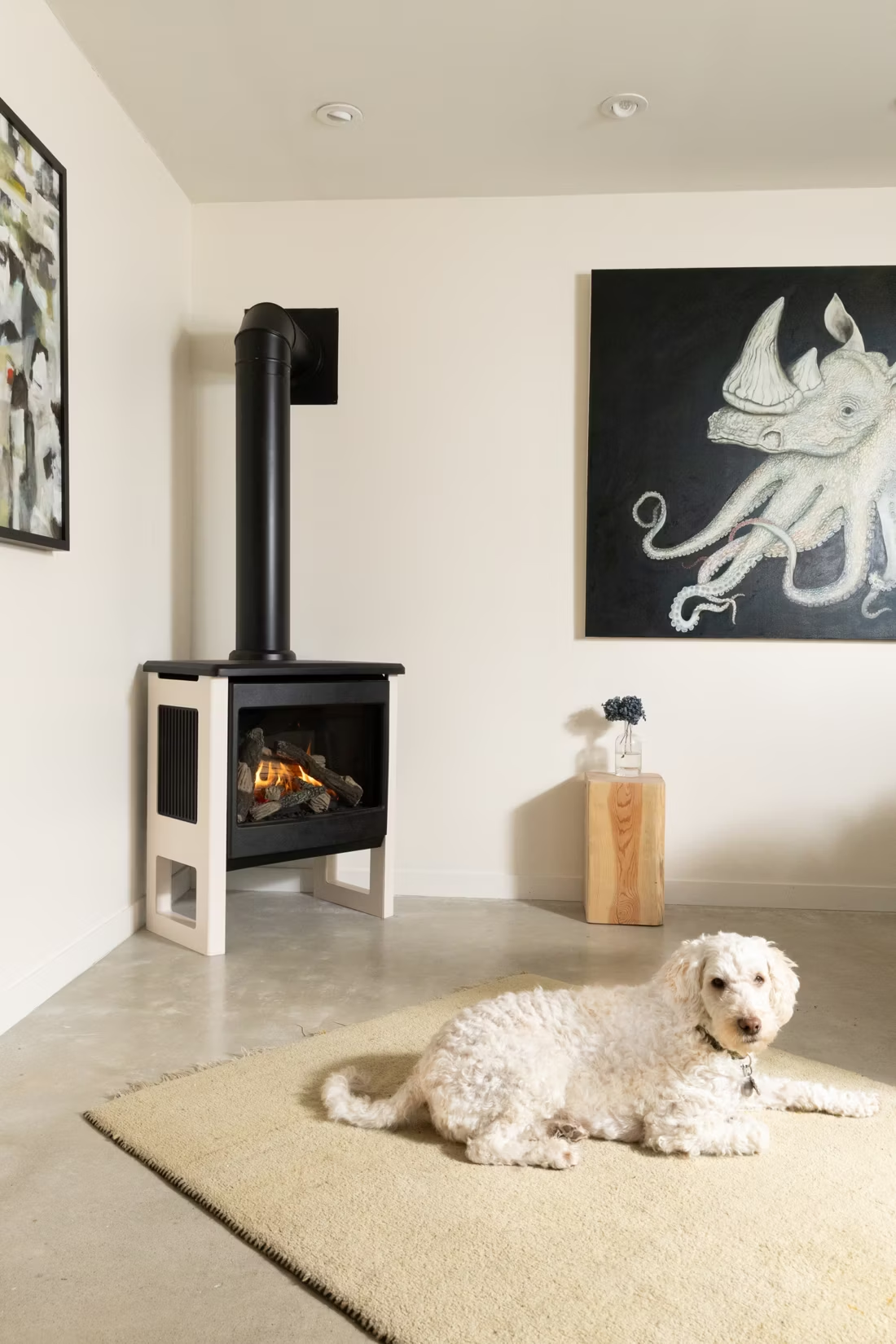
A gas fireplace is a fully built-in unit framed into a wall, which fits new construction or a major remodel well. A gas insert slides into an existing masonry firebox and uses that chimney chase as its vent path—the right call for an older Raeford home with a wood-burning fireplace it wants to upgrade without tearing into a wall. A gas stove is a freestanding, cabinet-style unit that sits on the floor like a wood stove but runs on gas, which works well in a room with no existing chimney or in a manufactured home common in more rural parts of the county. A local dealer can walk your space and recommend the configuration that actually fits.
Do I need a permit to install a gas fireplace in Hoke County?
Yes. New gas fireplace installations require both a building permit and a gas line permit through the Hoke County Building Inspections Department, whether the home sits inside Raeford's town limits or out in unincorporated county land. The gas line work has to be done by a licensed gas-fitter, which is a good reason to go through a full-service hearth dealer rather than a general handyman—a certified dealer coordinates the appliance install, the gas or propane line work, and the inspection sign-off as one job.
Should I get a vented or vent-free gas fireplace?
Vented, direct-vent gas fireplaces pull combustion air from outside and exhaust it back outside through a sealed pipe, keeping any combustion byproducts out of the living space entirely. Vent-free units burn directly into the room and are legal in North Carolina with the right room-sizing and an oxygen depletion sensor, and since Hoke County has no listed air quality concerns, there's no local restriction pushing homeowners toward one type over the other on air-quality grounds. Even so, most local dealers still recommend direct-vent as the safer default for main living spaces, reserving vent-free for supplemental use in smaller rooms where running new venting isn't practical.
How often does a gas fireplace need to be serviced?
Plan on an annual inspection, ideally in early fall before the heating season's coldest stretch arrives. A technician checks the burner, pilot assembly, gas connections, and venting, and cleans the glass and interior. Even in a mild climate like Hoke County's, where a gas fireplace might only run heavily for a few weeks a year, annual servicing matters because units that sit idle for long stretches over the summer are more prone to pilot and igniter issues when you finally need heat. A standard service call from a local gas appliance technician typically runs $150 to $250.
Gas vs. wood vs. pellet—what makes sense for a Hoke County home?
With only 3,280 heating degree days and winter lows averaging 30°F, Hoke County's heating season is short enough that many homeowners prioritize convenience over fuel cost. Gas delivers instant, thermostat-controlled heat with no ash or chimney maintenance, which suits a climate where the fireplace might only run hard for a few cold snaps each winter. Wood—burned as locally common oak, hickory, maple, or pine—still appeals to homeowners who want a backup heat source that works without electricity, especially in the county's rural stretches. Pellet stoves, stocked regionally by brands like Lignetics, Hamer Pellet Fuel, and Greenway Renewable Energy, split the difference: cleaner and more automated than wood, but still dependent on power to run the auger. For most Hoke County homes focused on a fireplace that just works on demand, gas is usually the simplest starting point.
What's the difference between an insert and a zero-clearance fireplace?
An insert is a fireplace that slides into a pre-existing wood-burning fireplace—if you don't have one, there's nothing to insert it into. A zero-clearance fireplace is built into a framed wall, which makes it the answer for remodels and new construction. Simple test: existing masonry fireplace means insert; blank or framed wall means zero-clearance.
Can I put a TV above my fireplace?
Yes—with an asterisk. Fireplaces are hot and TVs don't like heat. Either put a mantel between them to deflect rising warmth, or choose a fireplace with heat-management technology that creates a cool zone on the wall above—the wall stays around 125 degrees, barely warm, while the room still gets full heat. If you like clean lines and don't want a mantel, heat management is the answer.
How much should I budget for a fireplace?
For an average home—covering the fireplace, the vent pipe, and basic installation—a budget between $3,900 and $5,500 gives you a lot of options across wood, gas, and pellet. By the time you add finish work, gas line, and electrical, the average complete installation lands between $5,000 and $12,000 all-in. In a remodel or new build, a good rule is to put about 2.5% of the total project cost toward the fireplace.
Can a fireplace actually lower my heating bill?
Yes—by creating a comfort zone. A furnace heats every square foot of the house just to warm the one room you're in; a gas fireplace on low burns roughly a sixth of the gas a typical furnace does. Set the furnace around 55–60 degrees as a baseline, then heat the rooms your family actually uses. Families who heat this way commonly save $20–$60 a month.
Get your free Project Guide & Parts List for a gas fireplace in Hoke County.
Tell me a bit about your home, whether you're on natural gas or propane, and how you want to use the fireplace, and I'll match you with a trusted local Hoke County dealer and send over a free Project Guide & Parts List—the exact equipment, vent kit, and recommended installer for your project, no big-box guesswork.
Find Your Fireplace →