
Add real fireplace warmth to your Halifax County home—no chimney needed.
From Roanoke Rapids to Scotland Neck, Weldon, Enfield, and the rural stretches along the Roanoke River, an electric fireplace or insert brings instant, flame-look warmth without venting or gas lines. Find the right unit and connect with a trusted local installer.
Every Project Starts From One of These Five Situations
Electric heat that fits a mild Roanoke River winter.
Halifax County sits in climate zone 4A, a mixed-humid zone where winter lows average around 30°F and total winter heating need is moderate—a fraction of what a place like Duluth MN or International Falls MN sees over a season. That moderate load matters: it means an electric fireplace or insert doesn't have to be a novelty item here. A 1,500-watt unit puts out real, usable heat for a bedroom, den, or sunroom in Roanoke Rapids or Weldon on the kind of chilly-but-not-frigid nights that make up most of the county's winter.
Halifax County's housing stock also plays a role—a mix of older farmhouses along the river corridor, ranch homes in Enfield and Scotland Neck, and a meaningful share of manufactured and mobile homes throughout the rural county. Electric units install with zero clearance to combustibles and no masonry, chimney, or gas line, which makes them a practical fit for homes where running new venting isn't realistic, and for renters in Roanoke Rapids or Littleton who want fireplace ambiance without any structural work. Halifax Electric Membership Corporation (Halifax EMC) serves much of the rural county, while Duke Energy Progress covers Roanoke Rapids and the Weldon corridor—either way, plugging in or wiring a dedicated circuit is far simpler than adding wood or gas venting from scratch.
Three steps. No salesperson until you're ready.
Tell us about your project
Your zip code, your situation, and the fuel you're leaning toward—or let the answers point you to one.
See what's actually available
The brands dealers within 100 miles genuinely carry—real options, never a catalog mirage.
Get your dealer & Project Guide
A trusted local dealer, plus the free Project Guide & Parts List that names every component of the job.
Frequently Asked Questions
How much does an electric fireplace installation cost in Halifax County?
A plug-in electric insert or freestanding unit typically runs $300 to $1,200 installed, since most just need a standard 120V outlet and can be handled in an afternoon. A built-in electric fireplace or wall-mounted unit with a dedicated circuit runs higher, usually $1,800 to $4,500, especially in older farmhouses along the Roanoke River corridor where the electrical panel may need updating before a new circuit can be added. Homes in Roanoke Rapids and Weldon with newer wiring generally land on the lower end of that built-in range; rural properties with older service sometimes need panel work factored in.
Will an electric fireplace actually heat my Halifax County home?
It depends on how you're using it. With a moderate winter heating need and winter lows averaging around 30°F, Halifax County's heating demand is moderate compared to a place like Bismarck ND or Fargo ND—most electric fireplaces here are best used as supplemental heat for a single room rather than a whole-house solution. A standard 5,000 BTU (1,500W) unit can comfortably take the edge off a bedroom, den, or sunroom on a cold evening, but it won't replace central heat for a whole home in Scotland Neck or Enfield during a hard freeze. For homes wanting a bigger footprint, some larger built-in models push closer to 8,000-10,000 BTU equivalent, which covers more square footage.
What's the difference between a plug-in electric fireplace and a built-in unit?
A plug-in electric fireplace or insert runs off a standard 120V outlet, requires no electrician, and can be moved or removed later—a good fit for renters in Roanoke Rapids apartments or anyone not ready to commit to permanent changes. A built-in unit is wired into a wall or existing fireplace opening, often on a dedicated 120V or 240V circuit for higher heat output, and is meant to stay put. For Halifax County homeowners converting an old wood-burning fireplace they no longer use, a built-in electric insert into the existing masonry opening is a popular option—it keeps the mantel and hearth look while eliminating ash, smoke, and chimney maintenance entirely.
Do I need a permit or electrician for an electric fireplace in Halifax County?
A standard plug-in unit generally doesn't require a permit since it's just using an existing outlet. A built-in electric fireplace that needs a new dedicated circuit does require licensed electrical work, and depending on the scope, an electrical permit through Halifax County Building Inspections. This is especially relevant in older homes along the river corridor where the existing panel may be at capacity—a licensed electrician can tell you quickly whether your service can handle the added draw or whether a panel upgrade is needed first.
Are electric fireplaces a good fit for manufactured and mobile homes in Halifax County?
Yes—this is one of the strongest use cases for electric units in the county. Halifax County has a meaningful share of manufactured and mobile homes in its rural areas, and wood or gas installations in these structures can be complicated by clearance rules, floor and wall construction, and venting restrictions. An electric fireplace or wall-mounted unit sidesteps most of that: no chimney, no combustion, no gas line, and clearance requirements that are far easier to meet in a manufactured home's stud spacing. It's a common upgrade for both owner-occupied manufactured homes and rental units around Enfield and Littleton.
Halifax County has no air quality restrictions on wood burning—so why go electric instead?
That's true—Halifax County has no non-attainment status or seasonal burn advisories, and oak, hickory, maple, and pine are all readily available locally for wood heat. Electric still wins out for a specific set of homeowners: renters who can't install a chimney, owners of homes without an existing fireplace or flue, anyone who wants supplemental warmth without hauling and stacking wood, and people who simply want the visual of a fire without the maintenance. If you already burn wood or are set up for it, that's a legitimate and often cheaper way to heat in this region. Electric is less about competing with wood here and more about filling the gap where wood or gas isn't practical.
How much does it cost to run an electric fireplace in Halifax County?
Running cost depends on your utility rate and how many hours a day you use it. Halifax Electric Membership Corporation serves much of the rural county while Duke Energy Progress covers Roanoke Rapids and Weldon, and rates in this part of North Carolina typically run in the low-to-mid teens per kWh. A 1,500-watt unit run on high for 4 hours an evening costs roughly 80 cents to $1.20 a day at those rates, or somewhere around $25 to $35 a month for regular evening use through a mixed-humid winter—noticeably less than running central heat harder to cover the same room.
Where can I find someone to install an electric fireplace in Halifax County?
For plug-in units, installation is simple enough that many homeowners handle it themselves—set the unit, plug it in, done. For built-in units requiring new wiring, look for a licensed electrician familiar with dedicated-circuit fireplace installs; several serve the Roanoke Rapids and Weldon area and are comfortable working in both newer construction and the county's older farmhouse stock. Hearth retailers who carry electric fireplace lines can typically also coordinate the install or refer you to an electrician who's done the work before, which saves you from juggling separate vendors.
Electric vs. pellet vs. gas—which fits my Halifax County home?
Electric fireplaces offer the simplest install—no venting, no fuel storage, no combustion byproducts—but limited heat output and higher per-BTU running cost, and they go dark in a power outage. Pellet stoves, with regional brands like Lignetics, Hamer Pellet Fuel, and Greenway Renewable Energy supplying the area, offer meaningfully more heat output and lower fuel cost, but need electricity to run the auger and a place to store bags of pellets. Gas fireplaces and inserts split the difference where natural gas or propane service is available, delivering strong heat output without wood handling. For a Halifax County home where the goal is ambiance plus modest supplemental warmth in one room, electric is usually the easiest and least disruptive choice; for homes wanting to meaningfully cut a heating bill, pellet or gas is worth a closer look.
Do electric fireplaces actually produce heat?
Yes—most put out around 4,800–5,000 BTUs from a standard outlet, which comfortably warms a bedroom, office, or den as a comfort-zone heater. What they won't do is carry a whole house the way wood, gas, or pellet can. Think of electric as ambiance-first with honest supplemental heat: flames on with no heat in July, flames plus warmth in January.
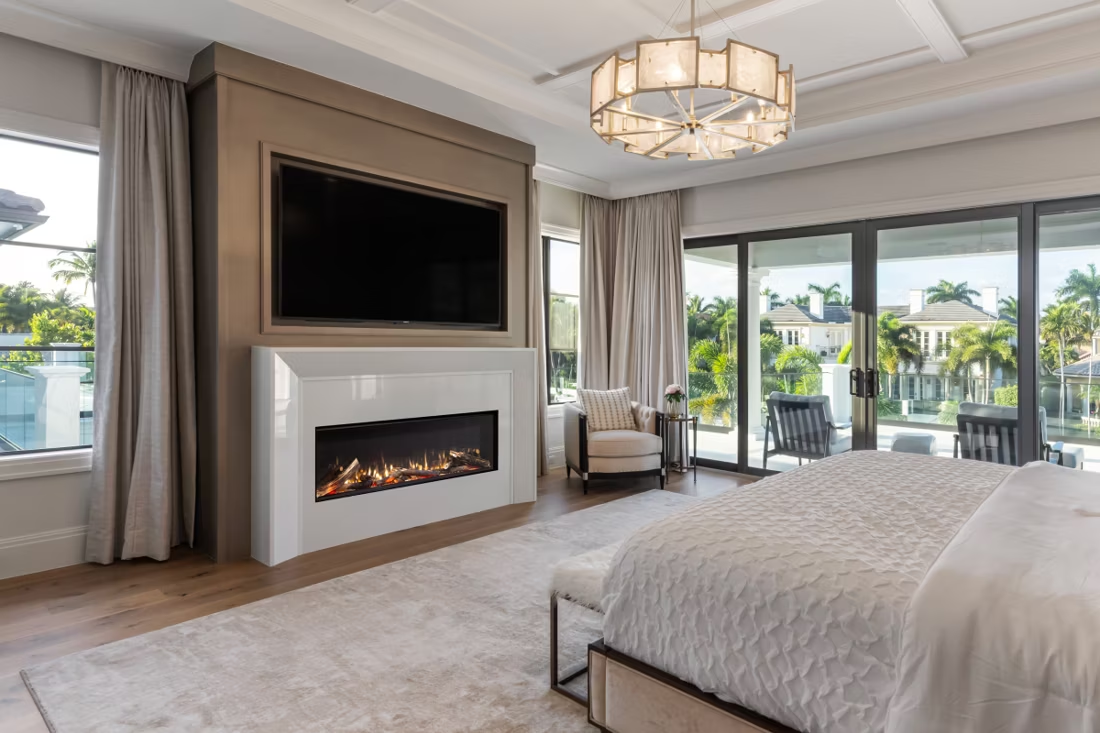
Can I put a TV above my fireplace?
Yes—with an asterisk. Fireplaces are hot and TVs don't like heat. Either put a mantel between them to deflect rising warmth, or choose a fireplace with heat-management technology that creates a cool zone on the wall above—the wall stays around 125 degrees, barely warm, while the room still gets full heat. If you like clean lines and don't want a mantel, heat management is the answer.
Does a fireplace add value to my home?
On average, a fireplace adds back to the home about the same amount you spent installing it. Add the monthly savings from heating the rooms you actually use instead of the whole house—often hundreds of dollars a year—and the value case is strong before you even count what a fire does for how your family uses the room.
Can a fireplace actually lower my heating bill?
Yes—by creating a comfort zone. A furnace heats every square foot of the house just to warm the one room you're in; a gas fireplace on low burns roughly a sixth of the gas a typical furnace does. Set the furnace around 55–60 degrees as a baseline, then heat the rooms your family actually uses. Families who heat this way commonly save $20–$60 a month.
Stove and Fireplace Dealers in Halifax County
Find your electric fireplace in Halifax County.
Tell us a bit about your home and we'll match you with the right electric fireplace or insert, plus a free Project Guide & Parts List and a trusted local installer to put it in.
Find Your Fireplace →