
Warmth and ambiance, without the chimney.
Governors Club's Piedmont winters rarely demand a primary heat source—electric fireplaces deliver instant warmth and real-flame ambiance without venting, gas lines, or firewood. Find the right unit and connect with a trusted local dealer.
Every Project Starts From One of These Five Situations
The Piedmont's mild winters make electric an easy fit.
Governors Club sits in Chatham County at 469 feet in elevation, where winter lows average a relatively mild 29°F and the heating season is modest in length—a fraction of what a home in Duluth, MN or Fargo, ND has to plan for. That climate profile means most Governors Club homes don't lean on wood or pellet heat to get through winter; central HVAC handles the bulk of the load, and a fireplace is more about ambiance, zone comfort, and finishing a room than survival heat.
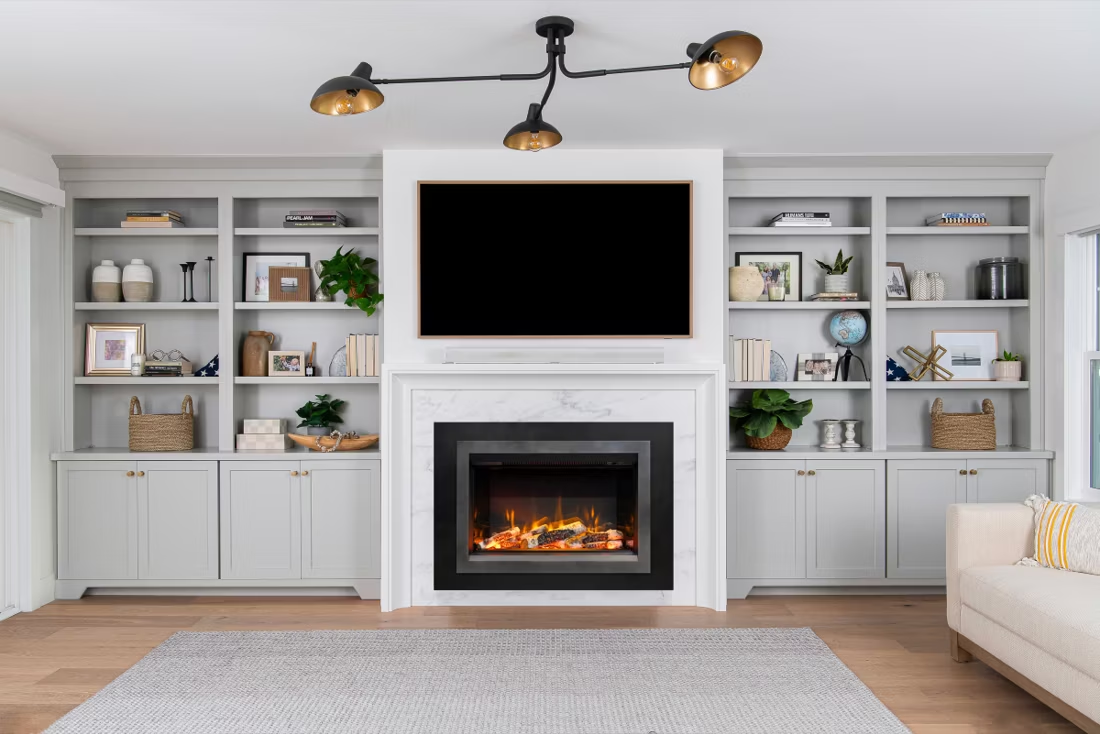
That's exactly where electric fireplaces excel. No chimney, no combustion, no venting to route through framing or roof lines—which matters in a golf-course community where many homes are custom builds or additions with limited existing masonry. Plug-in inserts and built-in electric units install in a fraction of the time of a gas or wood project and run on standard household circuits, working equally well in a primary suite, a sunroom, or a home office. With Duke Energy Progress and Duke Energy Carolinas both serving Chatham County at residential rates in the 13.9 to 15.5 cents per kWh range, running a supplemental electric unit for evening ambiance costs only a few cents an hour.
Three steps. No salesperson until you're ready.
Tell us about your project
Your zip code, your situation, and the fuel you're leaning toward—or let the answers point you to one.
See what's actually available
The brands dealers within 100 miles genuinely carry—real options, never a catalog mirage.
Get your dealer & Project Guide
A trusted local dealer, plus the free Project Guide & Parts List that names every component of the job.
Frequently Asked Questions
How much does an electric fireplace installation cost in Governors Club?
Electric fireplaces are the least expensive hearth project in the Piedmont, and that holds true in Governors Club. A plug-in insert that drops into an existing masonry firebox or a wall-mount unit typically runs $300 to $1,200 installed, since there's no venting, gas line, or chimney work involved—most of the cost is the unit itself plus a licensed electrician's time if a dedicated circuit is needed. A full built-in electric fireplace with custom surround and framing, common in Governors Club's larger custom homes, can run $1,500 to $4,000 including finish carpentry. Ask a local dealer for a firm quote based on your specific unit and wall configuration.
Will an electric fireplace heat my whole home?
No—and in Governors Club's climate, that's rarely the point. With winter lows averaging around 29°F and a relatively short, mild heating season, most homes here rely on central HVAC for whole-house heating and use a fireplace for supplemental warmth in a single room. A typical electric fireplace puts out 4,000 to 5,000 BTUs, enough to noticeably warm a bedroom, sunroom, or living area of 400 to 1,000 square feet, but it's designed as zone heat and ambiance, not a furnace replacement.
What's the difference between an electric insert, a wall-mount, and a built-in electric fireplace?
An electric insert is built to slide into an existing masonry firebox—a common upgrade for Governors Club homes with an existing wood-burning fireplace that's rarely used. A wall-mount unit hangs directly on a wall like a flat-screen TV and needs no firebox at all, popular in newer construction or additions. A built-in electric fireplace is framed into a wall during construction or remodel, with a custom surround and mantel—the choice most homeowners in Governors Club's custom-built neighborhoods go with for a primary living space or primary suite.
Do I need a permit to install an electric fireplace in Governors Club?
In most cases, no. A plug-in electric insert or a wall-mount unit that runs off an existing household outlet doesn't require a permit. If you're adding a dedicated 120-volt or 240-volt circuit for a larger built-in unit, that electrical work should go through a licensed electrician, and depending on scope, Chatham County Central Permitting may require an electrical permit. Local dealers who install built-in units typically coordinate any required electrical permitting as part of the project.
Which electric utility serves Governors Club, and how much will it cost to run a fireplace?
Governors Club sits in a part of Chatham County split between Duke Energy Progress and Duke Energy Carolinas, so which one serves your specific address depends on your street. Residential rates run roughly 13.9 to 15.5 cents per kWh between the two. A typical electric fireplace on its heat setting draws about 1,500 watts, so running it for an evening—say 3 to 4 hours—costs somewhere around 60 to 90 cents. Running it purely for the flame effect without heat draws a fraction of that.
Electric vs. gas fireplace—which is right for my Governors Club home?
Both are common choices here, and the right one depends on what you're solving for. Gas delivers real flame and higher heat output—useful on the occasional cold front that pushes lows into the 20s—but requires a gas line and venting plan. Electric skips all of that: no gas line, no venting, and a much simpler retrofit into an existing fireplace opening or a new wall. For homes without existing gas service or where the goal is ambiance in a secondary room like a sunroom or bonus room, electric is usually the simpler and less expensive path. For a primary living space where real heat output matters, gas is worth the extra installation complexity.
Do electric fireplaces really look like a real fire?
Modern units have closed the gap considerably. Flame-effect technology from brands like Dimplex (their Opti-myst line uses a fine water mist and LED lighting to mimic smoke and flame) and Amantii produces a convincing, layered flame that most guests don't immediately identify as electric, especially at night. Entry-level units with simple LED flame bars look more obviously artificial. If realism matters, ask a local dealer to show you the flame effect in person rather than relying on product photos, since lighting and glass matter as much as the flame technology itself.
Can I convert my existing wood-burning fireplace to electric?
Yes, and it's one of the more common upgrades in Governors Club's older or more traditional homes. An electric insert slides into the existing masonry firebox, and because there's no venting or gas line required, there's no need to open up the chimney or run new lines—the insert simply plugs into a nearby outlet or a new dedicated circuit if the unit calls for one. It's a same-day project in most cases, and it eliminates ash cleanup, chimney maintenance, and the wood-smoke concerns some homeowners want to avoid altogether.
How long does an electric fireplace unit last, and what maintenance does it need?
Electric fireplaces are largely maintenance-free compared to wood or gas units—there's no chimney to sweep, no burner to service, and no combustion byproducts to worry about. Most quality units last 10 to 15 years, with the main wear point being the heating element or LED flame bulbs, both of which are typically user-replaceable. Occasional dusting of the vents and a wipe-down of the glass front is about the extent of upkeep, which is part of why electric units are popular in secondary rooms and vacation homes in Governors Club that don't get daily attention.
Does an electric fireplace need a vent or chimney?
No—that's its superpower. An electric fireplace needs a wall and an outlet, period. No vent pipe, no gas line, no clearances to design around, which is why it works in bedrooms, offices, apartments, and walls where venting a gas or wood unit would be impractical or impossible. Installation is typically the simplest and least expensive of any fireplace type.
Do electric fireplaces actually produce heat?
Yes—most put out around 4,800–5,000 BTUs from a standard outlet, which comfortably warms a bedroom, office, or den as a comfort-zone heater. What they won't do is carry a whole house the way wood, gas, or pellet can. Think of electric as ambiance-first with honest supplemental heat: flames on with no heat in July, flames plus warmth in January.
Can I install a fireplace myself?
If you're putting a fire in your house on purpose, it's best to work with an expert. Unless you're genuinely experienced in framing, gas line, vent pipe, and the national code on clearances to combustibles, have a professional do it—and ideally the same company that sells you the fireplace, so warranty, service, and liability all live under one roof.
What is an in-home preview and do I need one?
It's a visit where a hearth professional measures your space, confirms the model you picked actually works in your home, and walks the specs—framing, gas line, venting, finish work—before anything is ordered. Some details you just can't know until you see the house. Never make a down payment without one; it's the single most-skipped step that burns buyers.
Nearby Dealers
Hearth shops serving Governors Club and the surrounding area. Every listing shows whether it is a WhyFire partner, a dealer we have verified as authorized for the brands we recommend, or a local business carrying hearth products. No manufacturer pays for placement. How we verify dealers →
We’ve paused dealer listings for this connection today. Enter your zip or postal code above to find dealers near you, or come back tomorrow.
Popular Electric Brands
Where each brand came from, what's inside it today, and every current model. No brand pays to be here. Not every dealer carries every brand, so enter your zip code to see what's sold near Governors Club.
Fireplace Xtrordinair
Fireplace Xtrordinair, now often called FireplaceX, is the fireplace brand of Travis Industries, Inc., of Mukilteo, Washington.
5 electric models →DaVinci
DaVinci Custom Fireplaces is a brand of Travis Industries, Inc., of Mukilteo, Washington, the company behind Lopi and Fireplace Xtrordinair.
5 electric models →Kozy Heat
Kozy Heat was founded in 1976 by Dudley Hussong in Lakefield, Minnesota, and incorporated as Hussong Manufacturing Co., Inc. in 1978.
3 electric models →Forge & Flame
Forge & Flame is the stove brand Hearth & Home Technologies introduced in August 2023 to bring Vermont Castings, Harman, and Quadra-Fire under one name.
1 electric model →Electric Service in Governors Club
An electric fireplace's heater draws about 1,500 watts—pennies per hour at local rates.
Duke Energy Progress - (Nc)
Duke Energy Carolinas, LLC
Find your electric fireplace in Governors Club.
Tell us a bit about your home and we'll help you find the right electric fireplace, insert, or built-in unit—plus a free Project Guide & Parts List with your recommended local dealer.
Find Your Fireplace →