
Clean, instant heat for Chatham County homes.
From the farmhouses around Bear Creek and Bonlee to the new construction filling in Chatham Park outside Pittsboro, gas delivers real flame and real warmth without a wood pile. Find the right unit and get matched with a trusted local dealer.
Every Project Starts From One of These Five Situations
Reliable warmth without the wood pile.
Chatham County sits in climate zone 4A with about 3,504 heating degree days a year and average winter lows near 30°F—real Piedmont winter, but nothing close to a place like Fargo, ND, where HDD runs near 9,000. Winters here are defined more by chilly, damp nights, the occasional ice storm off a stalled front, and a handful of hard freezes than by weeks of sustained sub-zero cold. That moderate profile is exactly the kind of climate where gas fireplaces tend to outshine wood for daily comfort: you don't need an all-night catalytic burn to get through January in Siler City or Goldston—you need reliable, on-demand heat for a cold evening.
Natural gas service reaches the town cores of Pittsboro and Siler City through Piedmont Natural Gas (now Dominion Energy North Carolina), but most of the county's rural expanse—the farmland around Bonlee, Bennett, and Silk Hope—runs on propane delivered by regional suppliers. Meanwhile, growth tied to Chatham Park's new subdivisions and the jobs arriving with the VinFast plant and Wolfspeed's Siler City facility is pushing a lot of new construction, and builders are increasingly specifying direct-vent gas fireplaces as a standard great-room feature—no wood hauling, no ash, no chimney sweep, just a switch and a flame.
Three steps. No salesperson until you're ready.
Tell us about your project
Your zip code, your situation, and the fuel you're leaning toward—or let the answers point you to one.
See what's actually available
The brands dealers within 100 miles genuinely carry—real options, never a catalog mirage.
Get your dealer & Project Guide
A trusted local dealer, plus the free Project Guide & Parts List that names every component of the job.
Frequently Asked Questions
How much does a gas fireplace installation cost in Chatham County?
Local installers we work with typically quote $4,000 to $9,500 for a gas fireplace or insert installation in Chatham County, depending on the unit, whether it's natural gas or propane, and how much venting or gas line work is needed. A direct-vent insert dropped into an existing masonry fireplace with gas already run to the room sits at the lower end. A new built-in fireplace for a Chatham Park great room, or a propane tank installation and long line run out to a farmhouse near Bear Creek, pushes toward the higher end. A trusted local dealer will give you a firm number after seeing your home.
Can I convert my existing wood fireplace to gas?
Yes—it's one of the most common projects for the older farmhouses scattered around Siler City, Bonlee, and Goldston that still have a working masonry fireplace. A direct-vent gas insert slides into the existing firebox and uses a stainless liner run up your current chimney, so you keep the look of the original hearth while getting real heat output and none of the smoke or ash. Whether you go natural gas or propane depends on what's already run to the house—homes inside Pittsboro or Siler City with natural gas service usually have the simpler, cheaper conversion.
Do I need natural gas to install a gas fireplace, or can I use propane?
Either works, and which one makes sense mostly comes down to where in Chatham County you live. Natural gas service through Piedmont Natural Gas (Dominion Energy North Carolina) is generally limited to the town cores of Pittsboro and Siler City. Outside those service areas—which is most of the county's rural land—propane is the standard, supplied by regional propane companies either from an existing tank or a new tank install. Most gas fireplace models can be configured for either fuel; your dealer sets the correct orifice and regulator for whichever you have.
Will my gas fireplace work during a power outage?
Most will. Gas fireplaces with IPI (intermittent pilot ignition) run on a small battery backup that kicks in the moment the power drops, so the unit lights on demand just like normal. That matters in Chatham County, where ice storms and downed lines from Piedmont thunderstorms can knock out power for hours at a time. Valor fireplaces take a different approach—their pilot assembly generates its own electricity through a thermocouple, so there are no batteries to remember at all. Ask your local dealer which ignition system a given model uses before you buy.
What's the difference between a gas fireplace, gas insert, and gas stove?
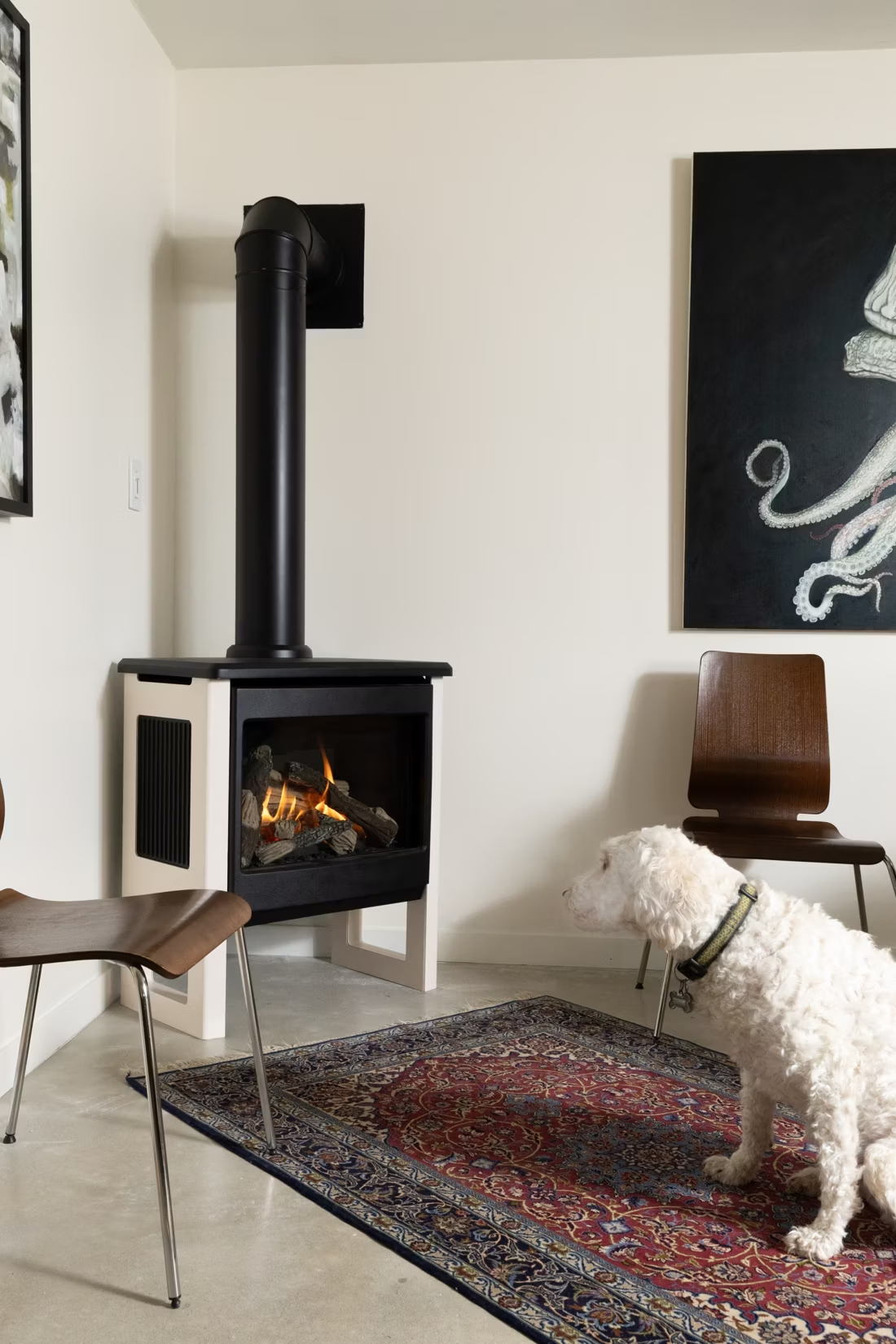
A gas fireplace is a fully built-in unit framed into a wall—the common choice for new Chatham Park construction where there's no existing masonry to work around. A gas insert slides into an existing masonry firebox, which is the typical route for older farmhouses around Bonlee and Bear Creek that already have a fireplace and chimney. A gas stove is a freestanding cabinet unit that sits on the floor and vents through a wall or chimney, useful when you want supplemental heat in a room without an existing hearth. A local dealer can walk your specific room to recommend which fits.
Do I need a permit to install a gas fireplace in Chatham County?
Yes. New gas fireplace installations require a building permit and a gas line permit. Inside Pittsboro or Siler City, the town issues the permit; in the unincorporated parts of the county, it runs through the Chatham County Central Permitting Department. Gas line work has to be done by a licensed gas-fitter, which is one reason working with an established hearth dealer is worth it—they coordinate the gas line, venting, and inspection sign-off as one job instead of leaving you to chase down separate trades.
What's the difference between vented and vent-free gas fireplaces?
Vented (direct-vent) fireplaces pull combustion air from outside and exhaust the byproducts back outside through sealed venting—the cleanest and most universally accepted option. Vent-free units burn directly into the room without external venting; they're legal in North Carolina but come with strict room-sizing and oxygen-depletion-sensor requirements. For the well-sealed new construction going up in Chatham Park, and for older farmhouses alike, direct-vent is the option most local dealers recommend by default—it delivers real heat without any tradeoff on indoor air quality.
How often should my gas fireplace be serviced?
Plan on an annual inspection, typically $150 to $250 with a local hearth service provider. A technician checks the burner, pilot assembly, venting, and gas connections, and cleans the glass and interior. It's a much smaller job than sweeping a wood chimney, but skipping it is how pilot and ignition problems go unnoticed until the coldest night of the year—right when you need the fireplace most.
Gas vs. wood—which is right for my home?
Chatham County has plenty of oak, hickory, maple, and pine in its woodlots, and wood heat still makes sense for anyone who wants a backup source that doesn't depend on the grid or a fuel truck. But for most households—especially the growing number commuting to jobs at VinFast, Wolfspeed, or down into the Triangle—gas wins on convenience: no cutting, splitting, hauling, or ash cleanup, just consistent heat at the flip of a switch. With winter lows averaging around 30°F and only about 3,504 heating degree days a year, Chatham County's climate doesn't demand the all-night burn times wood is built for, which is part of why gas has become the default choice in newer great rooms and primary living spaces across the county.
Why is my open fireplace making my house colder?
Open fireplaces suck—literally. As the fire burns, it consumes air your furnace already paid to heat and pulls it out through the chimney, so the house is actually colder after the fire goes out than before you lit it. An insert fixes this: it seals the chimney, puts fixed glass across the front, and turns that hole in your house into a real heat source.
Can I put a TV above my fireplace?
Yes—with an asterisk. Fireplaces are hot and TVs don't like heat. Either put a mantel between them to deflect rising warmth, or choose a fireplace with heat-management technology that creates a cool zone on the wall above—the wall stays around 125 degrees, barely warm, while the room still gets full heat. If you like clean lines and don't want a mantel, heat management is the answer.
Can a fireplace actually lower my heating bill?
Yes—by creating a comfort zone. A furnace heats every square foot of the house just to warm the one room you're in; a gas fireplace on low burns roughly a sixth of the gas a typical furnace does. Set the furnace around 55–60 degrees as a baseline, then heat the rooms your family actually uses. Families who heat this way commonly save $20–$60 a month.
How much should I budget for a fireplace?
For an average home—covering the fireplace, the vent pipe, and basic installation—a budget between $3,900 and $5,500 gives you a lot of options across wood, gas, and pellet. By the time you add finish work, gas line, and electrical, the average complete installation lands between $5,000 and $12,000 all-in. In a remodel or new build, a good rule is to put about 2.5% of the total project cost toward the fireplace.
Stove and Fireplace Dealers in Chatham County
Find your gas fireplace in Chatham County.
Tell us a bit about your home and we'll match you with a trusted local dealer and send over your free Project Guide & Parts List—the exact parts, vent kit, and recommended installer for your gas fireplace project in Chatham County.
Find Your Fireplace →