
Instant Heat for Syracuse's Long, Gray Winters.
With a long, demanding winter and lake-effect systems rolling off Ontario for months at a stretch, Syracuse homes lean on dependable heat. Find the right gas fireplace or insert and connect with a trusted local dealer.
Every Project Starts From One of These Five Situations
Built for Syracuse's Lake-Effect Winters.
Syracuse sits at just 403 feet in climate zone 5A, but its position downwind of Lake Ontario means heating season starts early and drags on—a long, demanding winter with average winter lows around 16°F and stretches of overcast, snow-squall weather that rival Buffalo for gray-sky persistence. In neighborhoods like Eastwood, Strathmore, and Sedgwick, two-story brick homes built between 1900 and 1950 were originally heated with coal, then converted to oil or gas as those systems became standard. Gas heat fits that housing stock naturally.
Niagara Mohawk Power Corp, doing business as National Grid, distributes natural gas throughout the city's zip codes—13203, 13210, 13224, and the rest of the Syracuse footprint—making a direct-vent gas fireplace a straightforward add for most homeowners. Wood-burning fireplaces are largely a non-factor here: city lot sizes, limited firewood access, and older masonry flues that were never built for heavy daily use mean most Syracuse households pass on wood entirely in favor of gas or electric. That makes gas inserts a popular way to bring a dormant, decorative fireplace back to life with real heat output and none of the ash or chimney maintenance.
Three steps. No salesperson until you're ready.
Tell us about your project
Your zip code, your situation, and the fuel you're leaning toward—or let the answers point you to one.
See what's actually available
The brands dealers within 100 miles genuinely carry—real options, never a catalog mirage.
Get your dealer & Project Guide
A trusted local dealer, plus the free Project Guide & Parts List that names every component of the job.
Frequently Asked Questions
How much does a gas fireplace installation cost in Syracuse?
Most gas fireplace and insert installations in Syracuse fall between roughly $4,000 and $11,000. A direct-vent insert dropped into an existing masonry fireplace—common in the city's older brick two-stories—runs toward the lower end when a gas line is already nearby. A new built-in gas fireplace in a remodel, or a home where the gas line has to be extended from the meter through finished walls, pushes toward the higher end. Local installers will give you a firm number after seeing the chimney or wall cavity in person.
Can I convert my old masonry fireplace to gas?
Yes, and it's one of the most common projects in Syracuse's older housing stock. Many homes in neighborhoods like Strathmore and Eastwood still have their original masonry fireplace—often decorative or unused for decades—with a flue that's structurally fine but never built for sustained wood-burning. A gas insert uses that existing chimney as the vent path, typically with a stainless liner run from the firebox to the top of the flue. Because true wood-burning setups are uncommon here, a gas conversion is often the easiest way to make a dormant fireplace functional again without touching the exterior masonry.
Do I need natural gas, or can I use propane?
Within the city and most of Onondaga County, natural gas service through Niagara Mohawk (National Grid) covers the vast majority of Syracuse zip codes, so if your home already has a gas water heater or furnace, adding a fireplace usually just means running a new branch line. For homes in outlying parts of the county beyond the gas utility's distribution footprint, propane is the standard fallback, supplied by a local propane provider with either a buried or above-ground tank. Most gas fireplace models can be set up for either fuel—your installer configures the orifice and regulator to match.
Will my gas fireplace still work if the power goes out?
Most modern gas fireplaces with IPI (intermittent pilot ignition) run on a small battery backup that kicks in automatically when the power drops, so the unit lights and operates normally off the batteries. That matters in Syracuse, where lake-effect snow squalls and ice storms off Ontario can knock out power for hours at a time in winter. Valor fireplaces take a different approach—their pilot's thermocouple generates its own electricity, so there's no battery to remember at all. Ask your local dealer about the ignition system on any unit you're considering, especially if you want the fireplace to double as backup heat.
What's the difference between a gas fireplace, gas insert, and gas stove?
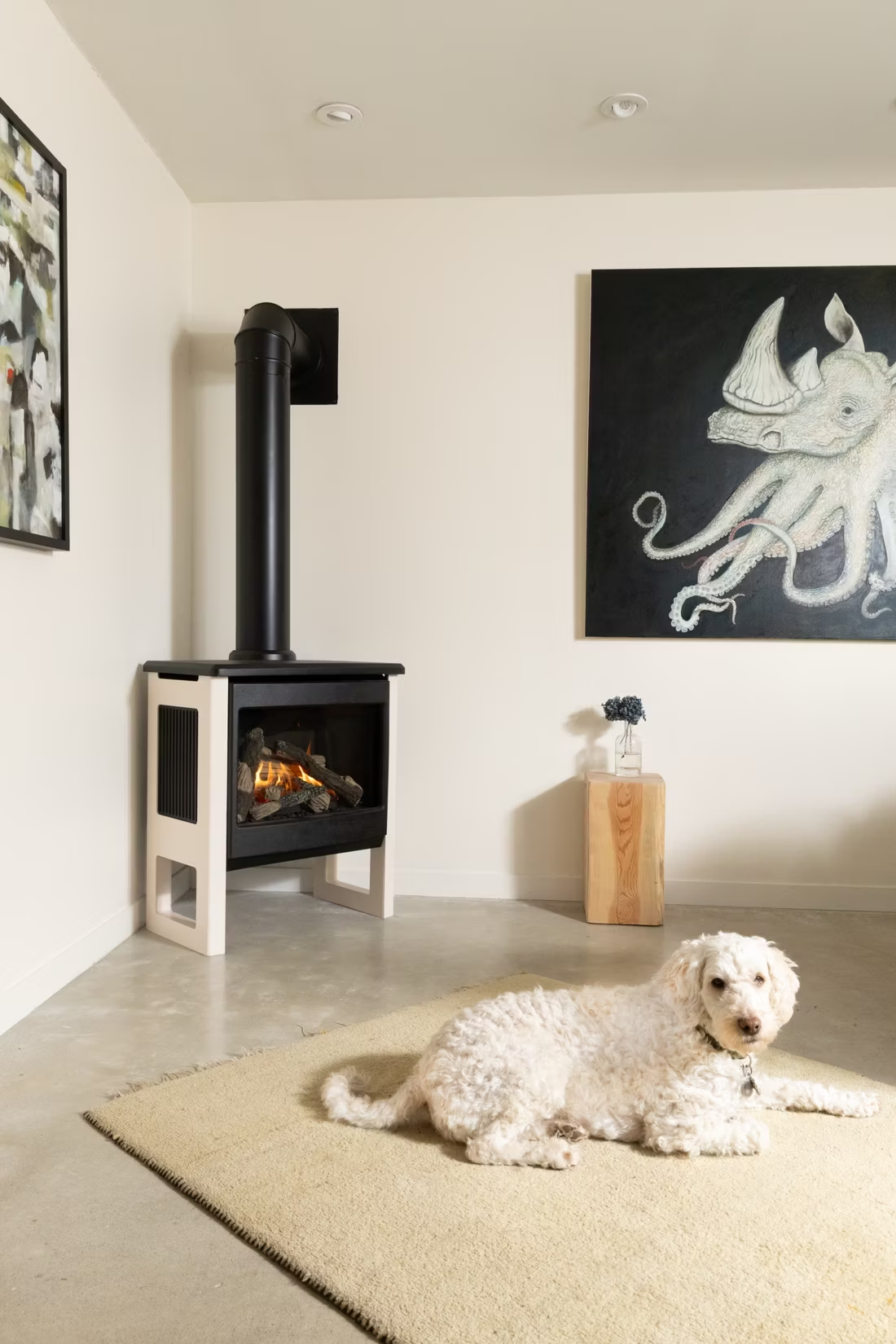
A gas fireplace is a fully built-in unit framed into a wall—the right call for new construction or a remodel without an existing chimney. A gas insert slides into an existing masonry firebox and uses that chimney as its vent, which fits the older housing stock common across Syracuse's east side and university-area neighborhoods. A gas stove is freestanding, sitting on the floor like a wood stove but burning gas—a good option for homes without a chimney at all, since it can vent straight out through a nearby wall. For most Syracuse homeowners with an old, underused fireplace, an insert is the simplest upgrade.
Do I need a permit to install a gas fireplace in Syracuse?
Yes. The City of Syracuse Department of Code Enforcement requires a building permit for new gas fireplace installations, and the gas line work itself must be done by a licensed gas fitter and inspected before the appliance is put into service. Homes outside city limits fall under the relevant Onondaga County town building department instead. Most established hearth dealers coordinate the permit, the gas line hookup, and the final inspection as part of the installation, so you're not managing separate trades yourself.
Should I get a vented or vent-free gas fireplace?
Vented, direct-vent gas fireplaces draw combustion air from outside and exhaust it back outside through a sealed pipe—they're the standard choice in cold-climate cities like Syracuse because they deliver strong heat output without affecting indoor air quality. Vent-free units burn directly into the room air and are legal in New York within strict room-size and ventilation limits, but they're less common here, partly because Syracuse's older homes with smaller, tightly sectioned rooms often don't meet the square-footage requirements comfortably. For most homeowners in the area, a direct-vent unit is the simpler, more universally recommended option—your local dealer can confirm which rooms in your home would even qualify for a vent-free unit if you want to compare.
How often does a gas fireplace need to be serviced?
Plan on an annual inspection, ideally in early fall before the heating season ramps up. A technician checks the burner, pilot assembly, venting, and gas connections, and cleans the glass and interior—a much smaller job than chimney sweeping, but still important for safety and efficiency. Local gas appliance service providers in the Syracuse area typically charge $150 to $250 for this visit, and it's worth keeping current given how many months of the year a Syracuse fireplace actually gets used.
Gas vs. electric—which fits my Syracuse home better?
Gas delivers real flame, higher heat output, and can double as backup heat during a power outage with battery-backed ignition—a genuine advantage through Syracuse's long, snowy heating season. Electric fireplaces need no venting or gas line at all, plug into a standard outlet, and install in an afternoon, which makes them a common choice in the apartments and condos around downtown zip codes like 13202 and 13203 where running gas line isn't practical. Wood, by contrast, is rarely part of the conversation here—most Syracuse homes lack easy firewood access and modern flues built for daily wood use—so the real decision for most homeowners comes down to gas for heat performance versus electric for installation simplicity.
Why is my open fireplace making my house colder?
Open fireplaces suck—literally. As the fire burns, it consumes air your furnace already paid to heat and pulls it out through the chimney, so the house is actually colder after the fire goes out than before you lit it. An insert fixes this: it seals the chimney, puts fixed glass across the front, and turns that hole in your house into a real heat source.
Is my gas fireplace wasting gas?
If it was installed more than 15 years ago, probably. Older gas fireplaces keep a standing pilot light burning all the time, and that little flame can cost a couple hundred dollars a year. Newer models use pilot-on-demand ignition—the pilot lights only when you use the fireplace and goes out when you turn it off.
How much should I budget for a fireplace?
For an average home—covering the fireplace, the vent pipe, and basic installation—a budget between $3,900 and $5,500 gives you a lot of options across wood, gas, and pellet. By the time you add finish work, gas line, and electrical, the average complete installation lands between $5,000 and $12,000 all-in. In a remodel or new build, a good rule is to put about 2.5% of the total project cost toward the fireplace.
Can a fireplace actually lower my heating bill?
Yes—by creating a comfort zone. A furnace heats every square foot of the house just to warm the one room you're in; a gas fireplace on low burns roughly a sixth of the gas a typical furnace does. Set the furnace around 55–60 degrees as a baseline, then heat the rooms your family actually uses. Families who heat this way commonly save $20–$60 a month.
Nearby Dealers
Hearth shops serving Syracuse and the surrounding area.
Find your gas fireplace in Syracuse.
Tell us a bit about your home and we'll match you with a trusted local Syracuse dealer and send over your free Project Guide & Parts List—the exact parts, vent kit, and installer recommendation for your gas fireplace project.
Find Your Fireplace →